ISLAMABAD: Finance Minister Muhammad Aurangzeb said on Tuesday the government had no plans to seek more bilateral financing from friendly countries and that Pakistan’s external position had stabilised following recent inflows from Saudi Arabia.
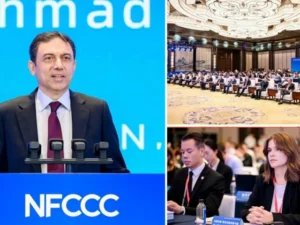
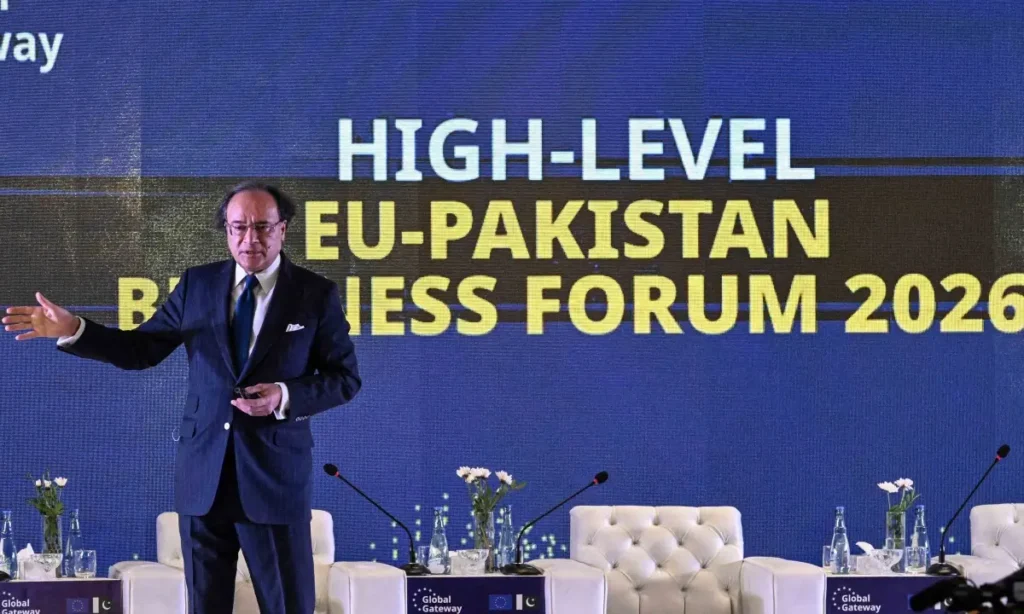
The minister made these remarks on sidelines of the first high-level EU Pakistan Business Forum in Islamabad, organised by the European Union in collaboration with the government of Pakistan, marking a key step in strengthening bilateral economic ties.
He said after securing $3 billion from Saudi Arabia, that there was no need for additional financing.
Recently, Saudi Arabia had pledged an additional $3bn in deposits for Pakistan and extended its existing $5bn facility for a further three years. Subsequently, Pakistan received $2bn from the kingdom on April 15 and another $1bn on April 21 under the arrangement.
Aurangzeb said the government was now shifting its focus towards commercial borrowing rather than bilateral financing.
He said the government was set to issue a $250 million Panda bond, which is denominated in Chinese currency, in May while the issuance of Eurobond and Sukuk over the next two to three years was also under consideration.
The finance minister said the Asian Development Bank and the Asian Infrastructure Investment Bank had provided guarantees for the Panda bond last week, adding that discussions with Chinese authorities were in their final stages. He said he had discussed the matter with his Chinese counterpart two weeks ago.
He further stated that Pakistan had received gross inflows of $261 million under the Roshan Digital Account (RDA) scheme in March. He said he was anticipating a higher inflow through the RDA in April.
Responding to a question about the upcoming International Monetary Fund’s (IMF) executive board meeting in May, he expressed confidence that Pakistan had met all of the international lender’s condition and would receive a tranche of $1.2bn under two concurrent programmes — $7bn Extended Fund Facility (EFF) and Resilience and Sustainability Facility (RSF).
He said he did not foresee any issues in the ongoing IMF programme.
The minister also dismissed concerns about shortages of food or fertiliser amid supply constraints caused by the Strait of Hormuz closure following the onset of now-paused US-Israeli war on Iran.
“We have to assess the impact of this conflict, but energy prices remain relatively low in Pakistan,” he claimed.
He said that remittance inflows had remained stable over the past two months despite the conflict in West Asia.
Aurangzeb said the government had already received budget proposals from various stakeholders, including associations and chambers, adding that the proposals would now be reviewed.
He, however, did not respond to questions regarding a possible increase in the petroleum development levy in the upcoming energy price review or any relief measures for consumers in the next budget.
Addressing the EU Pakistan Business Forum, which he also inaugurated, Aurangzeb said Pakistan’s economy is projected to grow by four per cent in the current fiscal year, citing improving macroeconomic indicators as a sign of recovery.
The minister gave a detailed presentation at the forum on the government’s economic performance and progress achieved so far, noting that the improvement was significant compared to the previous fiscal year.
Aurangzeb said the country has been consolidating gains in key macroeconomic indicators, highlighting that the current account posted a surplus of slightly over $1 billion in March.
On April 16, the State Bank of Pakistan announced that Pakistan recorded a surplus of $1,070 million in March compared to a surplus of $23m in February.
He expressed satisfaction over the performance of IT exports, the positive trajectory in value-added sectors, and the continued rise in remittances.
The finance czar further stated foreign exchange reserves are expected to reach around $18bn by the end of June, providing an import cover of three months.
Earlier this month, the Asian Development Bank (ADB) upgraded Pakistan’s economic growth rate to 3.5pc for the current fiscal year.
According to data released by the National Accounts Committee (NAC) on April 2, Pakistan’s economy grew by 3.89pc in the October-December quarter of 2025-26, showing an increase from 2.18pc recorded in the same period last year.
Special Assistant to the Prime Minister on Industries and Production Haroon Akhtar Khan also addressed the forum and underscored that the EU remains Pakistan’s largest export destination, particularly with the GSP+ framework.
However, he stressed that the future of this partnership lies beyond trade, focusing on investment, technological collaboration, and integration into global value chains.
Khan stressed that the future of the EU-Pakistan partnership lay “beyond trade, focusing on investment, technological collaboration, and integration into global value chains”.
The European Union Ambassador to Pakistan, Raimundas Karobolis, at the inauguration, said the EU enjoyed strong economic relations with Pakistan.
“It is a source of pride for me to say that the EU is the top export destination for Pakistan. The purpose of the forum is not just to celebrate our trade relations, but to deepen, diversify, ‘green’, and transform them into long-lasting investments. Through this, our mutual prosperity will thrive”, the envoy said.
The forum brought together around 1,000 senior policymakers, European and Pakistani business leaders, investors and financial institutions.
With the EU being the largest single market in the world, a leading exporter of outward Foreign Direct Investment (FDI) globally and Pakistan’s number one export destination, the forum represents a significant opportunity to further the EU-Pakistan economic partnership.
The opening session also marked the launch of the EU-Pakistan Business Network, which brings together more than 300 EU companies active in Pakistan. The Network will aim to serve as a collective voice of EU businesses in the country, facilitating dialogue with policymakers and supporting new European companies exploring opportunities in Pakistan.
Further, opportunities emanating from the EU’s Global Gateway initiative — the EU’s largest investment program outside of the EU which aims to mobilise and de-risk €400bn of investments in the period 2021-2027 — were presented in a dedicated plenary session with Director for Asia and the Pacific at the Directorate-General for International Partnerships, European Commission, Peteris Ustubs, Director at the European Investment Bank, Thouraya Triki; and Director of Agribusiness, Food and Forestry at FMO (the Entrepreneurial Development Bank from the Netherlands), Hans Bogaard.
Discussions throughout the day focused on opportunities and challenges in priority sectors such as agribusiness, digital innovation and fintech, green logistics, sustainable textiles, and responsible mining.
Throughout the two-day forum, more than 600 B2B meetings are scheduled, reflecting strong interest from both European and Pakistani companies in forming joint ventures and partnerships.
New financial programmes and partnerships are also expected to be signed during the forum.
The event provides a structured platform for high-level dialogue and deal-making between a combined economy of over 700m people.
PM Shehbaz meets EU officials
Separately, Prime Minister Shehbaz Sharif met senior officials of the EU as well as business representatives from European companies at the Prime Minister’s House, Prime Minister’s Office (PMO) said.
During the meeting, PM Shehbaz noted that the EU was Pakistan’s “largest trading partner and the destination for the highest volume of exports from Pakistan”.
The premier voiced optimism that the EU-Pakistan Business Forum would “encourage further enhancement of trade and investment ties between Pakistan and the EU,” assuring the EU delegation of the government’s continued support for “growth of trade and investment relations”.
The premier added that Pakistan remained “firm” in its resolve to work towards stabilising its economy, “despite regional challenges, including the recent spike in oil prices”.
Speaking about the situation in the Middle East, the prime minister recalled that he had held two phone calls with EU Council President Antonio Costa, where the two discussed “regional security situation as well as ways to further strengthen Pakistan-EU relations”.
The EU delegation lauded Pakistan for its “leading role” in peace efforts in the region. The delegation also noted the “enormous potential for further growth of B2B ties between the EU and Pakistan in various sectors, including energy, communications, IT, etc”.
“More than 600 B2B meetings are expected on the sidelines of the EU-Pakistan Business Forum,” PMO added.
The EU delegation was led by Ustubs, and Ambassador of the European Union to Pakistan, Raimundas Karoblis, was also present at the meeting.