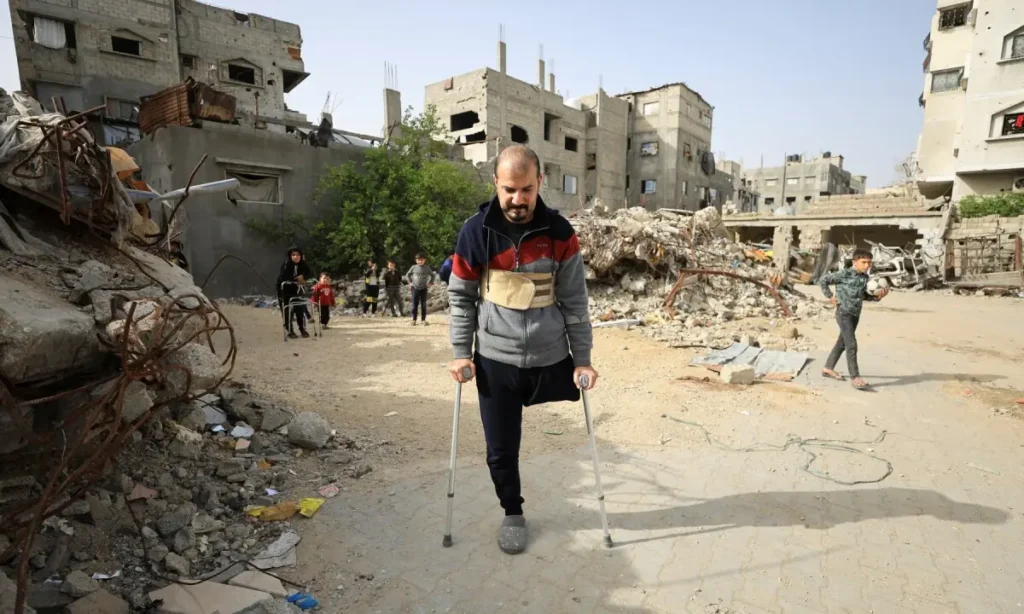
“I am not asking for the luxuries of life, I am asking for a limb so I can regain my humanity,” a 40-year-old former office worker says.
Fourteen-year-old Fadel al-Naji used to be a keen footballer but is now largely confined to his home in Gaza City since both legs were severed in an Israeli drone attack in September.
He sits sullenly on a couch with one hollow pant leg dangling and the other tucked into his waist beside his 11-year-old brother who lost an eye in the same strike.
“He has become withdrawn and isolated,” said his mother Najwa al-Naji, showing old videos of him doing kick-ups on her phone.
“It is as if he is dying slowly, and I wish that they would fit him with prosthetic limbs.”
But those are in scarce supply for Gaza’s nearly 5,000 war amputees — a quarter of whom are children like al-Naji — because of Israeli restrictions on materials like plaster of Paris, seven aid and medical sources told Reuters.
Israel cites security concerns as the reason for restrictions.
Taken together with Gaza’s pre-war amputee population provided by Palestinian health officials, its per capita amputee rate now exceeds even Cambodia, which had been the worst due to landmines, aid group Humanity and Inclusion said.
Such is the need that two medical centres said they were trying to reuse old prosthetic limbs recovered from people killed in the war. Others are creating makeshift artificial limbs with plastic piping or wooden planks, medics said, though this risks damaging the stump or causing infection.
Unfulfilled promise
Gaza’s amputees are a symbol of unfulfilled pledges from the October ceasefire and US President Donald Trump’s 20-point plan envisaging full aid “without interference”.
It also foresaw the reopening of the Rafah border crossing — Gaza’s sole route out to Egypt — but medical evacuations, including for amputees, have been irregular.
Israel restricts imports of items it says have potential military as well as civilian use under a policy pre-dating the two-year war.
While plaster of Paris and other plastic components for prostheses are not specified on Israeli lists of so-called dual use items, “construction products” are there, an Israeli export control document showed.
Israel’s Coordinator of Government Activities in the Territories (Cogat) military agency, which controls access to Gaza, claimed it facilitated the regular entry of medical equipment but would not permit materials that could be used by Hamas for a “terrorist build-up”.
Responding to questions about prostheses, Cogat said it was in dialogue with the UN and other aid groups to identify ways to enable an adequate medical response.
The International Committee of the Red Cross (ICRC), which supports the Artificial Limbs and Polio Centre in Gaza, the main centre for prosthetics, said imports of plaster of Paris were almost completely restricted for over four months with supplies left only to June or July.
“What we are producing now are very small quantities compared to the actual need,” said Hosni Mhana, the centre’s spokesperson, without giving numbers.
The Qatari-funded Sheikh Hamad Hospital said no supplies were received during the war and that it ran out. It could now only offer maintenance on existing prostheses.
“There are no local alternatives for prosthetic manufacturing materials,” said the hospital’s General Director Ahmed Naim.
Humanity and Inclusion, which fit 118 temporary prostheses in Gaza since early 2025, said supplies from its last shipment in December 2024 were dwindling.
The Trump-led Board of Peace, which sought to boost aid for Gaza, said it took very seriously the hardships of amputees and other patients in Gaza.
“These are urgent civilian needs,” it said in a statement to Reuters, noting that the ceasefire obligations included the sustained flow of humanitarian, commercial and medical supplies.
Restrictions and delays were raised with the relevant authorities, it added. “We have significant guarantees and commitments that these restrictions will be eased and eliminated as armed parties agree to decommission their weapons and hand over authority to a Palestinian technocratic government in Gaza.”
Prolonged trauma
Artificial limbs could not be imported whole into Gaza since they were built for each patient, with plaster used to take an exact cast of the residual limb to shape a custom-made socket.
Reuters interviewed three other Gaza amputees, all struggling to resume their pre-war lives without prostheses.
Some of the amputees were on a waiting list and may underwent preparatory work, which could include stump revisions, a form of surgery to hone its shape.
One on the list is Hazem Foura, a 40-year-old former office worker unable to work since losing his left leg above the knee in December 2024 when he said Israel bombed his house.
“I am not asking for the luxuries of life, I am asking for a limb so I can regain my humanity,” he said.
Lack of prostheses severely disrupted recovery and prolonged trauma for amputees, many of whom might have avoided limb loss had more specialist surgeons been available.
It also put them in greater danger from ongoing Israeli attacks, which killed 750 Palestinians since the ceasefire, Palestinian health officials said.
Israeli restrictions on items like wheelchairs eased since the ceasefire, the ICRC and the UN children’s agency said, but medics said manoeuvring around Gaza’s rubble-strewn roads remained a challenge.
As well as materials, expertise is lacking, with only eight prosthetists still in Gaza according to the World Health Organisation (WHO).
Follow-up care for children is especially tough, medics said, since they need regular refittings as they grow.
“The amputation itself is not just a lost limb, it’s lost hope, it’s lost independence,” said Heba Bashir, prosthetic and orthotic technical officer for Humanity and Inclusion.
“For the kids, it means losing their future.”
Header image: Palestinian amputee Hazem Foura, who lost one leg, walks using crutches in a street in Gaza City on April 3, 2026. —Reuters