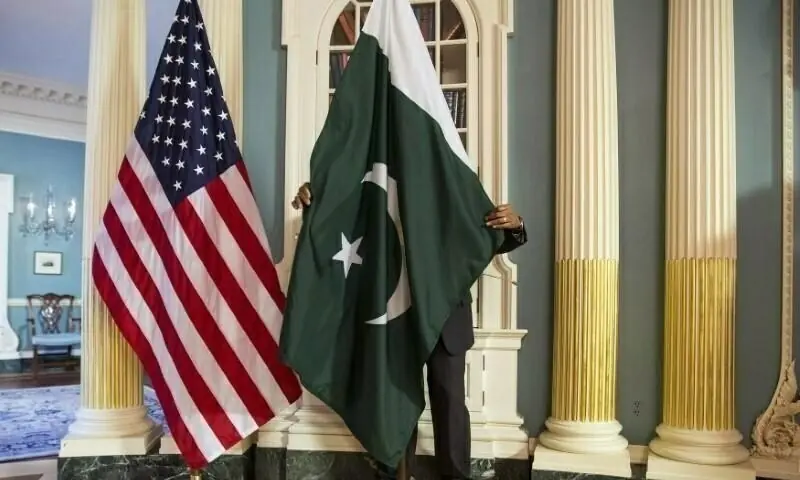
A strategic compact between Pakistan and the US is a real possibility, and it needs to be viewed through the lens of American security and geopolitical interests at a time when multilateralism and international law are in retreat.
Washington’s stake in the stability of South Asia — particularly Pakistan and its volatile neighbour, Afghanistan — is shaped by broader great-power competition. Instead of a wasteful rivalry, Professor Stephen Walt’s theory of offshore balancing offers a more pragmatic, cooperative alternative.
Walt argues that the US should maintain a light offshore presence, backed by regional bases that reassure allies rather than provoke rivals, while avoiding a dangerous head-on military build-up against China. Pakistan’s own alliance-building reflects a similar logic. Walt’s ‘balance of threats’ theory holds that India’s aggressive posture, geographic proximity and growing power push Pakistan to carefully balance its ties with both China and the US.
This dynamic opens space for a degree of US-China convergence in South Asia: Washington does not want to cede the region to a rival power, while Beijing wants to protect its Global Development Initiative, built around what it calls ‘corridor economics’.
Afghanistan is often called the ‘graveyard of empires’, but that label undersells its history — it has instead been fertile ground for competing global powers. In this contest, a stable Pakistan is well placed to serve as a geoeconomic bridge that also serves US interests.
The Taliban conundrum
If Washington were to heed Jeffrey Sachs’s calls for geopolitical cooperation with China, Afghanistan and Pakistan would be the natural place to test that vision. Even under a starker, more adversarial lens — John Mearsheimer’s theory of offensive realism, which envisions US dominance of the Western hemisphere and Chinese dominance of the East — deeper US engagement in this region still makes strategic sense. Ceding ground to a rising rival rarely serves a great power’s long-term interests.
Since the US withdrawal from Afghanistan in 2021, China has expanded its economic footprint there and would welcome a land corridor through the country to Iran and Europe. Russia, pursuing its own Eurasian integration agenda, wants to keep Central Asian states within its orbit — even as those states look for ways to reduce their dependence on Moscow. Infrastructure corridors linking their landlocked economies to Pakistan’s warm-water ports on the Arabian Sea offer them a route to greater autonomy.
Afghanistan itself remains unstable, ruled by a regime that took power by force and has since become a haven for terrorism and organised crime — a threat not just to Pakistan but to the wider world. The Taliban’s worldview is rooted in medieval cultural norms that treat violence, patriarchy and misogyny as cultural preferences. Its distorted understanding of religion, and its treatment of dissent as apostasy, has allowed it to stall or renege on its commitments.
The Taliban have broken their promises to virtually every party they have negotiated with, and are aligned with more than 20 terrorist and militant groups. These groups are not only tolerated but allowed to profit from organised crime — narcotics trafficking, kidnapping for ransom, and arms smuggling. Terrorist networks rarely stay confined within borders: violence targeting Pakistan can easily spill into a broader regional and transnational threat, one that concerns the security of the international community, including the US.
US interests in the region
The US has three principal interests in Pakistan’s stability and in dismantling terrorist networks in Afghanistan.
The first is geopolitical. Scholars as different as Mearsheimer, Walt and Sachs agree that Washington should not disengage from the region and leave a vacuum for rivals to fill — and indeed, rising violence from Afghanistan-based groups has already allowed regional and global competitors to expand their influence there.
The second interest is economic, centred on the US search for critical minerals, an area where China has moved faster than the US in both Afghanistan and Pakistan.
Pakistan’s western provinces, Khyber Pakhtunkhwa and Balochistan, hold significant untapped reserves of copper, gold and rare elements critical to modern technology and the energy transition. Balochistan alone accounts for roughly 55 per cent of Pakistan’s mineral-rich territory. The Reko Diq deposit is estimated to hold 5.9 billion tonnes of ore, including more than 13 million tonnes of copper and 18 to 21 million ounces of gold — making it one of the largest undeveloped copper-gold deposits in the world.
The third US interest is counterterrorism. Monitoring transnational terrorism remains a top priority for Washington as a preventive measure against global attacks. It is therefore in America’s interest that the terrorism emanating from Afghanistan, and the insidious proxy warfare by India, be controlled — so that a stable Pakistan can continue to deliver on counterterrorism, mineral development and its broader geopolitical value to US interests in the region.
The way forward
To help achieve these goals, the US could consider equipping Pakistan with advanced counterterrorism capabilities: surveillance and strike drones, Black Hawk helicopters, AC-130 gunships, signals intelligence and communication-interception tools, and AI-driven intelligence fusion systems. These would strengthen Pakistan’s ability to detect, track and neutralise terrorist threats while protecting critical economic and strategic assets.
Persistent proxy conflict and terrorism in Pakistan’s western regions threaten US interests across the board — critical minerals, Central Asian connectivity, counterterrorism, economic integration and competition with China.
By adopting a more proactive approach to regional security, renewing counterterrorism cooperation with Pakistan, and discouraging the use of Afghan territory for proxy warfare, the US can certainly safeguard its long-term geopolitical and economic interests in South and Central Asia, while burnishing its image as a global stabiliser.