
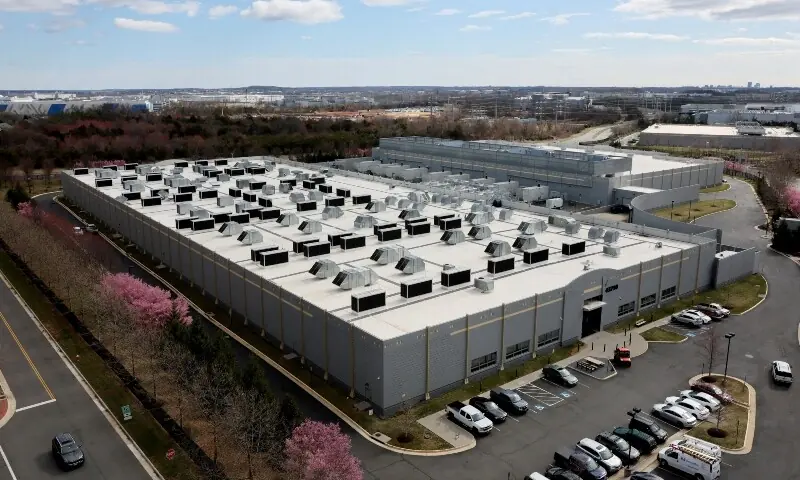
New York became the first US state on Tuesday to halt construction of large new data centres, imposing a one-year moratorium as concerns grow that the facilities driving the artificial-intelligence boom are raising power costs, straining water supplies and burdening local communities.
The moratorium positions New York at the forefront of a growing national debate over how to manage the infrastructure needed to support AI.
While technology companies are racing to build new data centers, lawmakers and regulators in dozens of states are weighing measures to limit their effect on electricity grids, utility bills and local communities.
“As data centre development threatens to hike up utility bills, deplete our natural resources, and create uncertainty for New Yorkers, it’s my responsibility to take action and lead,” said New York Governor Kathy Hochul.
She will also pursue legislation to repeal sales tax exemptions for large data centres, Hochul added.
The construction ban will apply to data centres that use 50 megawatts or more of power, officials in the governor’s office said.
During the moratorium, the state’s Department of Environmental Conservation will not issue any discretionary permits not already deemed complete, the governor’s office said.
Instead, Hochul directed state officials to develop a Generic Environmental Impact Statement to ensure that new data centres coming online are held to “consistent standards,” as well as examine the potential environmental impacts of the construction and operation of data centres in the state.
The ban will be lifted once the state finalises those standards, according to Hochul’s office.
Data centres spark backlash
New York’s legislature last month passed a bill meant to impose guardrails on data centres, but it has not yet been sent to Hochul’s desk for signing.
The bill targets data centres that consume more than 20 megawatts of power, giving it a wider scope than Tuesday’s executive order.
Officials in Hochul’s office described the bill as complicated, adding that “it’s going to take some time to work through” with the state legislature.
So-called hyperscalers Alphabet, Microsoft , Meta, Amazon and Oracle did not immediately respond to requests for comment on New York’s move, nor did data centre operators Digital Realty, Equinix and NTT Data.
The expansion of data centres in the United States is driving up power demand and electricity bills in large swaths of the country, drawing local and political backlash.
Only one in three Americans approve of the fast pace of data-centre construction and most would oppose building one in their own community, according to a recent Reuters/Ipsos poll.
Dozens of state legislatures have introduced bills to rein in the effects of data centres on power bills and the environment. New York is the first to enact a full moratorium.
In April, Maine Governor Janet Mills vetoed a bill that would have imposed a similar freeze on those facilities.
As of May, there were more than 12 gigawatts of very large energy-using loads, including data centres, in line to connect to the state’s grid, according to a recent report by the New York independent grid operator.
One gigawatt of electricity can power about 750,000 homes.
New York has the eighth-most expensive retail price for residential electricity in the country, according to US Energy Department data.
While the state’s expensive land and tight power supplies have largely limited data center interest compared to states like Texas and Ohio, New York has attracted some interest from the server warehouses.
The state currently has more than 130 data centres, according to Data Center Map, compared with more than 600 in Virginia and about 500 in Texas.