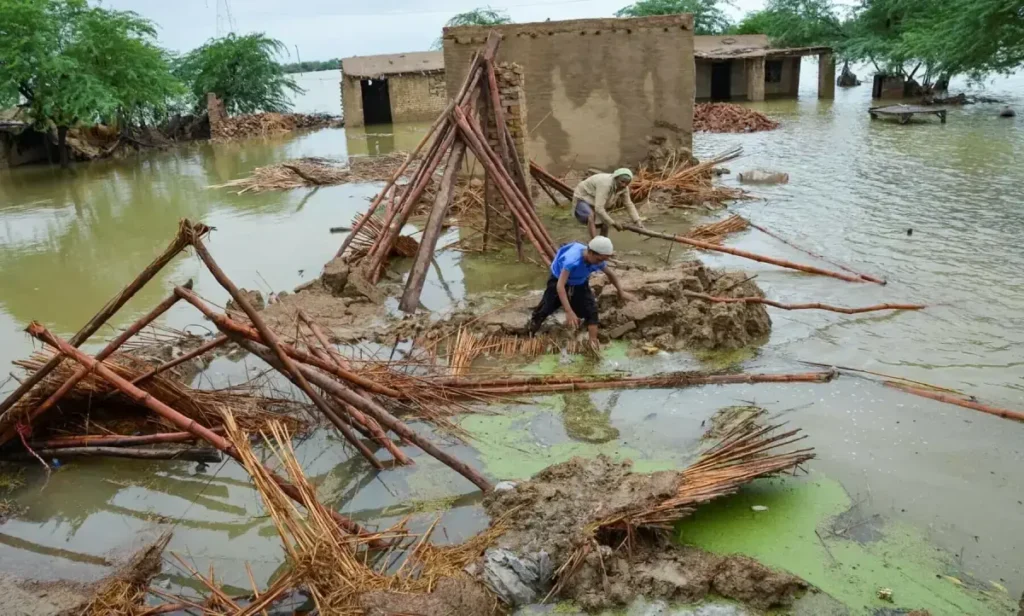
ISLAMABAD: Amid a blame game and fiduciary concerns, the government has quietly restructured the Rs115 billion World Bank-funded post-flood rehabilitation project, depriving more than 134,000 verified flood-affected families in Balochistan of the resilient homes they were promised.
Official documents and background discussions indicate that investigations were underway into alleged record tampering, duplicate claims and multiple payments for the same housing units. There were also recorded attempts to disrupt such probes.
The project steering committee (PSC), led by Planning Minister Ahsan Iqbal and Balochistan Chief Minister Sarfraz Bugti, has now capped the $155 million housing component of the $400m Integrated Flood Resilience & Adaptation Project (IFRAP) at about 69,000 homes. The World Bank has consequently dropped its proposed $180m additional financing that could have extended reconstruction to the remaining affected families.
After the devastating 2022 floods, Pakistan secured more than $9bn in international pledges at the January 2023 Geneva Conference. IFRAP was designed to rebuild homes in Balochistan through a community-led, owner-driven model. Prime Minister Shehbaz Sharif had publicly promised a resilient house for every family that lost one. Yet at its June 22-23 meeting, the PSC unanimously redirected the remaining housing funds towards roads and irrigation and formally declined additional World Bank financing.
Over 134,000 flood-hit families in Balochistan being affected amid investigations of record tampering, duplicate claims
The decision reverses that commitment, despite more than 134,000 verified families having been surveyed and registered for assistance.
PSC meeting minutes showed the planning minister expressed concern over “misreporting” of completed houses as “the number of completed houses presented to the Prime Minister was 15,000 whereas official reports reflected 8,694 completed houses”.
There are conflicting arguments – one side claiming misreporting to downgrade housing project for ‘redirecting’ funds to contractor-oriented larger infrastructure project and the other side showing concern over slow pace of house completion in four years due to lack of land titles, access to financial accounts and transparency. The planning commission has now proposed satellite imagery for verification.
Both the minister and the CM ordered an independent high-level inquiry to ensure transparency and accountability. The committee also noted serious corruption charges against certain officials but the fact finding committee could not be given access to records in Balochistan.
Not only this, the ministries of planning and economic affairs appeared at different wavelength. The EAD put on record that the WB had expressed concerns over changes in project leadership arrangements. Clearly, the bank and the planning commission apparently had their own priorities for the project leadership.
Informed source said the minister for planning and WB country director Bolormaa Amgaabazar have had at least two meetings to clear the situation but issues continue to prolong.
Interestingly, a similar project, the Sindh People’s Housing for Flood Affectees (SPHF) involving around $3bn funding and over 2m home reconstructions, goes on and presents a success story though the planning commission remains unhappy without a third-party verification.
When contacted, the commission said the inclusive development programme “under IFRAP was damaged in a coordinated manner for vested interests by shifting financing from important sectors i.e. education, health, PHE, irrigation, bridges, roads, livelihood and youth skill development to housing to show burn rate”.
The commission denied that housing project had been stopped, adding that about 75,000 fully damaged houses were under construction, 26,000 of them completed. It said the project originally approved by Ecnec was 68,922 that would remain protected. It said vested interests planned diversion of funds from early warning system, irrigation etc to housing in violation of Ecnec approved scope. It reported that out of total $400m IFRAP envelope, $245m had already been signed.
It said the allegation of misreporting of 15,000 completed houses to PM was raised by a local parliamentarian, and inquiry established misrepresentation.
About different treatments to two similar projects in Sindh and Balochistan, the commission said they were incomparable, as IFRAP in Balochistan was a federal budget project with a single WB loan on federal government and involved budgetary disbursement and compliance requirements while Sindh was a direct borrower from multiple lenders and financed through section 42 entity – a non-profit non-binding disbursement schedules.
Published in Dawn, August 10th, 2026