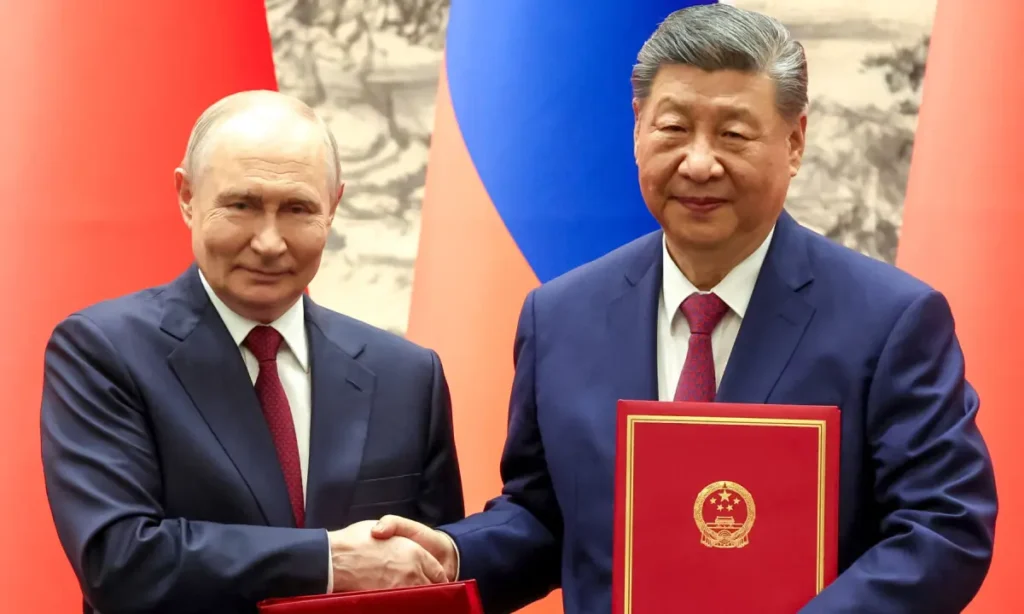
China and Russia condemned United States President Donald Trump’s Golden Dome missile defence shield plans and Washington’s “irresponsible” nuclear policy at a joint summit on Wednesday, a week after President Xi Jinping hosted Trump in Beijing.
A statement from Xi and Russian President Vladimir Putin said Trump’s plan for a ground- and space-based missile interceptor system posed a threat to global strategic stability.
It also criticised the United States over the expiry of the last remaining treaty restricting the size of the US and Russian nuclear arsenals, which lapsed in February with Trump failing to respond to Moscow’s proposal to extend the limits by a year.
Both sides jointly signed a statement on strengthening comprehensive strategic coordination and a declaration advocating multi-polarity in the world order.
“The global agenda of peace and development is facing new risks and challenges, with the danger of fragmentation of the international community and a drift back toward the ‘law of the jungle’,” their joint declaration said, according to the Kremlin.
Xi and Putin, who have met more than 40 times, both stressed the closeness of the Russia-China ties that they sealed in 2022 with the signing of a strategic partnership treaty, less than three weeks before Moscow’s full-scale invasion of Ukraine.
For Xi, it capped a remarkable week of diplomacy in which he has set out to showcase China as a pillar of stability in a world rocked by trade wars and military conflicts in Iran and Ukraine.
While the summit with Trump was largely about managing tensions between the world’s two most powerful countries, the meeting with Putin posed a different challenge — how to demonstrate progress in a relationship that the two sides have already proclaimed is “without limits”.
In contrast to Trump’s visit last week, which yielded little in the way of immediate concrete announcements, Putin and Xi signed a slew of agreements on Wednesday on trade, media and energy.
But there was no apparent breakthrough on a massive new natural gas pipeline, the Power of Siberia 2, that the two sides have been discussing for years.
Moscow keen to press ahead with pipeline
Moscow had signalled ahead of the visit that it was seeking further energy agreements with China, the largest buyer of Russian oil, including pipeline supplies and sea-borne shipments.
The Russian leader has been weakened over four years of the Ukraine conflict, with his country’s economy shrinking in the first quarter of the year as factors such as wartime spending, labour shortages and sanctions take their toll.
During Putin’s last visit in September 2025, Russian gas giant Gazprom said both sides had agreed to move forward with Power of Siberia 2, a 2,600-km pipeline to carry 50 billion cubic metres (bcm) of gas per year from Russia to China via Mongolia.
China has said very little publicly about the project. While Xi said on Wednesday that cooperation in energy and resource connectivity should be the “ballast stone” in China-Russia relations, he did not mention the pipeline.
Key issues such as gas pricing remain unresolved, and analysts expect negotiations could take years.
The Kremlin said both sides reached a “general understanding on the parameters” of the project, although no details or clear timeline were agreed.
Xi wants ‘comprehensive ceasefire’ in Middle East
The US war on Iran has hampered crude and gas flows, giving an opportunity to Putin to offer Russian energy sources as an alternative.
“Russia and China are actively cooperating in the energy sector… We are, of course, ready to continue reliably supplying all these types of fuel to the rapidly growing Chinese market,” Putin said on Wednesday.
His priorities may differ from China’s, which wants the Middle East conflict concluded as soon as possible.
Underlining that, Xi told Putin on Wednesday that “a comprehensive ceasefire is of utmost urgency, resuming hostilities is even more inadvisable and maintaining negotiations is particularly important”.
Russia has sought to capitalise on the energy crisis and rocketing oil prices spurred by the closure of the Hormuz strait.
Russia’s top diplomat Sergei Lavrov had said after meeting Xi in April that Russia could “compensate” for China’s energy shortages as the Middle East war hits global supplies.
“[China] relies on the freedom of the world’s major waterways to sustain its economic activities, and would prefer that the standoff in the Strait of Hormuz end sooner rather than later,” James Char of Singapore’s Nanyang Technological University told AFP.
Honour guard and gun salute
Putin was received by Xi outside Beijing’s opulent Great Hall of the People in much the same fashion as Trump last week, complete with chanting children and military fanfare.
Opening talks, both were quick to laud their countries’ special ties as they extended their treaty of “friendly cooperation”.
Putin, quoting a Chinese phrase, told Xi: “A day apart feels like three autumns,” adding that relations had reached an “unprecedentedly high level” despite “unfavourable external factors”, Russian media footage showed.
In an apparent swipe at the United States, Xi warned of “unilateral and hegemonic countercurrents running rampant” in the world.
Xi said the countries should focus on a long-term strategy and promote a “more just and reasonable” global governance system, according to Chinese state news agency Xinhua.
“China-Russia relations have reached this level because we have been able to deepen political mutual trust and strategic cooperation,” Xi said at the start of his meeting with Putin.
Putin said after the talks that Russian-Chinese ties had “reached a truly unprecedented level and continue to develop”.
Putin said their relations were helping ensure global stability and stressed that Russia remained a reliable energy supplier amid Middle East disruption.
“The comprehensive partnership and strategic cooperation between Russia and China in the new era is an example of international relations in the modern world,” Putin told Xi.
Putin also invited Xi to visit Russia next year.