New appointments span Iran’s security and military establishment, including SNSC, IRGC, army and navy
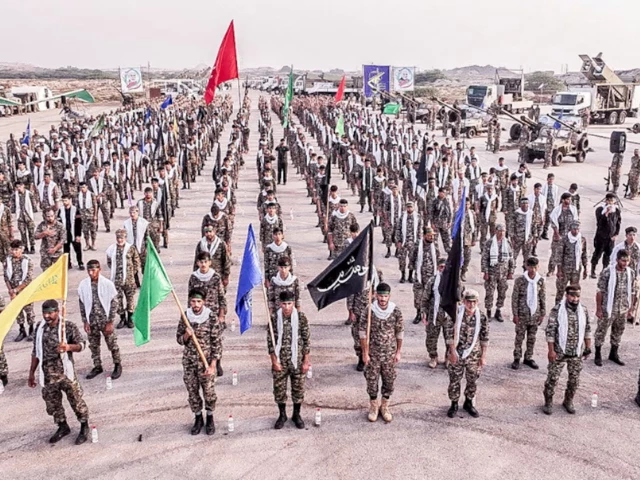
Members of the Islamic Revolution Guards Corps (IRGC) navy participate in an exercise in Abu Musa Island, in this picture obtained on August 2, 2023. IRGC/WANA (West Asia News Agency)/Handout via REUTERS/File Photo
In a major reshuffle following the recent war with the United States and Israel, Iran’s Supreme Leader Ayatollah Mojtaba Khamenei has issued separate decrees appointing a new head of the country’s top security body and six senior commanders to key military positions.
The appointments span Iran’s security and military establishment, including the Supreme National Security Council (SNSC), the General Staff of the Armed Forces, the Islamic Revolutionary Guard Corps (IRGC), the IRGC Navy, and the Basij Organisation.
Under the new orders, Mohsen Rezaei, a longtime IRGC commander and veteran of the Iran-Iraq War, takes the helm of the country’s top security body, replacing Baqer Zolqadr.
Maj Gen Ali Abdollahi has been appointed chief of the General Staff of the Armed Forces, the country’s highest military coordinating body overseeing both the regular armed forces and the IRGC. Brig Gen Kioumars Heydari, former commander of the Army Ground Forces, has been appointed as his deputy.
The reshuffle also brings a new leadership team to the IRGC. Maj Gen Ahmad Vahidi, a veteran IRGC commander and former deputy defence minister, has been appointed top commander of the guards, while Maj Gen Mostafa Izadi has been named his deputy.
The changes extend to the IRGC’s naval forces, with Rear Adm Ali Ozamaei appointed commander of the IRGC Navy.
Hossein Taeb, a former IRGC intelligence chief, has been appointed head of the Basij Organisation, a paramilitary volunteer force and a major component of the IRGC.
The appointments come amid an increasingly complex regional security environment, marked by heightened tensions across West Asia and growing strategic and military challenges.
Mohsen Rezaei
Hailing from southwestern Khuzestan province, which borders Iraq, Rezaei was active in anti-Pahlavi activities before the 1979 revolution and spent several months in prison for his anti-government activities.
He studied mechanical engineering at a university in Tehran while continuing his political activities in the years leading up to the revolution. Following the revolution, his close ties to Ayatollah Khomeini helped pave the way for his appointment as the first commander of the IRGC in 1981 at the age of 27.
READ: Who is Iran’s Mohsen Rezaei, the new head of Iran’s Supreme National Security Council?
His tenure coincided with the eight-year Iran-Iraq War, during which he commanded numerous operations against Iraqi forces. He remained at the helm of the IRGC until 1997, when he was appointed secretary of the Expediency Council, a powerful body tasked with resolving disputes between different branches of the Iranian establishment. He held the position until 2021.
Rezaei’s foray into electoral politics was unsuccessful. He lost a parliamentary election in 1999 and unsuccessfully ran for president four times. However, he served as vice president for economic affairs under president Ebrahim Raisi from 2021 to 2023.
In 2020, Rezaei was added to the US Treasury Department’s Specially Designated Nationals and Blocked Persons (SDN) List under Executive Order 13876.
On Sunday, he was appointed head of Iran’s top security body, replacing Mohammad Baqer Zolqadr. Zolqadr had held the position since April 2026, following the assassination of Ali Larijani.
Maj Gen Ali Abdollahi
Abdollahi hails from northern Gilan province and has held senior military and government positions since the 1979 revolution, including serving as an IRGC commander during the Iran-Iraq War in the 1980s.
Between 1987 and 1991, he served as deputy to then-IRGC Aerospace Force commander Mohammad Baqer Qalibaf. He later became a senior commander in Iran’s Law Enforcement Forces in the early 2000s.
READ MORE: ‘We only think of enemy’s complete surrender,’ says Iran’s IRGC
During Mahmoud Ahmadinejad’s presidency (2005–2013), Abdollahi served as governor of Semnan province in central Iran and later as governor of his native Gilan province in the north.
He also served as deputy interior minister for security and law enforcement affairs before returning to the military.
In the early and mid-2010s, he served as deputy chief of the General Staff of the Armed Forces. He was subsequently appointed commander of the Khatam al-Anbiya Central Headquarters, the main coordinating body of Iran’s armed forces, following the 12-day war in June 2025.
Abdollahi is currently under US Treasury sanctions.
On Monday, he was appointed chief of the General Staff of the Armed Forces, replacing Abdolrahim Mousavi, who was assassinated on the first day of the 40-day war.
Brig Gen Kioumars Heydari
Heydari, who hails from western Kermanshah province, comes from an army background, unlike the other appointees, and has held several senior positions in Iran’s regular military, known as the Artesh.
He joined the army during the Iran-Iraq War, initially serving as a volunteer Basiji before formally joining the army in 1984. He later rose through the ranks and eventually headed the army’s regional headquarters in his home province.
In the mid-2000s, Heydari was appointed deputy coordinator of the army’s ground forces. He later became deputy commander of the ground forces, a position he held until 2016, when he was promoted to commander.
Following the 12-day war last year, he was appointed deputy commander of the Khatam al-Anbiya Central Headquarters.
In 2022, Heydari was placed on the sanctions lists of the US Office of Foreign Assets Control (OFAC) and the European Union. A year later, the British government also imposed sanctions on him.
Heydari now takes over as deputy chief of the General Staff of the Armed Forces, reporting to Abdollahi. He replaced Mohammad-Reza Gharaei Ashtiani.
Maj Gen Ahmad Vahidi
Hailing from southern Fars province, Vahidi joined the IRGC shortly after the 1979 Islamic Revolution and served on the front lines during the eight-year Iran-Iraq War in the 1980s.
During the war, he headed the IRGC’s intelligence organisation. After the conflict, he was appointed commander of the IRGC’s Quds Force, one of the most significant military positions of his career.
ALSO READ: EU designates Iran’s Revolutionary Guards a terrorist organisation in policy shift
Vahidi also entered politics, holding senior positions in successive administrations between 2003 and 2024, including deputy defence minister, defence minister and interior minister.
He also headed the National Defence University, which provides training to military and security personnel.
In December 2025, Vahidi was appointed deputy commander of the IRGC under Maj Gen Mohammad Pakpour. Following Pakpour’s killing in the recent war, Vahidi was chosen as his successor, although the formal announcement of his appointment was made on Monday.
Vahidi is now regarded as a key figure in Iran’s new military leadership amid the continuation of the war against the US and heightened security threats.
Maj Gen Mostafa Izadi
One of the IRGC’s most senior commanders, Izadi joined the Guards shortly after the 1979 revolution and has held various positions within the force for more than four decades.
During the Iran-Iraq War, he served as the IRGC commander in Kurdistan Province, which borders Iraq, as well as commander of the Guards’ Hamzeh Sayyed al-Shohada and Najaf Ashraf headquarters.
After the war, Izadi was appointed deputy operations chief of the IRGC and subsequently became commander of the IRGC Ground Forces.
Between 1993 and 2006, he served as deputy chief of the General Staff of the Armed Forces. His most recent assignment was deputy for strategic affairs at the General Staff and head of the Cyber and Emerging Threats Headquarters at the Khatam al-Anbiya Central Headquarters.
Izadi has now been appointed deputy commander of the IRGC, replacing Vahidi.
Rear Adm Ali Ozamaei
Hailing from Iran’s southern Hormozgan province, Ozamaei joined the armed forces during the Iran-Iraq War in the 1980s before later transferring to the IRGC Navy.
In the early 2000s, he was appointed deputy coordinator of the IRGC Navy’s First Naval District and, in the following decade, became deputy commander of the same district.
From 2012 to 2025, Ozamaei headed the IRGC Navy’s Fifth Naval District, headquartered in Bandar Lengeh, a port city on the Persian Gulf.
Last year, he was appointed deputy commander of the IRGC Navy under Rear Admiral Alireza Tangsiri. Following Tangsiri’s assassination during the recent war, Ozamaei assumed command of the force.
On Monday, he was formally appointed commander of the IRGC Navy, taking charge at a particularly sensitive time, with tensions running high amid the closure of the Strait of Hormuz.
Hossein Taeb
Hailing from the Iranian capital, Tehran, he joined the IRGC shortly after the 1979 Islamic Revolution and remained active in various capacities over the following decades.
In the early 2000s, he served as the IRGC’s deputy for cultural and social affairs before becoming deputy commander and later commander of the Basij Organisation.
In 2009, in what was arguably his most significant assignment, he was appointed head of the IRGC Intelligence Organisation, a position he held until 2022, when he became an adviser to the IRGC commander.
He was placed on the US State Department’s sanctions list in 2022.
On Monday, he was appointed commander of the Basij Organisation by decree, replacing Alireza Soleimani, who was killed in the recent war.