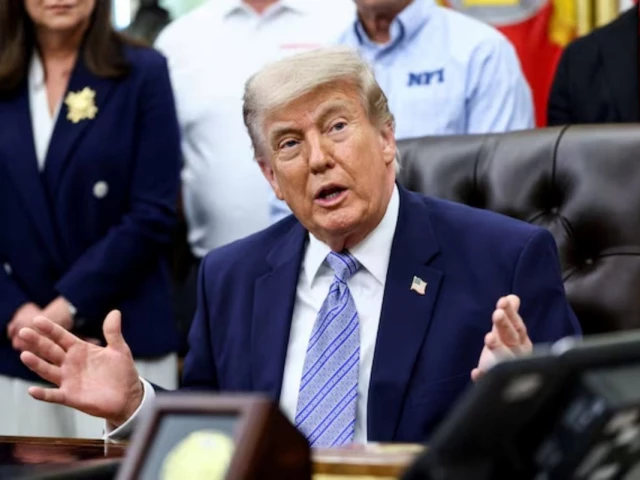
US President Donald Trump. Photo: Reuters
WASHINGTON:
US President Donald Trump vowed fresh and “hard” military strikes against Iran on Wednesday, accusing Tehran’s negotiators of “playing us for suckers,” as tensions between the two countries surged following renewed hostilities and the collapse of fragile ceasefire efforts.
Speaking to reporters in the Oval Office, Trump confirmed that the United States would carry out further attacks on Iran, a day after Washington conducted retaliatory strikes following the downing of a US Apache helicopter near the Strait of Hormuz.
“We hit them hard yesterday and we’re going to hit them again hard today, in case you miss it, in case you don’t turn on your television set,” Trump said, adding that Iran had repeatedly stalled negotiations. “And we’ll see what happens with a deal. We were really close to a deal, but they keep tapping us along, they keep playing us for suckers,” he said.
The US military said Tuesday’s strikes targeted Iranian air defence systems and radar installations after the attack helicopter was shot down. Its two crew members were later rescued. Trump also suggested that Washington could escalate further by targeting Iranian infrastructure.
“I am not going to say that to you. But I can do that,” he said when asked about reports that power plants and bridges were under consideration. His remarks come amid a sharp escalation in hostilities that has seen repeated exchanges of fire between the two sides despite a ceasefire that took effect in April.
Iran, meanwhile, responded with missile and drone strikes on US bases in Jordan, Kuwait and Bahrain, according to officials, although Washington said there was no significant damage. Tehran said it would stand firm against fresh US threat.
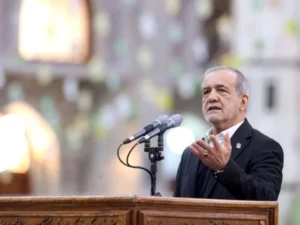
Iran’s President Masoud Pezeshkian vowed to stand firm against any pressure or threat. “Iran, relying on the knowledge and capabilities of its specialists, national unity, and solidarity, will stand firm against any pressure or threat,” Pezeshkian said in a post on X.
“Critical infrastructures are the lifeblood of the people. Threats to target themfrom transportation networks to the electricity and water industriesare not a show of strength but a sign of desperation in the face of a nation’s will,” he added.
The US Central Command said American forces had struck command-and-control centres, surveillance sites and defence infrastructure linked to Iranian operations near the strategic Strait of Hormuz.
In a parallel development, Trump claimed that US forces had carried out a “secret mission” to ensure the movement of oil tankers through the Strait of Hormuz, saying more than 100 million barrels of oil had passed through the waterway.
“Last month, I directed our Great US Military to execute a secret mission to support oil tankers and other commercial ships through the Strait of Hormuz,” he said on his Truth Social platform. He claimed the operation had involved more than 200 commercial vessels and was critical in stabilising global oil flows amid Iranian restrictions on the waterway.
Iran has largely closed the Strait of Hormuz since the outbreak of conflict, while the US has also enforced its own maritime restrictions in the region, according to officials.
Trump also said inflation in the United States had risen to a three-year high, attributing it to disruptions caused by the conflict. Oil prices surged following the latest escalation, with markets reacting sharply to fears of prolonged instability in the Gulf.
The US president further claimed that Iran was “paying the price” for delaying a peace deal, accusing its leadership of failing to engage seriously in negotiations. “The Bully of the Middle East is DEAD!!!” he wrote on Truth Social, while warning that Tehran would face consequences for “stalled diplomacy”.
The president insisted that US actions were aimed at restoring security and protecting global shipping routes, adding that the situation remained fluid and subject to rapid developments. Despite his hardline rhetoric, however, Trump also said he still hoped for a broader peace agreement.
Diplomatic efforts, including mediation attempts by Qatar and other regional actors, have so far failed to produce a breakthrough, according to officials familiar with the talks. Meanwhile, global concerns are mounting over the economic impact of the conflict, particularly disruptions to oil supplies passing through the Strait of Hormuz.
Trump has maintained that the United States will continue military pressure while also pursuing a negotiated settlement, although his remarks suggest growing impatience with the pace of diplomacy. As the situation continues to escalate, officials on both sides have warned that further strikes and counterstrikes remain likely, raising fears of a broader regional conflict with global consequences.
AGENCIES