Agreement would allow US companies to export civilian nuclear technology to the kingdom, sent to Congress on Monday
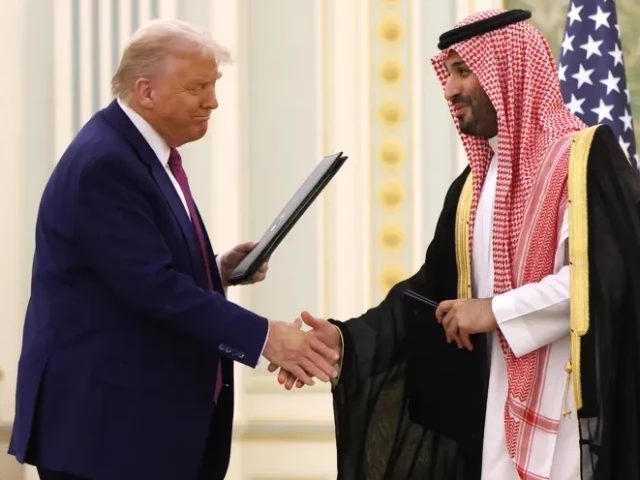
President Trump formalised a strategic economic partnership during a ceremonial signing with Saudi Crown Prince Mohammed bin Salman. PHOTO: CNN
President Donald Trump has sent Congress a proposed agreement with Saudi Arabia on civil nuclear energy while insisting the pact will only go into effect if the kingdom normalises relations with Israel, a US administration official told Reuters on Tuesday.
The agreement, which was reached in July and would allow US companies to export civilian nuclear technology to the kingdom, was sent to Congress on Monday, according to the US official, who declined to be identified.
The Saudi embassy in Washington did not immediately respond to a request for comment.
It was not clear how Trump expects sending the nuclear deal to Congress, which has 90 session days to consider it, will advance his objectives.
“The president’s position has not changed that the agreement will only move forward if Saudi Arabia joins the Abraham Accords,” the US official said in an email, referring to US-brokered agreements between Israel and Arab and Muslim-majority nations to normalise relations.
Read: IAEA chief says new initiative to support nuclear power at sea
Those accords, reached in 2020 and 2021, were between Israel and the UAE, Bahrain, Morocco and Sudan.
Days after agreeing to the Saudi nuclear deal in July, Trump, who worked on a similar pact during his first term, set normalisation as a condition for it to go into effect.
Former President Joe Biden also pushed for a nuclear deal and wanted to tie it to the accords. Diplomats thought Riyadh was close to normalising relations with Israel in 2023, but the start of Israel’s war on Gaza in October 2023 changed the landscape.
Saudi Arabia has demanded an irreversible path to a Palestinian state before recognising Israel.
The 30-year nuclear deal calls for the construction of AP1000 reactors, a project worth tens of billions of dollars that would benefit Westinghouse, jointly owned by Canada-based Cameco and Brookfield Asset Management.
The deal was sent to leaders in Congress and is expected to be handed to committees on Wednesday, two congressional sources said. Unless Congress objects to the deal within 90 session days, it will go into force. If Congress were to reject the agreement, Trump could veto that decision, which would require a two-thirds majority in Congress to override.
‘Hardly ideal’
Some Democratic lawmakers and nonproliferation advocates have criticised the nuclear pact for not barring Saudi Arabia from enriching uranium or reprocessing nuclear waste, two potential pathways for making a nuclear weapon. The UAE agreed to such measures, known as the gold standard, in its 2009 civil nuclear deal with Washington.
Read more: Iran decries US ‘terrorist’ strike on nuclear power plant, warns of devastating response
The Trump administration said the deal had nonproliferation measures required by law.
By starting the process, Trump has opened the possibility that Congress could allow the deal to proceed without normalisation and proliferation stipulations, said Henry Sokolski, the head of the Nonproliferation Policy Education Centre. “This is hardly ideal if you’re serious about no enrichment and recognition of Israel,” Sokolski said.