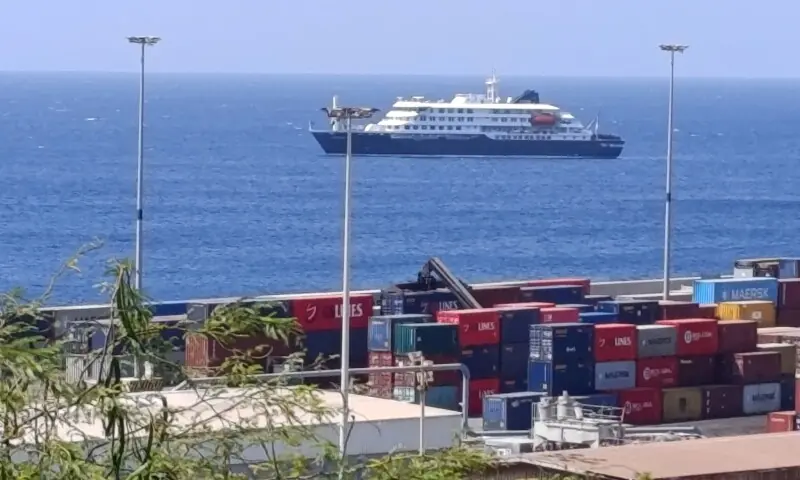
Spain said it had begun bringing Spanish passengers ashore from the cruise ship hit by a hantavirus outbreak on Sunday, with groups of nationals from other countries to follow.
The ship anchored near the Spanish island of Tenerife earlier in the day.
Spanish nationals were the first to disembark on small boats in groups of five and be taken to shore, where they were transferred onto buses and taken to the local airport.
The passengers, who are not showing any symptoms of the virus, will board a flight back to Madrid on a Spanish military plane and be taken to a hospital to be quarantined, government officials said, emphasising that they will have no contact with members of the public.
The luxury cruise ship left for Spain on Wednesday from the coast of Cape Verde after the World Health Organisation (WHO) and European Union asked the country to manage the evacuation of passengers following the detection of a hantavirus outbreak.
No rodents detected on the ship
Countries including Belgium, France, Germany, Ireland, the US, UK and the Netherlands confirmed on Saturday they had sent planes to evacuate their citizens aboard the ship, though local government officials in the Canaries said not all planes had arrived by Sunday morning.
The WHO said in an update on Friday that eight people no longer on the ship had fallen ill, including three who died — a Dutch couple and a German national; of the eight, six are confirmed to have contracted the virus, with another two suspected cases. It has recommended a 42-day quarantine period for passengers aboard the ship starting from Sunday.
Spain’s health ministry said in a report that the ship had passed the appropriate health checks: “There are more than 500 cruise ships a year that come from Argentina and Chile, which is home to the virus, and yet an outbreak of this illness has never happened in the European territory, so the possibility it happens in relation to this ship is remote.”
Hantavirus is usually spread by rodents, but it can, in rare cases, be transmitted person-to-person.
“According to the information provided by the experts who boarded the ship, the hygiene and environmental conditions are appropriate, and they have not detected rodents, so transmission by exposure to rodents on board is not likely,” the report read.
Passengers will not leave the boat until their allocated evacuation plane has arrived, Spanish officials said.
Passengers from the Netherlands will be the next group to leave the vessel, and their plane will also transport passengers from Germany, Belgium and Greece, Spanish Health Minister Monica Garcia said on Sunday.
After that, passengers from Turkey, France, the UK and the US will be evacuated, the minister added, speaking to reporters at the port of Tenerife.
“The final flight of the operation is departing from Australia … It is the most complex flight and is scheduled to arrive tomorrow afternoon,” Garcia said, adding that the final flight would pick up six people from Australia, New Zealand and other Asian countries.
Thirty crew members will remain on board and sail to the Netherlands, where the ship will be disinfected.
All passengers considered high-risk contacts: EU agency
Europe’s public health agency said ahead of the ship’s expected anchoring on Sunday off the Spanish island of Tenerife that all passengers on the cruise ship were considered high-risk contacts as a precautionary measure.
Passengers without symptoms will be repatriated for self-quarantine via specially arranged transport, not regular commercial flights, by their respective countries, the European Centre for Disease Prevention and Control (ECDC) said on Saturday as part of its rapid scientific advice.
Although at disembarkation, passengers will be considered high-risk, not all will necessarily be considered high-risk upon return to their home countries, the ECDC said.
The agency urged symptomatic passengers to be prioritised for medical assessment and testing on arrival, adding they may isolate in Tenerife or be medically evacuated home, depending on their condition.
UK army in ‘daring’ parachute op to aid suspected Hantavirus patient
Earlier on Sunday, British military personnel carried out an airborne operation to deliver urgent medical support for a suspected Hantavirus patient on a South Atlantic island, ministers said.
An army specialist team parachuted onto the island of Tristan da Cunha, Britain’s most remote overseas territory, a defence ministry statement said.
One of three British nationals diagnosed with suspected hantavirus linked to the outbreak on the MV Hondius cruise ship is on the island.
The team of six paratroopers and two military clinicians, all from the 16 Air Assault Brigade, descended from a Royal Air Force (RAF) A400M transport aircraft “in a daring parachute drop”, the statement said.
Vital oxygen supplies and other medical aid were air-dropped almost simultaneously.
The urgent response came after confirmation by the UK Health Security Agency (UKHSA) on Friday of a suspected infection in a British national on the island.
Tristan da Cunha, a group of volcanic islands with a population of around 220 has no airstrip and is accessible only by boat.
With oxygen supplies at critically low levels, officials said an airdrop was the only viable option to deliver care in time and support the island’s two-person medical team.
Foreign Secretary Yvette Cooper paid tribute to the armed forces for an “extraordinary operation”.
The drop involved a long-range flight of nearly 6,800 kilometres from RAF Brize Norton in central England to Ascension Island, followed by a further 3,000-kilometre flight to Tristan da Cunha, the statement said.
On Friday, the WHO said that the hantavirus outbreak posed a minimal risk to the general public.
“This is a dangerous virus, but only to the person who’s really infected, and the risk to the general population remains absolutely low,” WHO spokesman Christian Lindmeier told reporters.