
• Multi-agency report says over 9m Pakistanis face ‘crisis’ conditions; another 1.7 million in the more severe ‘emergency’ category
• Notes devastating monsoon rains, severe flooding wiped out crucial cropland, livelihoods
• Warns global hunger remains at critical levels amid conflict, drought, aid cuts; outlook for 2026 remains ‘bleak’
ISLAMABAD: Pakistan remains one of the 10 fragile countries where global acute food insecurity is most concentrated, according to a UN-backed report released on Friday, as intensifying climate extremes and persistent economic challenges continue to strain the nation.
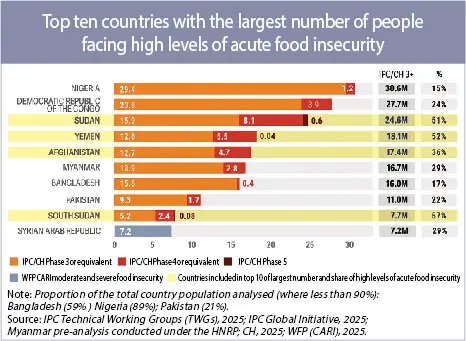
The 2026 Global Report on Food Crises names Pakistan alongside Afghanistan, Bangladesh, the Democratic Republic of the Congo, Myanmar, Nigeria, South Sudan, Sudan, Syria and Yemen as the primary centres of acute hunger.
According to the report, Pakistan was among the world’s 10 largest food crises in 2025, with about 11 million people facing acute food insecurity.
Of those affected in Pakistan, 9.3m people were classified in “crisis” conditions and 1.7m in “emergency”, the two most severe categories short of famine.
The classification system used in the report, known as the Integrated Food Security Phase Classification (IPC), defines a food crisis as a situation requiring urgent action to protect lives and livelihoods.
Acute food insecurity arises when access to food becomes so limited that it threatens survival.
Deeper crisis
The report highlights extreme weather as a continuing driver of food insecurity in Pakistan, pointing in particular to heavy rains and flooding that caused localised crop losses.
“In 2025, severe floods were recorded worldwide, affecting livelihoods and food security. In Pakistan, heavy monsoon rains and flash floods affected more than 6 million people, destroying cropland and infrastructure,” the report said.
Pakistan also appears in the report’s nutrition analysis, with Balochistan, Khyber Pakhtunkhwa and Sindh identified as areas of concern.
However, the country lacks sufficient recent data to assign a formal severity classification for 2025, placing it among countries with “no severity data” for nutrition outcomes.
Even so, Pakistan is included in broader assessments of malnutrition risk pathways, reflecting vulnerabilities linked to diet, healthcare access, water and sanitation, and disease.
The report also points to Pakistan’s role in regional displacement dynamics. It is listed among the countries hosting large numbers of refugees in food-crisis contexts, particularly Afghan refugees.
It also projects that Pakistan’s inflation will rise slightly to 6pc this year, adding further pressure on the system.
Despite the scale of the crisis, Pakistan recorded modest improvements in 2025.
The number of people in the most severe categories declined compared with the previous year, with about 400,000 fewer people in crisis (Phase 3) and more than 500,000 fewer in emergency (Phase 4).
But these gains remain fragile due to worsening climate and economic conditions.
According to the report, Pakistan’s inclusion in the top ten reflects both the severity of need and a broader expansion of data coverage.
The analysis was extended from 43 rural districts in 2024 to 68 districts in 2025, covering parts of Balochistan, Khyber Pakhtunkhwa and Sindh.
As a result, the share of Pakistan’s population included in the analysis rose from 16pc to 21pc, adding more than 14m
people to the dataset.
Even so, the report cautions that trends must be interpreted carefully. Pakistan’s apparent increase in food insecurity over recent years is partly due to this expanded coverage, which rose from just 2pc of the population in 2020 to 21pc in 2025.
A global crisis
Globally, conflict, drought and shrinking humanitarian aid are expected to keep hunger at critical levels this year, with the overall outlook for 2026 described as bleak.
A third of people facing the crises were in Sudan, Nigeria, and the Congo alone, according to the 10th edition of the annual hunger monitor, published by development and humanitarian organisations.
Based on data from the United Nations, the European Union and humanitarian agencies, the report found that conflict remained the main driver of acute food insecurity worldwide.
However, with conflicts and climate extremes likely to sustain or worsen conditions in many countries, the ripple effects are being felt globally.
For the first time in the report’s 10-year history, famine was confirmed in two separate contexts in the same year: Gaza and parts of Sudan.
In total, 266m people across 47 countries and territories faced high levels of acute food insecurity in 2025, nearly double the share recorded in 2016. Furthermore, 1.4m people faced catastrophic conditions in parts of Haiti, Mali, Gaza, South Sudan, Sudan and Yemen. The toll on the youngest and most vulnerable populations has been particularly severe.
In 2025 alone, 35.5m children worldwide were acutely malnourished, including nearly 10m suffering from severe acute malnutrition.
Looking ahead to this year, the report said severity levels remained critical. Only Haiti is expected to escape from the worst “catastrophic” band, thanks to a slight improvement in security and increased humanitarian aid.
Improvements in some countries, such as Bangladesh and Syria, were almost fully offset by notable deteriorations in Afghanistan, Congo, Myanmar and Zimbabwe.
“We are no longer seeing just temporary shocks, but persistent shocks over time,” said Alvaro Lario, head of the UN’s International Fund for Agricultural Development (IFAD), which helps draw up the annual report.
“The main message is that food insecurity is not an isolated issue anymore, but is putting pressure on global stability,” Lario said.
The US-Israeli war on Iran has added to the alarm, Lario said.
“Even if the conflict in the Middle East were to end right now, we know that a lot of the food price shocks and inflation will happen in the next six months,” he added.
Published in Dawn, April 25th, 2026