‘A naval blockade is an act of war, responding to it is our right,’ says Major General Mohsen Rezaei
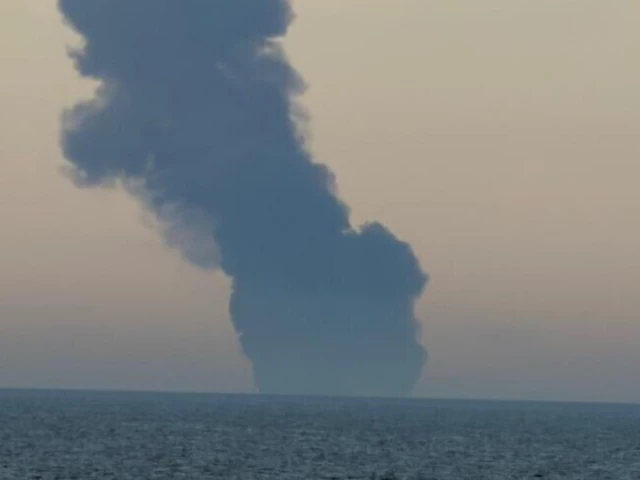
Black smoke rises at sea near the Strait of Hormuz. PHOTO: ANADOLU AGENCY
Iran vowed Sunday to confront the US over its naval blockade, with a top military adviser to the country’s supreme leader warning that the Sea of Oman could become a “graveyard” for US ships if tensions continue to escalate.
“My advice to the US militarily is to back off before the Gulf of Oman turns into a graveyard for your ships. Otherwise, our understanding is that a naval blockade is an act of war, and responding to it is our natural right, Maj. Gen. Mohsen Rezaei, a member of Iran’s Expediency Discernment Council, said in remarks carried Sunday by Iranian state television.
Rezaei added that Iran’s restraint should not be interpreted as acceptance of pressure or threats.
“If we’ve been patient until now, it doesn’t mean we have accepted it,” he said.
He also questioned the rationale behind the continued US military presence in the Gulf, arguing that Washington no longer had the justifications it once used to maintain its role in the region.
Read: Pakistan pushes diplomacy amid renewed war fears
“America comes here and brings its warships. Who is its enemy? At one time, they said they came to confront the Soviet Union. The Soviet Union no longer exists,” he said.
Rezaei said the Strait of Hormuz had always remained open to trade and argued that what was being rejected was foreign military campaigns rather than commercial movement.
“The Strait of Hormuz is open to trade, but it will be closed to military buildups and any attempts to destabilise security,” he said.
Regional tensions have escalated since the US and Israel launched strikes on Iran on February 28, prompting retaliatory attacks by Tehran and disruptions in the Strait of Hormuz.
A ceasefire took effect on April 8 through Pakistani mediation, but talks in Islamabad failed to secure a lasting agreement. The truce was later extended by US President Donald Trump without a specified deadline.
Since April 13, the US has enforced a naval blockade targeting Iranian maritime traffic in the strategic waterway.
Israel built 2 secret military bases in Iraq for Iran operations
Israel built two covert military sites in Iraq’s western desert to support operations against Iran, according to a report Sunday by the New York Times.
The newspaper, citing Iraqi and regional officials, said a newly disclosed site was one of two covert facilities used intermittently by Israel inside Iraq for more than a year.
The officials said the sites were used for air support, refuelling, and medical services and later played a role during the 12-day war against Iran in June 2025.
Read more: ‘The clock is ticking’: Trump warns Iran to ‘get moving fast’ as deal talks stall
One of the sites came to light after Iraqi shepherd Awad al-Shammari encountered unusual military activity near al-Nukhaib in March and alerted local authorities after seeing helicopters, tents and what appeared to be a makeshift landing strip, according to the Times.
The report said that 29-year-old Al-Shammari later disappeared and was found dead, while Iraqi forces sent to investigate the area also came under fire, leaving one soldier dead and two others wounded.
Earlier this month, The Wall Street Journal reported that Israel had established a secret military site in Iraq’s western desert to support operations against Iran.
In remarks to Anadolu following the Wall Street Journal report, a senior Iraqi security official dismissed claims of Israeli military activity in Iraq’s western desert as “false.”
The official said Iraqi forces had confronted a “mysterious” airborne operation in the al-Nukhaib desert area in March and that the incident had been handled at the time.
Iraq says it will not be a launchpad for regional attacks
Iraq will not allow its territory to become a passageway or launchpad for attacks against other countries, a military spokesman said Sunday.
Speaking to the Iraqi News Agency (INA), Sabah al-Numan, a spokesperson for the commander-in-chief of the armed forces, said Baghdad’s policy was based on avoiding regional and international conflicts to preserve domestic stability.
He said restricting weapons to state control remained a key pillar of the government’s security strategy and a necessary step toward ending armed activity outside the legal framework.
Al-Numan also stressed that Iraq would not allow other countries to interfere in its internal affairs, saying the country seeks to protect itself from the security and political fallout of regional crises.
Prime Minister Ali Al-Zaidi pledged Thursday to place all weapons under state control as part of a broader reform program after winning parliament’s confidence.
Israel’s military on alert and ready to join US attacks on Iran, media reports say
Israeli media report that the military is preparing for renewed hostilities with Iran, with public broadcaster Kan citing an unnamed security official as saying that Israel would join any new US strikes and target Iranian energy infrastructure, Al Jazeera reported.
The report followed a call between Trump and Netanyahu on Sunday that lasted for more than half an hour, in which Kan said the two leaders discussed the prospect of renewed fighting.
The Channel 12 broadcaster also described the conversation as taking place “in the shadow of preparations for renewed fighting in Iran” and reported that the Israeli military has been placed on high alert.
It said Israel expects to be notified by the US ahead of any strike, though it does not know the exact timing of a potential decision.
Channel 12 also noted that Trump is facing significant pressure, including from China, not to enter a new confrontation with Iran and to pursue a negotiated settlement instead.
Oil touches 2-week high after drone attack on UAE nuclear power plant
Oil prices extended gains on Monday as efforts to end the US-Israeli war on Iran appeared to have stalled, after a nuclear power plant in the United Arab Emirates came under attack and as US President Donald Trump is expected to discuss military options on Iran.
Brent crude futures climbed $2.03, or 1.86%, to $111.29 a barrel by 0720 PKT, after touching $112 earlier, the highest since May 5.
US West Texas Intermediate crude was at $107.73 a barrel, up $2.31, or 2.19%, following a rise to $108.70, its highest level since April 30. The front-month June contract expires on Tuesday.
Both contracts gained more than 7% last week as hopes of a peace deal that would end ship attacks and seizures around the Strait of Hormuz dimmed. Last week’s talks between Trump and Chinese President Xi Jinping ended without an indication from the world’s top oil importer that it would help resolve the conflict.
“The longer the conflict with Iran persists, the greater the risk of protracted oil price scarring, which could keep interest rates higher for longer,” Prestige Economics’ Jason Schenker said in a note.
“This could also present persistent downside risks to growth.”
Drone attacks on the UAE and Saudi Arabia and rhetoric from the US and Iran raised concerns of an escalation in the conflict.