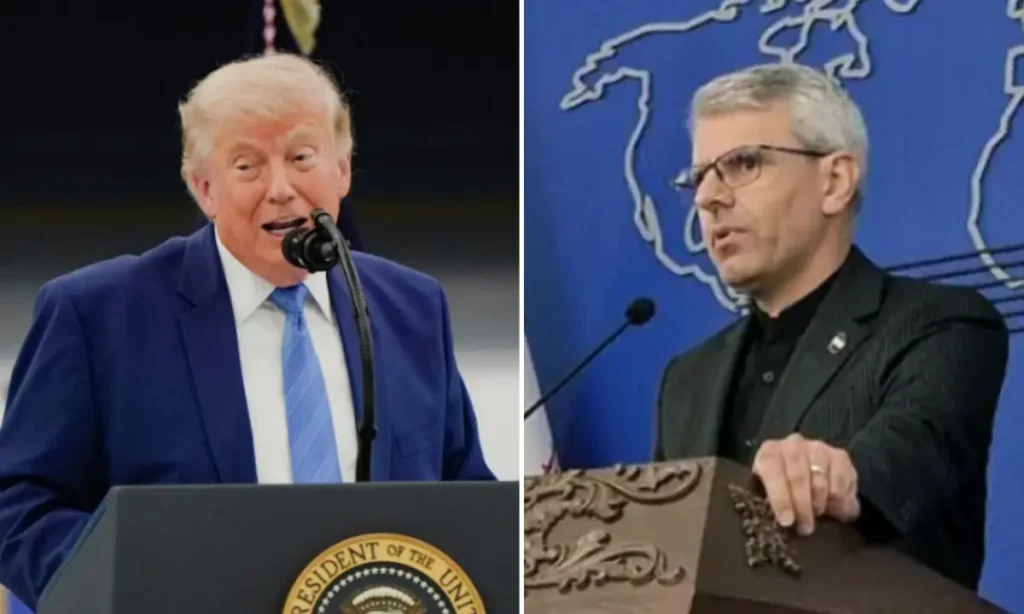
Iran said on Monday that no negotiations with the United States were currently being held despite US President Donald Trump announcing earlier that the two sides were set to begin parleys later today.
“Iran is not currently holding talks with the United States and is now in discussions with Oman over a temporary safe route through the Strait of Hormuz,” Iranian foreign ministry spokesperson Esmaeil Baqaei said in a televised press conference.
On Sunday, Trump said that new negotiations with Iran would begin on Monday after he decided to hold off on striking the country to pursue a deal to end the war entering its sixth month.
Trump told reporters that the talks would cover the Strait of Hormuz and ultimately, the denuclearisation of Iran.
Oil prices fell on Monday at the opening of Asian trade after Trump announced the new negotiations, with West Texas Intermediate dropping 4.7 per cent to $80.72 per barrel.
Following a return to strikes last month, fears had mounted that the fighting could escalate once again. Trump had threatened to hit Iran “very hard” and was reportedly considering renewed attacks including against energy infrastructure, with US embassies across the region on alert. Trump pulled back from that threat on Saturday, saying the “parameters” of a deal were there.
“Now what we’re doing is we’re talking to them in the form of a negotiation. It begins tomorrow afternoon,” Trump told reporters aboard Air Force One on Sunday, without providing details of the venue or participants in the talks.
The US president said he had been asked by Iran as well as US partners Saudi Arabia, the United Arab Emirates and Qatar to hold off on the strikes, which he claimed would have been “the biggest attack since World War II”.
Iranian media denied that Tehran had asked Trump not to strike.
The US president said at the start of the conflict that the war was necessary to deal with Iran’s nuclear programme. Western nations accuse Iran of seeking a bomb, though Tehran insists the programme is entirely civilian in nature.
‘Exchange of views’
Iranian lawmaker Hassan Ghashghavi, spokesman for the parliament’s national security commission, said on Sunday that mediators were trying to revive the US-Iran memorandum of understanding that was agreed in June.
That agreement was not intended as a final peace deal, but as a stepping stone to negotiations on a comprehensive agreement, though it did include provisions on Hormuz.
“They know that the main issue and, in fact, the key to the matter right now is the issue of the Strait of Hormuz, so yes, there is an exchange of views,” Ghashghavi said.
Posting on X, Iranian President Masoud Pezeshkian said, “We must strive to compel the enemy to remain committed to what it has signed.”
Iran deal with Oman?
Before the war, there was free passage for all vessels through the Strait of Hormuz, but Iran closed the strait during the war and now insists on retaining control and charging tolls, something the US rejects.
That dispute sparked the return to strikes last month, as Tehran refused to let ships travel any route other than one which hugs the Iranian coast.
On Sunday, Iranian foreign ministry spokesman Baqaei told state television that a deal was close with Oman, which sits on the other side of the strait, over a new route through it.
“We are now going to reach an understanding on a route acceptable to both sides—neither the northern route nor the southern route — but one that respects the sovereign rights of both sides and safeguards our national interests and security,” he said.
He insisted though that such an agreement did not mean the reopening of the strait.
Baqaei reiterated this during his televised address on Monday, saying that reaching an agreement with Oman was not sufficient to reopen the strait as the situation would remain unchanged while US “aggression” continued.
He elaborated that Iran had been discussing with Oman the creation of a new route through the Strait of Hormuz that would be one path with entry and exit lanes.
The Strait of Hormuz has become a sticking point in the Washington-Tehran conflict, which began with the US and Israel launching strikes on Iran on February 28. Iran has largely closed the Strait of Hormuz, a conduit for 20 per cent of the world’s oil and liquefied natural gas before the start of the war, causing energy prices to rise and stoking broader inflation.
Maritime trade tracking firm Kpler said on Friday that traffic through Hormuz had dropped sharply.
On Sunday, a tanker off the coast of Oman reported hearing an explosion near the vessel, the United Kingdom Maritime Trade Operations (UKMTO) Centre reported, adding that the vessel and crew were all safe.