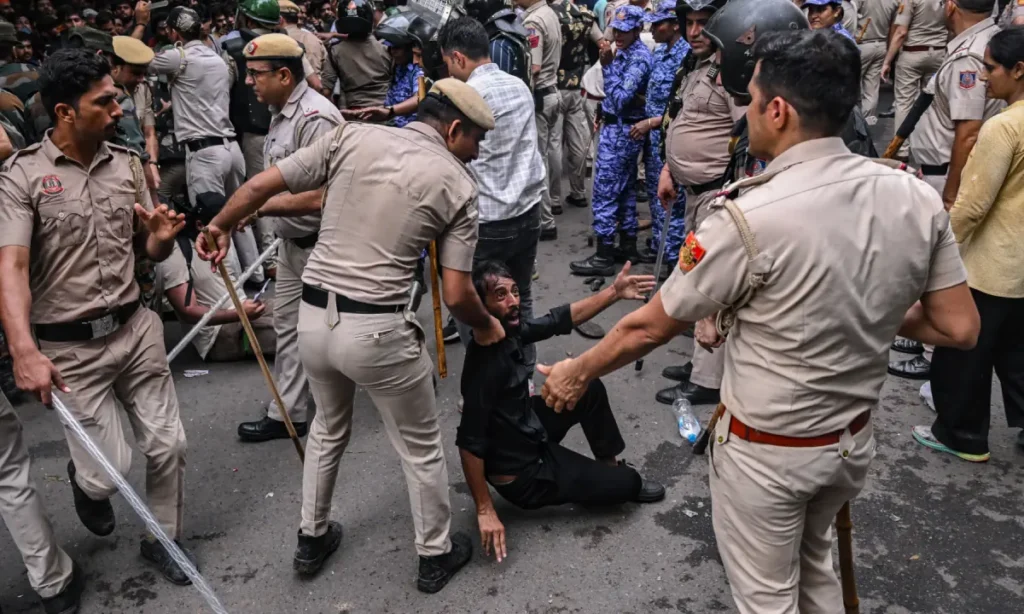
Indian police fired tear gas and baton-charged protesters in New Delhi on Monday as they tried to march on parliament to demand the resignation of the education minister over irregularities in major examinations.
The protesters, mostly young students, ran for cover as police charged at them and fired tear gas shells near Jantar Mantar in the Indian capital.
They are seeking the resignation of Education Minister Dharmendra Pradhan over exam irregularities, including question paper leaks and technical glitches.
Thousands of protesters started gathering from early Monday, defying a steady monsoon drizzle and police barricades, marking one of the biggest demonstrations in the capital in five years.
“Our country deserves a government that is bothered about what the young people have to say and is willing to correct its mistakes,” said Sumit Kumar, 18.
“The future belongs to us and not these politicians.”
The protest comes after prominent activist Sonam Wangchuk was forcibly taken to hospital on Saturday, bringing an abrupt end to his 20-day hunger strike in support of youths and the satirical Cockroach Janta Party (CJP) movement.
The CJP has won millions of followers on social media since its launch in May, tapping into widespread anger over the country’s education system and unemployment.
“Is this a war zone? Why is the police resorting to tear gas assault on peaceful protesters?” CJP said in a post on X.
“First, your government ignored this protest for a month, and now, when we are peacefully marching, your government is attacking us. Why?”
The movement is seen as one of the biggest challenges to Prime Minister Narendra Modi since he won his third term in office in 2024.
‘We shall win’
Despite rapid economic growth, millions of people in the world’s most populous nation still struggle to find stable and well-paying jobs, fuelling discontent.
Some 2.2 million aspiring medical students sat for a re-examination under tight security last month after the previous test was scrapped following a question paper leak that triggered widespread outrage.
That came on top of another scandal related to the online marking system of tests taken by nearly 2m high school students.
The CJP said two of its leaders met a senior minister on Monday and submitted a letter spelling out their demands after the government reached out to them in the morning.
The internet was cut in parts of central New Delhi on Monday, with police saying they had not given their permission for the protest.
“Any person violating these prohibitory orders shall be liable for prosecution,” Delhi Police said in a statement.
Shubhi Rao, 16, said she had joined the protest to support Wangchuk and demand accountability from the government.
“Prime Minister Narendra Modi has shown himself as someone who isn’t bothered about the youth of this country,” she told AFP.
Modi, in a public address before the start of the monsoon session of parliament, did not mention the protesters.
But Mallikarjun Kharge, a senior leader of the opposition Congress party, brought up the issue in the upper house.
“Thousands of students have gathered at Jantar Mantar. The government is trying to use force, suppress voices, and drive them away,” he said.
Slogans were also shouted inside the lower house by the opposition benches, demanding the resignation of the education minister and justice for students.
Activists set terms to end his fast.
CJP founder Abhijeet Dipke and his supporters began a sit-in last month seeking the resignation of Pradhan. Wangchuk joined them on June 28, launching an indefinite hunger strike at the site.
In a handwritten note from the hospital posted on his X account on Monday, Wangchuk said he would end his fast if the government took responsibility for recent failures in the education system and for paper leaks, or if CJP protesters were allowed to reach parliament and lawmakers assured them they would take up the issues.
He said he would also end the hunger strike if lawmakers and leaders of various parties met him in the hospital and gave him the same assurances, since his health did not allow him to march on parliament.
The rise of the CJP reflects frustrations among young Indians over issues like high youth unemployment and frequent examination paper leaks, analysts say.
Unemployment in 2025 stood at 3.1 per cent among those aged 15 and above, government data shows, but was 9.9pc for those from 15 to 29. In urban areas, it was 13.6pc, and 8.3pc in rural regions.