
Fontainebleau blaze scorches 800 hectares, forces A6 highway closure as smaller fires disrupt train services
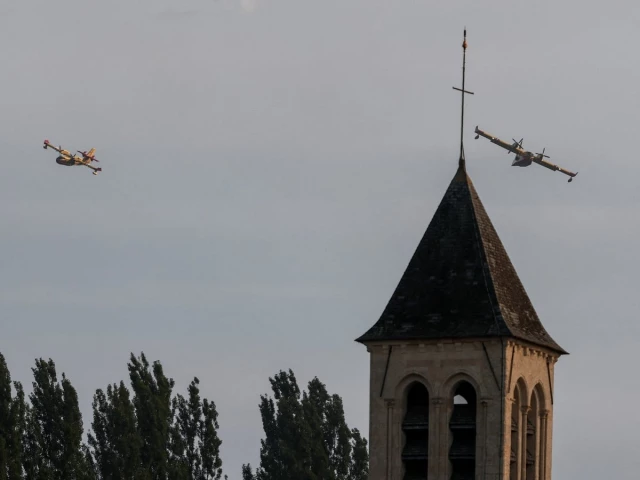
Firefighting planes, Canadair CL-415, fly over the church of Noisy-sur-Ecole, amid a wildfire affecting the area near Fontainebleau, France, July 13, 2026. PHOTO: REUTERS
More than 400 French firefighters worked through the night to contain a wildfire in the historic Fontainebleau forest south of Paris, and authorities sent two waterbombing planes on Monday to tackle the blaze as a heatwave gripped western Europe.
The fire broke out alongside a highway near Fontainebleau, home to one of France’s best-known royal palaces, which once served as a hunting lodge and autumn residence for past monarchs. By midnight, the flames had scorched more than 800 hectares (1,980 acres), fanned by hot winds.
Just 70 kilometres (43.5 miles) from Paris, the blaze forced the closure of the A6 highway linking Paris with Lyon and the south. Smaller fires in the area also disrupted high-speed train services.
“The fight continues today,” the French fire service said on X. Local residents have been warned that the Canadair planes will have to scoop water from the river Seine, which flows through central Paris.
#Incendies | 400 sapeurs-pompiers ont été à pied d’œuvre cette nuit pour lutter contre le feu dans la forêt de Fontainebleau (Seine-et-Marne) qui, depuis son déclenchement en bord d’autoroute hier après-midi, a déjà parcouru + de 800 hectares en milieu de nuit.
La lutte continue… pic.twitter.com/kwdnyS9IYw— Pompiers de France (@PompiersFR) July 13, 2026
European countries are worried about increasingly frequent heatwaves and record-breaking temperatures. Most scientists say the fires are driven by climate change, with large swathes of continental Europe parched.
Wildfires have already ripped through regions of France, Spain, Portugal and Greece, charring thousands of hectares of land.
The death toll from a blaze that swept through Spain’s southeastern Almeria province rose to 13 over the weekend, when a 93-year-old British woman died of burns.
Western Europe is gripped by its third prolonged spell of baking temperatures this summer. A heatwave in late June likely killed thousands of people, with countries reporting more than 10,000 excess deaths.
Power supplies were disrupted, schools shut and temperature records broken in France, Spain and Britain.
“To have this kind of excess at this time of year is unusual. It’s really high,” said Lasse Vestergaard, chief physician at Denmark’s Statens Serum Institut, which hosts EuroMOMO, a Europe-wide mortality surveillance system. “It is difficult to explain this high excess mortality by anything but the extreme heat,” Vestergaard told Reuters.