
An industry breakthrough comparable to OpenAI’s landmark GPT-3.0 model could come around mid-2027
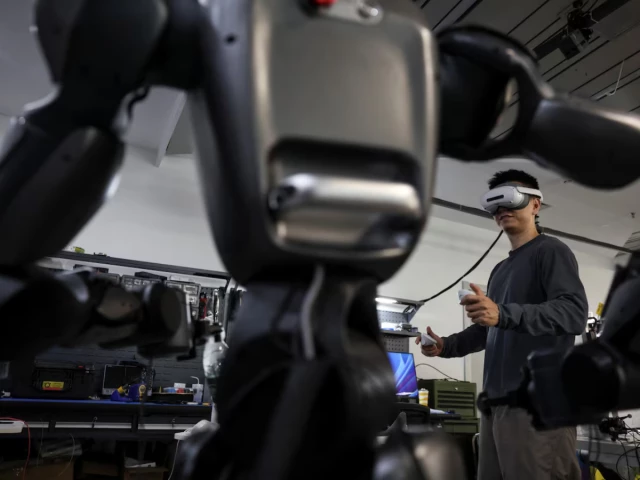
An engineer wearing VR goggles uses a controller to operate a Spirit AI’s Moz1 robot, at a testing area in the company’s headquarters in Beijing, China September 17, 2026. PHOTO: REUTERS
Humanoid robot brains are likely to achieve a breakthrough as soon as mid-2027, but their deployment in homes could take at least eight years as model development faces a data bottleneck, leading Chinese embodied AI firm Spirit AI said this week.
Despite impressive hardware advances allowing Chinese humanoids to sprint, dance and do backflips on command, Chinese robot firms are increasingly focusing on the software that determines robots’ intelligence and their economic productivity in real-world settings.
“The brain is indeed the weakest link in the complete robotics stack,” Gao Yang, co-founder and chief scientist of Spirit AI, told Reuters at its Beijing offices on Thursday.
An industry breakthrough comparable to OpenAI’s landmark GPT-3.0 model, which powered ChatGPT, could come around mid-2027, said Gao. Spirit AI’s robots have achieved a 90% success rate for simple tasks in structured living-room environments.
Read: King Charles warns AI leaders of ‘existential dangers’
“The next one to two years mark the initial window for industrial applications. Two years from now, we’ll see robots deployed in commercial service settings doing simpler tasks. Entering homes is far harder than both,” said Gao, who is also an assistant professor of robotics at Tsinghua University.
Focused on brains
Spirit AI currently has tens of its own Moz1 wheeled humanoid robots deployed on production lines at battery maker CATL and retailer JD.com, which is also an investor.
The 300-person startup has raised over $670 million since its 2024 founding, making it one of China’s most rapidly capitalised embodied intelligence firms. It is currently valued at 20 billion yuan ($2.9 billion). Gao declined to comment on any plans for an initial public offering.
“Progress is extremely fast. When Spirit AI was founded, a robot could perform only one isolated task well, like pouring water or folding a piece of clothing,” said Gao.
“Today, robots operate across large spatial areas and execute continuous complex workflows.”
Difficulties remain in perfecting fine-motor actions like unscrewing a bottle cap and dealing with unseen tasks, he said. Spirit AI overwhelmingly relies on real-world data to train its robot brains instead of virtual simulations, which many competitors use to reduce model training costs.
“Simulators handle rigid bodies well, but flexible objects like deformable electric cables remain a problem,” said Gao.
Human data collectors
The company employs around 1,000 contractors nationwide using wearable data-collection equipment in households and on production lines.
Read more: US Senate blocks AI ‘kill switch’ bill amid debate over superintelligence risks
Its Beijing offices include a robot data training centre where a Reuters witness saw dozens of young people fitted with sensors who repeated motions like opening fridges, unlocking safes, and cutting vegetables with knives to train the humanoid robots.
In other robot-training facilities in China, operators may need to repeat a movement more than 50 times to get one “clean” movement with the required precision.
However, Spirit AI found that using “dirty data” with a more diverse range of motions enabled its models to improve faster, Gao said.
Reporting by Laurie Chen; Editing by Eduardo Baptista and Christian Schmollinger