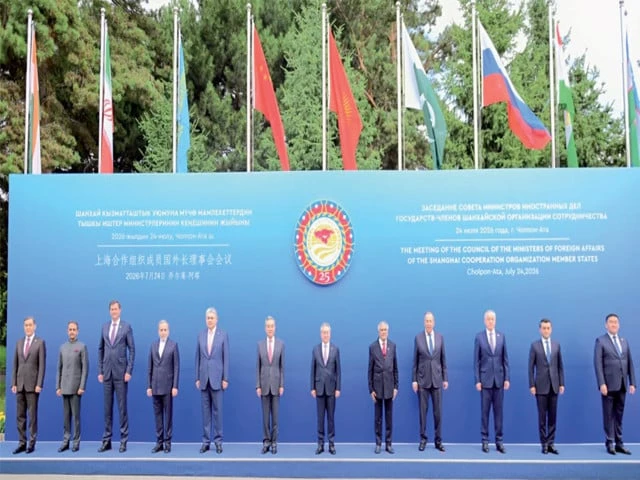
ISLAMABAD:
Deputy Prime Minister and Foreign Minister Ishaq Dar on Friday urged the Shanghai Cooperation Organisation (SCO) to press Afghanistan’s Taliban rulers to honour their counter-terrorism commitments, saying durable peace and stability in the region depended on ending terrorism emanating from Afghan soil.
Addressing the SCO Council of Foreign Ministers’ meeting (SCO-CFM) in Cholpon-Ata, Kyrgyzstan, Dar said, “Our region is passing through an eventful time.” He noted, however, “It has always been, and continues to be, Pakistan’s desire to see a peaceful, stable, regionally integrated, and prosperous Afghanistan, which is at peace with itself and its neighbours.”
This, the foreign minister said, was in the best interest of all SCO member states and beyond.
At present, Dar said, “the threat of terrorism emanating from Afghanistan is one of the most serious security challenges for us,” noting that terrorist organisations including the Tehreek-e-Taliban Pakistan (TTP) “continue to recruit, train, and operate from Afghan soil, under the watch and facilitation of the Afghan Taliban regime.”
“The enabling environment provided to terrorist organisations by the Afghan Taliban regime has been well-documented by the UN Analytical Support and Sanctions Monitoring Team,” the foreign minister stated.
Citing over 560 innocent Pakistani civilians martyred in over 2,000 terrorist incidents this year, Dar expressed deep concern over Afghan nationals found to be involved in these terrorist incidents.
Saying that durable peace, stability, and economic development could only be achieved “with the eradication of the menace of terrorism emanating from Afghan soil,” Dar urged the SCO to call on the Afghan Taliban regime to “honour its international counter-terrorism commitments to the international community and fulfil its responsibilities towards global peace and security.”
Turning to regional diplomacy, Dar said Pakistan believed “dialogue, diplomacy and mutual respect provide the only sustainable way forward to resolve conflicts and achieve durable peace and security.”
Guided by this conviction, he said, Pakistan led efforts to host talks between the United States and Iran in Islamabad in April, facilitating the first high-level direct diplomatic contact between the two countries in 47 years.
Describing the Islamabad memorandum of understanding (MoU), signed in June 2026, as a “historic breakthrough”, the foreign minister said the agreement was made possible through Islamabad’s close engagement with both sides and intensive diplomatic outreach to regional and international partners.
“Pakistan deeply appreciates the trust and confidence reposed in it by both Iran and the United States in undertaking this challenging responsibility in the larger interests of peace and security,” he said, urging the international community to build on the Islamabad MoU and the ongoing US-Iran technical talks to advance lasting peace.
He also urged vigilance “against those who seek to undermine regional stability,” Dar warned that such actors “will exploit every opportunity to derail the peace process and reverse the progress achieved.” Only through working together, he said, could the shared objective of long-term peace, stability, and prosperity be achieved for the region and beyond.
Further, the foreign minister lauded the SCO, saying it has “become an anchor for regional cooperation, driving vital progress in peace, security, stability, and economic connectivity, while also simultaneously fostering deep cultural exchanges among member states,” according to an X post by the Ministry of Foreign Affairs (MoFA).