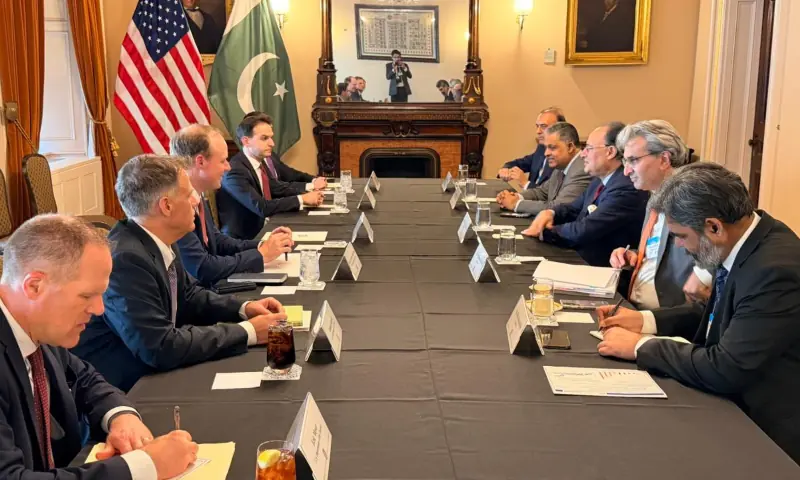
Finance Minister Muhammad Aurangzeb held a “productive” meeting with officials of the United States Department of the Treasury, with both sides discussing avenues for cooperation in the mineral and energy sectors, the finance ministry said on Saturday.
Aurangzeb arrived in the United States on Monday to participate in the World Bank Group and International Monetary Fund (IMF) Spring Meetings 2026, taking place from April 13 to 18 in Washington, DC. The Spring Meetings bring together finance ministers, central bank governors, policymakers and development experts from around the world amid ongoing global economic uncertainty.
On the sidelines of the World Bank-International Monetary Fund (WB-IMF) Spring Meetings 2026 in Washington, DC, Aurangzeb held a “productive” meeting with Francis Brooke, the deputy secretary at the US Department of the Treasury, the ministry said in a post on X.
“Both sides discussed avenues for cooperation and collaboration in energy, mineral development, and strengthening the anti-money laundering and countering the financing of terrorism (AML/CFT) framework,” the ministry said.
“The finance minister shared an overview of Pakistan’s macroeconomic stabilisation, its planned re-entry into international capital markets, and its external debt management strategy,” it said.
He highlighted key investment opportunities in Pakistan’s minerals and energy sectors, and briefed the Treasury leadership on progress and prospects in digital and virtual asset regulation, the statement added.
Aurangzeb also reaffirmed the “depth and strength of bilateral economic engagement” and underscored the importance of continued US support for Pakistan’s programme with the IMF.
Separately, the minister also held a meeting with Asian Infrastructure Investment Bank (AIIB) President Zou Jiayi on the sidelines of the meetings, where he appreciated AIIB’s robust engagement in Pakistan through an ongoing portfolio of approximately $1.7 billion, with an additional $1bn in the pipeline.
He also briefed her on the economic implications of the ongoing regional situation, particularly its impact on Pakistan’s energy supply chain, and highlighted Pakistan’s recent return to international capital markets, including the launch of a Eurobond through private placement after a gap of four years.
Aurangzeb invited AIIB to align its engagement with Pakistan’s infrastructure priorities and strategic development focus, the ministry said.
“Both sides acknowledged that Pakistan’s disbursement performance with AIIB has lagged behind that of other multilateral partners, including the World Bank and ADB,” it added.
The finance minister also participated in a roundtable titled “Delivering Social Protection Digitally: Lessons and Innovations from Pakistan, Middle East and North Africa”, organised by the WB, on the sidelines of the Spring Meetings. The roundtable featured presentations both on Pakistan’s Digital Public Infrastructure (DPI) journey and on the digital transformation of the Benazir Income Support Programme (BISP).
According to the finance ministry, he drew a “compelling parallel between Covid-19, described as the largest demand shock in recent history, and the ongoing Middle East conflict, which he characterised as the largest supply shock”.
He noted that countries that invested early in governance and technology were better positioned during Covid-19, and that Pakistan was now reaping similar dividends from its digital infrastructure as it navigates the current energy supply shock, the ministry said.
“His key message was that digital social protection is not merely a payment mechanism, but a vehicle for financial inclusion and economic empowerment,” it added.
Aurangzeb also held a constructive meeting with representatives of S&P Global Ratings, informing them that Pakistan had met its external obligations in a timely manner.
He noted that Pakistan had “successfully re-entered international capital markets with the launch of a Eurobond through private placement after a gap of four years, priced at just under seven per cent, reflecting renewed investor confidence in the country’s macroeconomic trajectory,” the ministry said.
Highlighting the government’s measures to manage the immediate economic impact from the evolving regional situation, Aurangzeb expressed confidence that Pakistan’s improved macroeconomic fundamentals and continued reform momentum presented a strong case for a rating upgrade.
In another meeting with representatives of Citibank, the finance minister appreciated the “detailed and structured” capital markets strategy presented by Citibank and advised the team to maintain close coordination with Pakistan’s Debt Management Office (DMO) to support ongoing and future market engagements.
He appreciated Citibank’s longstanding presence in Pakistan and expressed a strong desire to further reinvigorate and deepen the partnership, according to the ministry.
During his US visit, Aurangzeb is expected to participate in over 50 high-level engagements from April 13 to 18.
On Friday, the finance ministry said that he appreciated China’s support in facilitating Pakistan’s engagements with the International Monetary Fund (IMF) in a meeting with his Chinese counterpart.
On Thursday, IMF Managing Director Kristalina Georgieva commended Pakistan’s “continued progress on economic reforms” under the Fund’s programme and the resulting macroeconomic stability in a meeting with Aurangzeb.