Federation considers greater exposure, Iranian coach and league revival to improve
KARACHI:
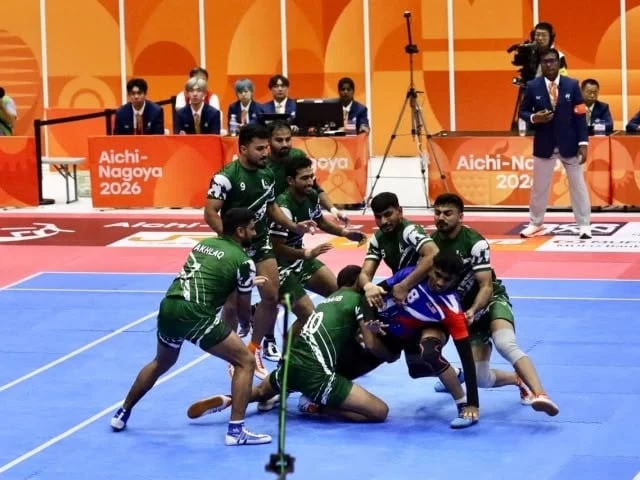
Pakistan’s disappointing campaign at the 20th Asian Games in Nagoya has prompted the country’s kabaddi authorities to consider changes aimed at restoring Pakistan’s standing in a sport in which it was once a major force on the international circuit.
For the first time in the history of the Asian Games, Pakistan returned without a medal in kabaddi. The team failed to reach the semi-finals after suffering a 51-30 defeat by Iran in a crucial group match. However, the biggest setback came against Thailand, a relatively inexperienced opponent, who edged Pakistan 48-45 to severely dent their semi-final hopes.
“Yes, it was unfortunate that we returned without a medal for the first time in four decades,” Pakistan Kabaddi Federation’s (PKF) Secretary General and former national captain Mohammad Sarwar told The Express Tribune.
“We were leading Thailand by 14 points, but we lost the match in the last seven minutes. It was heartbreaking for all of us,” Sarwar said.
He identified a lack of international exposure as one of the main reasons behind Pakistan’s disappointing performance, saying regular competitions against top teams were essential to developing match temperament.
“Our biggest issue is the lack of exposure. Other teams travel to India and keep playing matches, and that makes a significant difference. We do not play against India and rarely travel abroad, except for major events. We need to increase our international exposure because match temperament is crucial ahead of such important competitions,” Sarwar said.
Pakistan had also invited Iran to participate in a joint training camp ahead of the Asian Games, but the plan did not produce the desired results. “The team usually trains in Iran, but the conflict involving Iran and the United States prevented Pakistan from travelling there this time,” Sarwar said.
Pakistan have won seven bronze and two silver medals in kabaddi at previous Asian Games, making their failure to reach the podium a significant setback for the country.
Sarwar acknowledged that Pakistan needed to pay greater attention to mat kabaddi, the format played at the Asian Games, where barring strong India, Iran and South Korea have made considerable progress.
“We need to focus on this format. The problem is that circle-style kabaddi is usually given priority in Pakistan. Iran, for example, focus on Asian-style kabaddi, while their circle-style game is weak,” he said.
“We did not expect to return without a medal because we believed our team was competitive.”
The federation is also considering hiring an Iranian coach in an effort to improve the team’s performance in the Asian-style.
“We are now considering hiring an Iranian coach, even though we were the ones who taught them kabaddi. We will see how this experiment works,” Sarwar said.
Pakistan’s next target is the Asian Indoor and Martial Arts Games, where the federation hopes to build a stronger squad.
“Our next target is the Asian Indoor and Martial Arts Games. We will build a good team and see how the players perform,” Sarwar said.
The 6th Asian Indoor and Martial Games are penciled in for December 11-21 in Riyadh.
The federation also plans to revive its domestic league, which it believes could help improve players’ competitiveness and financial security.
“We held the Super Kabaddi League a few years ago and intend to revive it. Such an event is important if we want to keep the sport alive and strengthen players financially,” Sarwar said.
Pakistan began their Asian Games campaign convincingly, beating Malaysia 65-22 and Nepal 58-43. However, consecutive defeats against Thailand and Iran ended their hopes of reaching the semi-finals.
India won both the men’s and women’s kabaddi titles, defeating Iran in both finals. The Indian men secured a 40-34 victory, while the women won 37-34.
India’s continued progress has been supported by a high-profile professional league that provides players with regular competition and greater exposure. Pakistani players also featured in the league in the past, but their participation has been suspended in recent years because of strained political and diplomatic relations between the neighbouring countries.