Co-chairs Shamila N Chaudhary and Dr Colin F Jackson call on Field Marshal Asim Munir
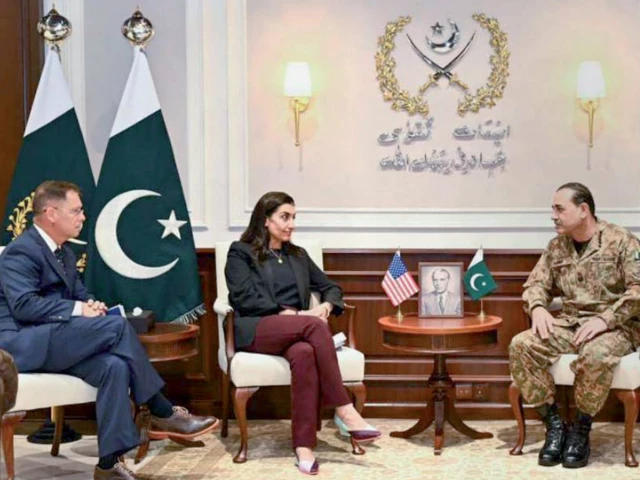
A delegation of the US Afghanistan War Commission meets with Chief of Defence Forces Field Marshal Asim Munir at General Headquarters in Rawalpindi. PHOTO: APP
ISLAMABAD:
ISLAMABAD
The United States Afghanistan War Commission has sought Pakistan’s perspective on the two-decade-long Afghan conflict as it undertakes a comprehensive review of Washington’s military, diplomatic and strategic engagement in Afghanistan.
A delegation of the commission, led by its co-chairs Shamila N Chaudhary and Dr Colin F Jackson, called on Field Marshal Syed Asim Munir chief of army staff and chief of defence forces at General Headquarters (GHQ) on Monday, according to the Inter-Services Public Relations (ISPR).
“The delegation is undertaking a review of the United States’ 20-year engagement in Afghanistan,” the military’s media wing said.
Discussions covered matters of mutual interest, including Pakistan’s support, the regional security environment and developments in Afghanistan, with a particular focus on perspectives relevant to the commission’s work.
The army chief shared Pakistan’s perspective on the security dynamics that shaped the conflict and highlighted the challenges Pakistan faced during the prolonged war in Afghanistan.
He underscored the importance of incorporating the regional perspective and Pakistan’s experience in assessing the strategic, diplomatic and operational dimensions of the conflict, according to ISPR.
The delegation acknowledged Pakistan’s longstanding role and sacrifices during the conflict and appreciated its continued contribution to regional peace and stability.
The meeting is significant because Pakistan is one of the countries whose policies and actions will come under close scrutiny in the commission’s assessment of the 20-year war.
Established by the US Congress in December 2021, the Afghanistan War Commission is an independent bipartisan body tasked with examining key strategic, diplomatic and operational decisions relating to the war in Afghanistan from September 2001 to August 2021.
Its mandate covers military operations, diplomacy, intelligence assessments, counterterrorism, reconstruction and development assistance, political initiatives and the highest-level policy deliberations of the US government.
It has also been asked to develop lessons and recommendations to inform future decisions by Congress and the US government. The commission consists of 16 members appointed on a bipartisan basis by congressional leaders. Chaudhary and Jackson serve as its co-chairs.
Pakistan has emerged as a specific area of interest in the commission’s research. Its second interim report identified “Pakistan’s pivotal role: leverage and constraints” as one of 12 major themes emerging from its work.
The commission’s assessment recognises that Pakistan played an important role in supporting early US counterterrorism operations and providing supply routes for coalition forces, while also examining the longstanding dispute between Washington and Islamabad over Pakistan’s policy towards the Taliban.
That debate goes to the heart of the history of the Afghan war.
Following the September 11, 2001 attacks, Pakistan became a major US partner in the campaign against Al-Qaeda and the Taliban. Islamabad provided logistical access, intelligence cooperation and other forms of support to US-led operations.
At the same time, Pakistan itself became a major victim of the conflict, suffering extensive human and economic losses as terrorism spread across the country.
Relations with Washington, however, increasingly became strained over allegations concerning Taliban sanctuaries, counterterrorism cooperation and the divergent interests of the two countries in Afghanistan.
The relationship reached several major crisis points, including the 2011 US raid in Abbottabad that killed Al-Qaeda chief Osama bin Laden, the NATO airstrikes at Salala that martyred Pakistani soldiers later that year and repeated disputes over the US strategy for ending the war.
For Islamabad, the commission’s review therefore offers an opportunity to put its version of the conflict on the official US record.
Pakistan has consistently argued that its role cannot be assessed solely through the prism of US objectives in Afghanistan and that its own security concerns, particularly along the Afghan border, must be taken into account.
The commission has itself stressed that understanding the war requires examining the decisions made over two decades rather than focusing only on the chaotic US withdrawal in August 2021.
Five years after the withdrawal, the commission said recently that the events of August 2021 “cannot be understood through the final days, weeks, or months of the war alone” because they were shaped by two decades of policies, achievements, setbacks and unresolved challenges. On August 15, 2021, the US finally withdrew from Afghanistan amid a speedy return of the Afghan Taliban to power.
The timing of the commission’s engagement with Pakistan is also noteworthy because the security environment in Afghanistan has changed considerably since the US withdrawal.
The Taliban remain in power, while Pakistan is once again confronting serious security challenges linked to terrorist groups operating from Afghanistan. Islamabad has repeatedly demanded that the Taliban authorities prevent Afghan territory from being used against Pakistan.
This makes the commission’s historical review relevant to current regional security dynamics.
The eventual report could influence how US policymakers understand the causes of the war’s prolongation, the failure to achieve a durable political settlement and the circumstances surrounding the Taliban’s return to power.
The commission has so far conducted hundreds of interviews, gathered thousands of government records and undertaken fact-finding missions as part of its investigation.
It has organised its research around policy and diplomacy, counterterrorism, conventional military operations, building Afghan security forces, reconstruction and intelligence assessments.
The commission was initially expected to complete its work in 2026. However, in August this year, its co-chairs announced that Congress had approved a one-year extension, with the final report now due in August 2027. The extension was sought to allow the commission to complete additional research and integrate further interviews and government records into its assessment.
For Pakistan, the Rawalpindi meeting represents more than an exchange of views on the past.
It provides Islamabad with a direct channel to place its experience of the Afghan war before the US body responsible for producing what could become one of the most comprehensive official assessments of Washington’s longest war.
The commission’s eventual findings will help determine how that history including Pakistan’s role, its sacrifices and its often-contentious relationship with Washingtonis recorded in the American policy narrative of the Afghanistan war.