
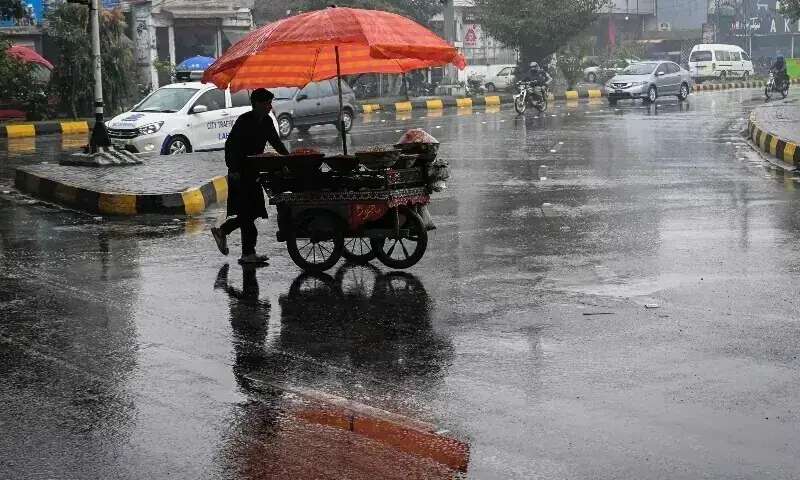
RAWALPINDI/LAHORE/KARACHI: Pakistan is confronting a stark weather dichotomy this week, as extreme heat scorches southern parts of the country while central and northern regions brace for widespread dust storms, rain, and potential landslides triggered by an incoming weather system.
The Pakistan Meteorological Department (PMD) said that a fresh westerly wave is expected to approach the northwestern parts of the country on Saturday evening and would persist in the upper regions until May 5.
In sharp contrast, extreme heat has gripped much of Sindh. In Karachi, the maximum temperature is expected to rise to 39 degrees Celsius over the weekend, according to Chief Meteorologist Ameer Hyder.
Across the large swathes of Khyber Pakhtunkhwa, the fresh westerly weather system is forecast to bring dust-thunderstorms and rain, with isolated heavy falls and hailstorms.
Chitral, Dir, Swat, Kalam, Shangla, Buner, Kohistan, Malakand, Battagram, Mansehra, Abbottabad, Balakot, Haripur, Mardan, Nowshera, Peshawar, Bajaur, Mohmand, Orakzai, Khyber, Swabi, Charsadda, Kohat, Kurram, Hangu, Karak, Bannu, Lakki Marwat, Tank, Dera Ismail Khan and Waziristan are expected to witness thunderstorms, rains and hailstorms under the influence of the westerly wave from Saturday evening till Monday.
In Punjab and the federal capital, a similar weather pattern is forecast for the same period. “Dust-thunderstorm/rain with isolated hailstorm is expected in Murree, Galiyat, Islamabad/Rawalpindi, Attock, Chakwal, Jhelum, Khushab, Sargodha, Mianwali, Bhakkar, Faisalabad, Sahiwal, Jhang, Lahore, Gujranwala, Sialkot, Narowal,” the Met Office said.
Southern Punjab districts, including Dera Ghazi Khan, Multan, and Rajanpur, are expected to witness rain-windstorms on May 3 and May 4.
The approaching system is also likely to affect Gilgit-Baltistan and Kashmir from the night of May 2 until May 5, bringing rain and wind-thunderstorms to Diamer, Astore, Skardu, Hunza, Neelum Valley and Muzaffarabad.
Parts of Balochistan, including Quetta, Ziarat, and Zhob, are also expected to see windstorms and thunderstorms from May 2 to May 4, while a dust-thunderstorm is predicted for upper Sindh on May 2 and May 3.
PDMA issues alert
Following the forecast, the Provincial Disaster Management Authority (PDMA) in Punjab issued an alert, directing the deputy commissioners of all respective districts to remain vigilant to address any “untoward situation” during and after the rains.
Both the PMD and PDMA have issued specific warnings and advisories. Authorities cautioned that windstorms, hailstorms, and lightning could damage weak structures such as electric poles, billboards, and solar panels.
Landslides could also take place in the “vulnerable areas of upper KP, Gilgit-Baltistan and Kashmir on May 3 and May 4”, PMD said.
Farmers have been advised to manage their crops according to the weather conditions, as hailstorms and windstorms pose a threat to standing crops, particularly in KP and upper Punjab.
Moreover, the PMD has advised tourists and travellers to “remain extra cautious and avoid unnecessary travelling” during the forecast period. All relevant authorities have been instructed to remain on high alert and take necessary measures to prevent any loss of life or property.
Sindh districts sizzle at 46.5°C
Meanwhile, extreme heat has gripped much of Sindh, with the PMD reporting that the cities of Shaheed Benazirabad, Sakrand and Dadu topped the heat charts at 46.5 degrees Celsius on Friday. This was above the normal temperature by 2.8 degrees Celcius in Shaheed Benazirabad, 4.3 degrees Celcius in Sakrand and 3.8 degrees Celcius in Dadu.
In Hyderabad, temperatures crossed the 45 degrees Celcius mark. Meanwhile, Jacobabad hit 45 degrees Celcius.
Officials warned that the persistent heatwave could continue and urged residents to limit outdoor activity, stay hydrated and take precautions against heat-related illnesses.
As for Karachi, the city has seen a continued increase in daytime temperature over the week: from 35.2 degrees Celsius recorded on Wednesday to 36.1 degrees Celsius on Thursday and 37.5 degrees Celsius on Friday. “Over the next two days (Saturday and Sunday), we are expecting that it may go up to 38 to 39 degrees Celsius,” said Chief Meteorologist Ameer Hyder.
He said there was little chance of rain in the city before the monsoon.
Hyder called for conducting studies on the factors contributing to hot weather conditions in Karachi. “The most important one is the continued loss of green cover. The city has turned into a concrete jungle, and new plantations are hardly seen.”
The PMD noted that while neutral conditions persist for El Nino Southern Oscillation and Indian Ocean Dipole, most global models suggest El Nino conditions are likely to emerge, with a 61 per cent chance, during the May-July period.
This could have further implications for weather patterns in the region, which typically sees its hottest months in May and June when temperatures in heat-prone areas can soar up to 52 degrees Celcius.
El Nino is a naturally occurring climate phenomenon that warms surface temperatures in the central and eastern equatorial Pacific Ocean. It brings changes in winds, pressure and rainfall patterns.