LAHORE:
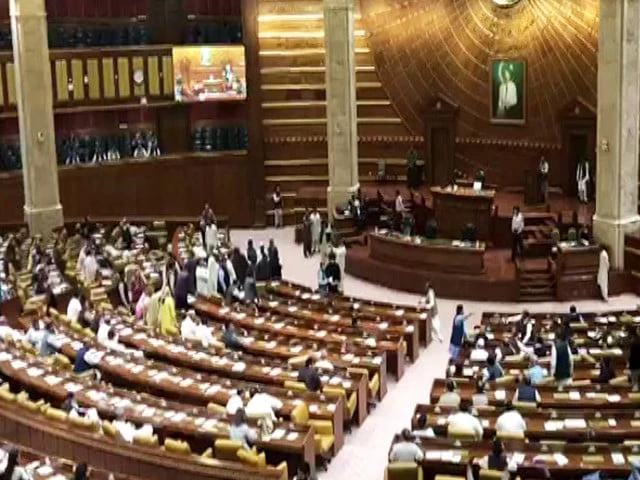
The provincial assembly of Punjab on Monday passed the Punjab Anti-Terrorism (Amendment) Bill, 2026 amid protests and a walkout by opposition lawmakers.
During the session, Punjab Assembly Speaker Malik Muhammad Ahmad Khan and Opposition Leader Moin Riaz Qureshi held a heated debate over the new legislation’s legal and constitutional implications.
Addressing the house, the speaker issued a ruling confirming that the bill could legally be placed on the agenda, citing Article 142 of the Constitution concerning criminal-law jurisdiction.
Defending the move, the speaker recalled how terrorism claimed more than 100,000 lives in Pakistan during the war on terror, including those of high-profile figures, and led to attacks on places of worship.
He argued that, in the past, terrorists often walked free due to a lack of witness protection and physical security. He noted that even democratic nations such as the US have established “faceless” or anonymous courts to deal with extreme terror threats, urging the opposition to propose constructive amendments rather than block the bill.
Qureshi condemned the “draconian” law, which he claimed aimed at “crushing the citizens of Punjab”. He accused the ruling government of introducing the amendment to target political rivals, particularly PTI leaders and activists, much like previous defamation and National Accountability Bureau laws.
He raised concerns about a provision under which a Grade-20-designated official would have the authority to advise the chief justice of the Lahore High Court on whether cases should be classified as “special security cases”.
Joining the debate, opposition lawmaker Ahmar Rashid Bhatti read out on the floor of the House an opinion column he had written for a daily newspaper, comparing the proposed law to a 1909 British colonial-era act that Quaid-e-Azam Muhammad Ali Jinnah opposed.
He warned that allowing the identities and voices of judges, prosecutors, defence lawyers and witnesses to be concealed or altered would violate Article 10-A of the Constitution, which guarantees the fundamental right to a fair and transparent trial.
Following the intense debate, opposition members chanted slogans against the bill and walked out of the hall. As they exited, lawmaker Waqas Mann pointed out a lack of quorum, but the treasury benches successfully rallied enough members to maintain it.
With the opposition absent, their proposed amendments were rejected, and the House voted to approve the Anti-Terrorism (Amendment) Bill, 2026.
The bill seeks to insert a new Section 21AAA into the Anti-Terrorism Act, 1997, creating a “special security case” mechanism for cases in which participants are considered to require extraordinary protection.
Under the proposed law, a designated authority — an officer of at least BS-20 whose identity would itself remain confidential — could declare a case or a class of cases a special security case. At the authority’s request, the LHC chief justice would assign the case to an Anti-Terrorism Court judge.
The bill also proposes that the identities of judges, public prosecutors, defence counsel, police officers, witnesses and other persons involved in such proceedings “shall not be disclosed”.
Judicial orders would carry official titles instead of the judges’ names, while witnesses would be identified through codes issued by the designated authority.
The proceedings could be held at secure premises or conducted through video links, including from prisons. The proposed provision would also allow the government to adopt other security measures it considers appropriate.