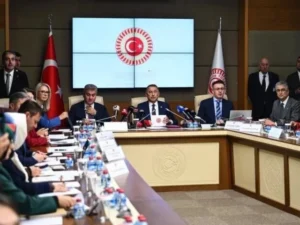

Adviser to the Prime Minister on Political Affairs Rana Sanaullah on Saturday said the debate over the creation of new provinces should take place in Parliament and a referendum could be held with the approval of the legislature.
Speaking at a press conference in Lahore, Sanaullah said, “The decision of whether any province will be created or not will be made in Parliament, and by Parliament,” adding that if a referendum were to be conducted to seek public opinion, it would also require approval by the National Assembly (NA) under Article 48 clause six of the Constitution of Pakistan.
Two days earlier, Parliamentary Affairs Minister Dr Tariq Fazal Chaudhry had said that the debate on forming new provinces would be held in the next session of the NA and the Senate in October. The debate was sparked across the country after Interior Minister Mohsin Naqvi said the administrative system had collapsed and there was a need for the creation of new units. The suggestion has resulted in widespread opposition from different parts of the country.
“The outcome will also emerge in Parliament,” he emphasised.
He opined that the matter could be resolved in a proper manner if all the political parties and provincial leaders deliberated on it.
Sanauallah also revealed that intra-party discussions were underway to determine PML-N’s unified stance on the formation of new provinces.
He said the PML-N would participate in the debate when the issue was brought up for discussion in Parliament and that Prime Minister Shehbaz Sharif would also express his views on the floor.
Sanaullah said that statements and speeches on the issue through different forums had not helped improve the situation and that the matter should be taken to the lower house for deliberation. He also stated that the matter was not fit for discussion on an economic forum.
“When this debate comes to Parliament, all parties will be able to present their positions,” he added.
He said that if he himself declared that provinces would or would not be created, he would be bypassing Parliament.
Sanaullah said the Pakistan Peoples Party (PPP) had “overreacted” to the issue, adding that no federal minister had so far raised the matter in the cabinet or Parliament.
Read: Referendum to decide creation of new provinces
Speaking about the strain in ties between the PPP and PML-N, Sanaullah said the bitterness between the parties developed during the Azad Jammu and Kashmir elections had considerably decreased.
He said a recent bi-party meeting was attended by senior leadership from the PPP and PML-N in the governor's house today.
“An understanding has been reached between them.”
He suggested that such meetings should ideally be held every month, and that the latest meeting had taken place after a gap of two to three months.
When probed about his views on Jamaat-e-Islami’s protest over petrol prices, Sanaullah said, “The prime minister wants petrol prices to decrease more than Jamaat-e-Islami does.”
However, he noted that sit-ins and long marches are within constitutional and legal bounds and hoped the political activities would remain peaceful.
“They have never been violent during their political activities.”
He revealed that the government had requested the party to postpone the protest for “two weeks” during a meeting that took place yesterday.
Sanaullah urged Jamaat-e-Islami not to put itself in a difficult spot.
Read more: Debate on new provinces to be held in next session of National Assembly, Senate in October: Tariq Fazal
“The government is considering ways to offer relief to the public in the form of subsidies or other methods,” he said during the presser.
Reiterating the explanation given by Petroleum Minister Ali Pervaiz Malik regarding escalating petrol prices, Sanaullah said the increase in prices of petroleum products was a consequence of the US-Iran war. He said the country has pushed for a diplomatic resolution of the conflict.
Referring to statements given by certain elements in the PTI about going to Islamabad and bringing down the system, he said there were also reports that some people attending the gathering could be armed. He said people involved in terrorist activities in Balochistan and Khyber-Pakhtunkhwa also intended to take advantage of the unrest.
“Those whose intentions are not peaceful must be stopped by law-enforcement agencies.”
Speaking on intra-party matters, Sanaullah said a meeting of the Punjab PML-N wing had been called during which inactive office-bearers would be replaced and vacant positions filled.
He said the process would be completed within the next 30 days.
Sanaullah also revealed that the Punjab government was planning to conduct local government elections.
Division or devolution of power?
“The system we are living under has collapsed.”
With these words, Interior Minister Mohsin Naqvi reopened one of Pakistan’s most politically sensitive debates: whether the country’s governance structure has become too centralised, too unwieldy and too distant from the people it is supposed to serve. Speaking at the Pakistan Economic Summit in Islamabad towards the end of July, Naqvi argued that Pakistan’s existing administrative model had failed to deliver basic services, timely justice and meaningful economic opportunities, and called for a serious discussion on creating new administrative units or provinces.
Naqvi’s argument is not simply about drawing new lines on a map. At its core is the question of whether a country of Pakistan’s size and population can continue to be governed through a structure in which political, administrative and financial power remains concentrated in a handful of provincial capitals. He contended that decentralisation could bring decision-making closer to citizens, improve service delivery and create space for new leadership.
A week ago, Naqvi proposed to take the debate over new provinces or administrative units directly to the public. He said that the government had failed to deliver basic amenities to the public, including education, potable water, healthcare and other services. Therefore, he asked the stakeholders to decide on the issue while remaining within the constitutional framework.
The Sindh Assembly, however, rejected the proposal to divide the province and reaffirmed its opposition to any such alteration in Sindh’s territorial limits. The resolution passed by it argued that any restructuring of the federation must respect constitutional procedures, democratic consent and the will of the people of the province.
Also Read: ‘Sindh is one, shall remain one’: Assembly passes resolution against division of province
The resistance illustrates why the provinces question is considerably more complicated than an administrative exercise.
MQM's Mustafa Kamal, who leads the health ministry at the centre, has avidly shown his interest in carving out provinces from Sindh. Before Naqvi's speech, Kamal had floated the idea of Sindh's division, which was met with strong opposition. He remains one of the greatest flag-bearers of the movement.
On September 7, PTI Chairman Barrister Gohar Ali Khan, whose party governs K-P, also cautioned that an attempt to divide Sindh and other provinces without the consent of the people would weaken the federation and urged political entities to avoid taking decisions on new provinces' creation in haste.
Yet creating new provinces would itself require a demanding constitutional process. Legal experts cited by The Express Tribune have pointed out that a public vote alone cannot create a new province. Any change affecting provincial boundaries must comply with the constitutional amendment procedure, including the required approval of the relevant provincial assembly. A referendum could potentially provide democratic legitimacy, but it would not replace the constitutional mechanism.
The debate, therefore, is ultimately about more than the number of provinces Pakistan should have. It is about how power should be distributed between the federation, provinces and local governments — and whether citizens should have greater control over the institutions responsible for delivering services to them.
In view of the constant back-and-forth between political parties on the issue at different forums, two days ago, Parliamentary Affairs Minister Dr Tariq Fazal Chaudhry said that deliberations on forming new provinces would be conducted in the next session of the Parliament and the Senate in October.