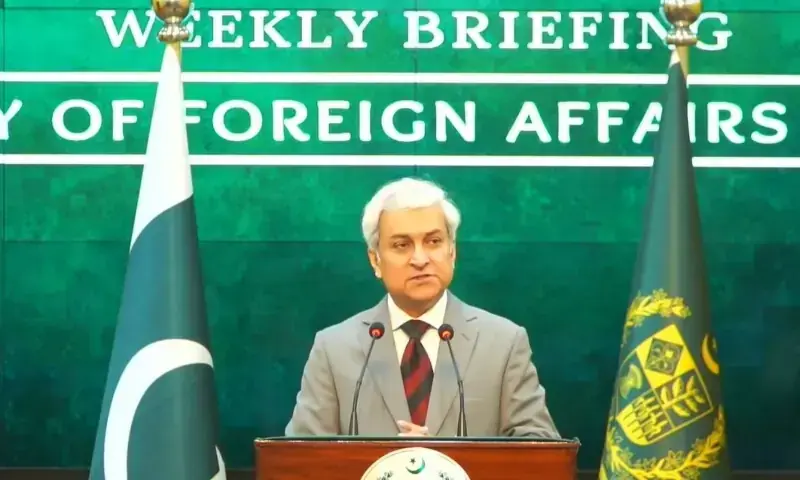
Foreign Office (FO) spokesperson Tahir Andrabi said on Thursday that Islamabad was hopeful about and would expect an agreement between the US and Iran “sooner rather than later”.
He said this during a weekly briefing, where he was asked how soon could the agreement be expected.
“You have asked us how soon we can expect an agreement. We remain optimistic. A simple answer would be that we expect an agreement sooner rather than later. We hope that the parties will come to a peaceful, sustainable solution and bring peace, not just to our region but internationally as well,” he said.
In this regard, Andrabi also said Pakistan would welcome a settlement between Iran and the US wherever it may be reached.
“If an agreement is reached in Pakistan, it would be an honour for us,” he said.
The FO spokesperson also said he could not say whether the draft of the agreement would be one page or longer.
Asked whether the US government could be under pressure to end the war due to the upcoming mid-term elections, Andrabi said: “We want a peaceful settlement, a peaceful solution, irrespective of what the causes are or and how the countries are compelled to reach a diplomatic solution. So, I think let’s not focus on the causes but focus on the effect. And the effect should be that there is peace, there is a peaceful settlement – we hope for that effect to take place.”
Andrabi’s remarks came after the US and Iran seemed to inch toward a peace deal on Wednesday. There were reports that Tehran was reviewing a fresh proposal from Washington for a peace following the suspension of ‘Project Freedom’ launched by the US to open the Strait of Hormuz.
The FO spokesperson recalled in his weekly briefing the Prime Minister Shehbaz Sharif had welcomed the “timely announcement” regarding the pause in ‘Project Freedom’ and noted that Pakistan remained firmly committed to supporting all efforts that promoted restraint and the peaceful resolution of conflict between the US and Iran through dialogue and diplomacy.
He added that PM had also expressed the hope that the “current momentum” would lead to a lasting agreement that would secure durable peace and stability for the region and beyond.
Andrabi further stated that “working with the same spirit of optimism and positive engagement”, Deputy Prime Minister and Foreign Minister Ishaq Dar had remained in contact with his counterparts throughout the last week in an effort to pursue peace, diplomacy and a peaceful settlement between Washington and Tehran.
The latest episode of hostilities between the two sides began with more than two months ago when the US and Israel launched strikes in Iran on February 28.
While a deal for a complete end to the war is yet to happen, the hostilities have been largely ceased since a the two sides agreed on a Pakistan-brokered ceasefire on April 8.
Following the ceasefire, a first round of historic direct US-Iran talks was held in Islamabad on April 11 and 12, with Pakistan playing the role of a mediator. The talks had ended without an agreement, but also without a breakdown.
With challenges in convening a second round, Islamabad has shifted back to its role as a facilitator and go-between.
But, there were some positive signals on Wednesday, with Trump saying he had had “very good talks” with Iran over the past 24 hours. Meanwhile, Tehran appeared receptive to the fresh US proposal to end the war, saying that it was reviewing the agreement and a response would be relayed to Washington via Islamabad.
US news outlet Axios also claimed that Washington and Tehran were close to agreeing on a one-page memorandum of understanding to end the war and “set a framework for more detailed nuclear negotiations”.
Among main issues that remain a sticking point between the two sides are unrestricted navigation through the Strait of Hormuz and Washington’s demand for long-term commitments on Iran’s nuclear programme, including constraints on enrichment and safeguards against weaponisation.
Repatriations from Cambodia
During today’s briefing, the FO spokesperson also addressed the detention of 54 Pakistanis in Cambodia following a raid on a scamming compound.
Earlier, it was reported that more than 200 Pakistanis were in the custody of Cambodian police in overcrowded facilities and facing a lack of basic facilities.
Andrabi said emergency travel documents had been issued to the detained individuals after ascertaining their nationalities.
“On our embassy’s request, the host authorities allowed all 54 individuals to travel back to Pakistan. And as of today, I understand 49 individuals have returned and three are being are processed. And I understand this complete repatriation will take place soon,” he added.
He also said that 85 Pakistanis had been detained in Kampala, Uganda on April 27 by immigration authorities for “engaging in unauthorised employment while on visit visas”.
“It was established that these individuals had been working for approximately four months with unregistered online companies,” he said, adding that sentences awarded to the detainees had been waived following the Pakistan embassy’s intervention.
But a fine of $400 had been imposed on each of those individuals for violation of visa conditions, Andrabi added.
He said all 85 of those individuals had been repatriated to Pakistan.
Reports of deportation from UAE
The FO spokesperson was also asked about the “unusually high number” of emergency exit documents (ETD) or outpasses being issued by the Pakistani consulate in the United Arab Emirates.
To that, Andrabi replied: “Yes, these ETDs were issued, mainly driven by administrative actions, including immigration status violation and other legal infractions. The Consulate General in Dubai, for example, I can tell you, issued around 2,714 emergency travel documents, while the embassy in Abu Dhabi issued 780 of those, between January to April 2026.
“So this was the four-month record. I can further tell that deportation basically prompted by a royal court pardon on Eid enabled the release and repatriation of jailed individuals. So this (deportation) took place as a result of our royal pardon to some of these individuals who were held in prison.”
When asked to confirm whether the Pakistani authorities had made inquiries to the Emirati officials and law enforcement agencies about those reports of expulsions, he said: “Our embassy is in touch with the UAE authorities. Our mission has also ensured that in the wake of the hostilities in the Gulf region, and in the wake of very serious armed attacks against the UAE, which we have condemned, our community fully complies with the local laws, with the local instructions.”
He said the Pakistani community, by and large, except for maybe one or two few sporadic cases, had been cooperating with the local authorities in the UAE.
“So, I think this is what the status is. The Ministry of Interior and relevant departments are also seized of this matter (repatriation). This matter is proceeding as per law. I do not see any political reason for their deportation. These are primarily legal cases, which are being taken care of, both by our diplomatic missions in UAE as well as by the UAE authorities.”