
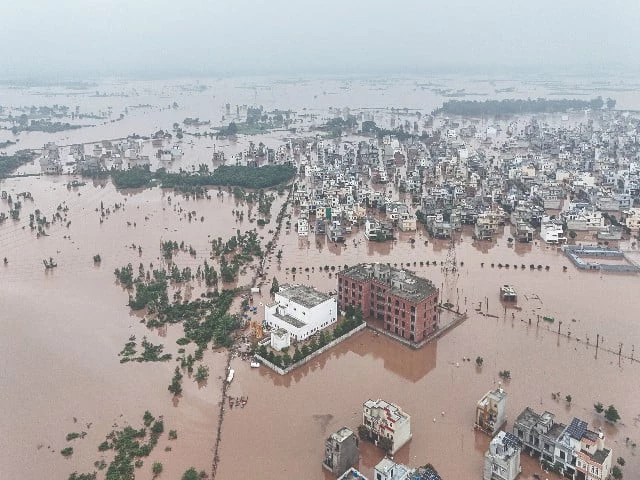
Intense rainfall in the mountainous regions can trigger sharp rises in rivers, streams and seasonal nullahs
This aerial view shows partially submerged residential buildings following the overflowing of the Ravi River in Lahore. Photo: AFP
The National Emergency Operations Centre (NEOC) of the National Disaster Management Authority (NDMA) warned on Thursday of a potential flood situation over the next 72 hours as heavy rain, thunderstorms and strong winds were expected across Gilgit-Baltistan, Azad Jammu and Kashmir, and upper Khyber-Pakhtunkhwa, prompting authorities to remain on high alert and take precautionary measures to protect vulnerable communities.
According to the latest NEOC alert, intense rainfall in the mountainous regions could trigger sharp rises in rivers, streams and seasonal nullahs, while landslides, flash floods and debris flows might pose additional risks in vulnerable areas.
Gilgit, Diamer, Ghizer, Hunza, Astore, Skardu and Shigar were among the areas facing the possibility of sudden flooding. In AJK, vulnerable areas included Bagh, Poonch, Muzaffarabad, Haveli, Bhimber, Sudhanoti, Mirpur and Kotli.
In K-P, Chitral, Dir, Swat, Bajaur, Mohmand, Shangla, Battagram, Kohistan, Mansehra, Abbottabad and Haripur might also experience sudden flooding following intense rainfall.
Read: Heavy rain, landslides feared across northern areas: NDMA
The weather system could also trigger urban flooding in Nowshera, Peshawar, Swabi and Mardan, with low-lying areas and connecting roads particularly vulnerable to inundation.
The NEOC forecasted increased flows in the Indus, Kabul, Swat, Panjkora, Kurram, Tochi, Jhelum, Chenab and Ravi rivers during the next 72 hours.
Rising water levels were also expected at several points along major rivers and adjoining streams and nullahs.
In Rawalpindi and Islamabad, rainfall could cause a significant surge in the flow of Nullah Lai, raising the risk of flooding in low-lying localities.
Relevant authorities were directed to remain vigilant and ensure timely preventive measures.
The NDMA placed particular emphasis on preparedness in mountainous areas, where monsoon rains could rapidly trigger landslides, debris flows and flash floods.
Local administrations were instructed to pre-position essential resources in vulnerable locations and keep safe evacuation arrangements ready.
The authority also advised residents, tourists and travellers in flood-prone areas to stay away from riverbanks, streams, seasonal waterways and other vulnerable locations.
Unnecessary travel should be avoided, particularly during periods of intense rainfall.
ممکنہ سیلابی صورتحال — آئندہ 72 گھنٹوں کے لیے الرٹ
نیشنل ڈیزاسٹر مینجمنٹ اتھارٹی (NDMA) کے نیشنل ایمرجنسیز آپریشن سینٹر (NEOC) نے آئندہ 2 سے 3 روز کے دوران ممکنہ سیلابی صورتحال کے پیش نظر الرٹ جاری کر دیا ہے۔
🌧️ گلگت بلتستان، آزاد کشمیر اور خیبر پختونخوا کے بالائی علاقوں میں تیز… pic.twitter.com/xJxMF7Coo5— APP (@appcsocialmedia) September 3, 2026
The NDMA cautioned the public against attempting to cross flooded roads, bridges, nullahs or fast-moving water either on foot or in vehicles.
Even shallow but swift-moving water could be powerful enough to sweep away people and vehicles.
Travellers were advised to check the latest weather forecasts and road conditions before setting out.
People were also urged to avoid roads closed by the administration and strictly follow traffic and safety advisories.
The NDMA said it was maintaining continuous coordination with relevant authorities and providing timely information, forecasts and early warnings to facilitate proactive response and minimise the impact of possible flooding.
The public had been advised to monitor official weather updates and district administration instructions and use the Pak NDMA Disaster Alert app for timely alerts.
In case of a flood emergency, citizens were advised to dial 911 for assistance.