• Punjab CM tells Baku summit about $2bn urban development plan
• Says Lahore declared ECO Tourism Capital for 2026-27
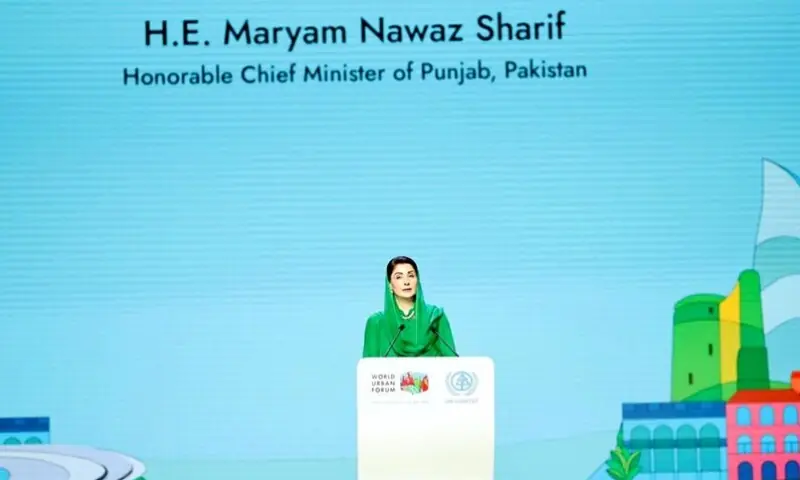
LAHORE: Punjab Chief Minister Maryam Nawaz on Monday addressed the World Urban Forum Leaders’ Summit in Baku, saying her province had launched an Urban Development Programme worth more than $2 billion aimed at rebuilding roads, drainage systems, water storage facilities, and urban resilience infrastructure.
“Cities become resilient only when development is people-centred, climate-conscious, and data-driven. Cities are not just roads and buildings — they are human stories where dignity is either protected or denied,” she said, adding that her government had launched the first province-wide door-to-door socio-economic data system of its kind.
“My government’s first priority was shelter. Under the flagship programme, Apni Chhat Apna Ghar, Punjab is delivering one of the fastest and largest affordable housing initiatives in the world through zero-interest loans. In less than a year, 160,000 families have received housing support, and more than 100,000 families have completed and moved into homes of their own,” she said.
She added that under the Model Village Programme, more than 2,000 villages were being transformed with clean water, sanitation, paved streets, and solar infrastructure.
“For the first time at this scale, Punjab is expanding clean drinking water infrastructure across urban and rural communities alike through new filtration systems, upgraded supply networks, and sustainable water solutions. No woman should have to walk miles carrying water for her family, and no child should suffer because of unsafe drinking water. Rural uplift is urban resilience,” she said.
Dressed in a green shalwar kameez, the chief minister further said that more than 30,000km roads had been constructed and completed, reconnecting communities and restoring mobility and economic activity within two years.
“Urban flood resilience is now being systematically strengthened across Punjab. After last year’s flooding, we immediately shifted towards flood-resilient infrastructure and climate-adaptive urban planning. This is the first time in decades that urban flooding is being addressed in a structured and data-driven way,” she said.
Under the “Magnificent Punjab” initiative, she said her government had undertaken a comprehensive revival of tourism, heritage, and cultural infrastructure across the province.
“More than 100 heritage sites, museums, archaeological landmarks, eco-tourism destinations, and religious sites are under renovation, restoration, preservation, and rescue, reconnecting our people with history, identity, and culture. Lahore, the cultural heartbeat of Pakistan, has been declared the ECO Tourism Capital for 2026-27,” she said.
The chief minister also informed the international audience about her government’s flagship project, Suthra Punjab, under which more than 150,000 sanitation workers were serving the province daily, making it one of the world’s largest solid waste collection programmes.
She said Punjab was building a clean mobility future with 1,100 electric buses introduced in the first phase and a target of 5,000 electric buses by 2029, alongside electric bikes and taxis.
She praised Azerbaijani President Ilham Aliyev for his vision of sustainable development and resilient cities, saying his leadership had transformed Baku into a modern, vibrant, and globally connected city.
Published in Dawn, May 19th, 2026