
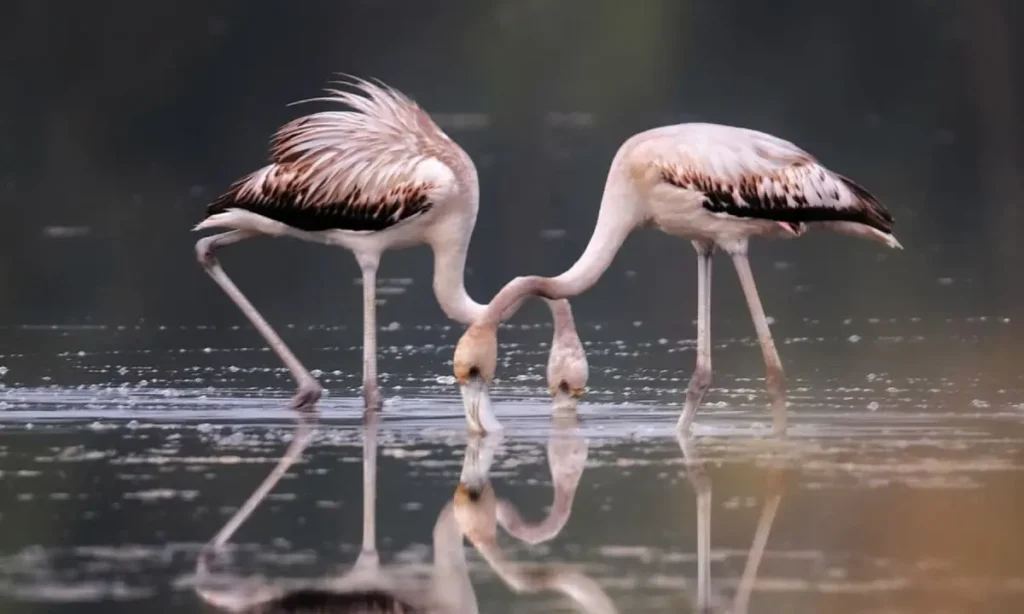
A flock of greater flamingos has returned to South Punjab after 50 years, bearing news worth investigating
It happened on a hot July morning. With a group of researchers, I set out for a routine wildlife survey half an hour’s drive from Muzaffargarh, in the sprawling wetlands of South Punjab. The vital but fragile lowland ecosystem is made up of 18 interlinked saline and freshwater lakes, river floodplains, oxbow lakes, and seasonal marshes.
Here, 45km west of Multan, the Indus River gets to catch its breath after cascading steep glaciers and alpine lakes. As its flow turns leisurely in the alluvial plains, the river turns into an indispensable sanctuary for foreign and local feathered friends like wintering waterfowls, waders, raptors, and divers.
But on that hot July morning, this ecological treasure, the Rangla Wetland Complex, was chosen as the laboratory for a marvelous collusion of science and nature: the pink birds had returned after nearly half a century. And this time, they had brought their babies. It was a family affair.
The 43-member flock of greater flamingos waded through the brackish shallow waters of the complex, showing off their lean, curved necks and black-tipped bills. The red in their wings woke as they flew over us—fire caught mid-crackle, briefly bared.
While a fraction of the group was adults, the overwhelming majority was sub-adults and juveniles, the youngest member estimated to be no more than six months old, still showing pale grayish brown down—a giveaway of early fledging—splashing close behind the parents.
Behold the implausible!
It has always been that the tourist flamingos begin arriving in Pakistan’s southern coastal mudflats and inland wetlands late autumn, to escape the gulag of winters of Central Asia and the Siberian tundra. The 4,500km-long journey over what we call the ‘Indus Flyway’ is long and tiring, requiring flight over the lofty Karakoram, Hindukush, Sulaiman ranges. As spring arrives, these pink birds prepare for their return—once again an arduous voyage back north.
To even attempt such a flight, the flamingos require maturity and strength, which comes with time, for all earthlings alike. It typically takes these rosy chicks three to five months to grow their flight feathers and learn to fly, making them ready to migrate with the flock.
And so, to watch them flap along the bed of a lake in Muzaffargarh was, in all honesty, not what we had expected when we set out at 5:30am. The biological and physiological implausibility for chicks of this age to have completed a gruelling migration stretching across thousands of miles left us stunned. It was impossible.
So, what’s really going on?
The news soon travelled to the city, and subsequently to the circles of dedicated birders and wildlife lovers, where hypotheses began circulating, one after the other, before all of them reached a consensus: these flamingos are not long distance migrants at all, they are local breeders.
This is the theory: a resident or semi-resident population of greater flamingos has quietly established a secret winter breeding colony within an isolated, undisturbed wetland in Pakistan. Flamingos are notoriously sensitive, highly colonial nesters that require extremely specific, undisturbed conditions—typically remote mudflats or inaccessible saline islands surrounded by shallow water—to build their conical mud nests and incubate their eggs without threat from land predators or human intrusion.
Once the young hatch and learn to fly, these birds do not stay in one place. Driven by an insatiable appetite for specialised aquatic nutrients, the flock embarks on localised movements. Flamingos feed primarily by filter-feeding on microscopic organisms, small aquatic insects, and crucially, Artemia (brine shrimp) and other rich crustaceans. The Muzaffargarh wetland complex offers an abundant, self-sustaining buffet of Artemia across its saline basins, and serves as an ideal foraging stopover for the nomadic flock moving between regional water bodies.
Enter science
This discovery arrives at a critical moment for the aquatic ecosystem of South Punjab.
Historically, saline lakes of Muzaffargarh have suffered from heavy anthropogenic (or human made) pressure. Years of uncontrolled hunting, opportunistic egg collection, agricultural run-off, and encroachments have severely degraded fragile littoral zones—the shallow, shore-hugging margins where these lakes meet land.
Despite community-led conservation and local awareness efforts, the delicate balance of nature that protects the rivers, lakes, oceans, and their inhabitants remains perpetually at risk.
Therefore, when we spotted the breeding-age juveniles on that hot July morning, our core belief as environmentalists was reinforced yet again: nature is not a place to visit; it is home, and homes are to be guarded. The gray and chonky chicks, wobbling in the shallow waters of Muzaffargarh with oversized legs, squealing for food, are to be guarded, even when little is known about their hidden micro-habitats.
Protecting the birds is only half the battle, though. We must first protect their habitats. If their pristine and undiscovered nesting sites elsewhere in the country are destroyed, for whatever reason, the entire population could collapse.
More than just an expedition
To prevent this, ecologists are urging provincial wildlife departments and research institutions to move beyond simple visual surveys and embrace current conservation technology. We need a complete picture of their movement patterns, for which the immediate priority must be a scientific capture-and-release programme, one of them said.
By safely trapping a few of these juveniles and fitting them with lightweight leg rings and solar-powered satellite transmitters, we can track their real-time telemetry. Satellite tagging would allow researchers to trace the precise flight paths of the flock as they navigate between Punjab’s riverine systems and saline basins, ultimately leading scientists straight to their hidden, undisturbed breeding grounds. Once found, these critical nesting sites can be designated as protected sanctuaries, shielded from human disturbance, poaching, and developmental encroachment.
Birds do not need border maps or navigation apps; they rely on water, earth, wind, stars, seasons, and memory passed down through generations. The unexpected return of greater flamingos to the flat plains between the Chenab and Indus rivers is more than a bird-watching expedition on a hot July morning—it may be a quieter signal of a climate, and a map that’s shifting under them.
Header: A pair of flamingos drink water by a lake in South Punjab. — all photos by author