Dawn CEO Nazafreen Saigol Lakhani says climate change is a threat to Pakistan’s economic stability.
The second edition of The Breathe Pakistan International Climate Change Conference, organised by DawnMedia, is currently underway in Islamabad.
Despite contributing minimally to global emissions, Pakistan remains among the most climate-vulnerable nations, underscoring the critical need for coordinated, locally grounded, and globally informed responses.
The two-day conference brings together policymakers, experts, and stakeholders from across sectors to examine intersecting challenges and chart a path forward.
The first edition of Breathe Pakistan sparked national dialogue and global collaboration around vital climate challenges — from climate justice and finance to renewable energy transitions, disaster risk reduction, and inclusive public-private partnerships.
View the full agenda here.
11:58am — Intensity of 2025 floods ‘much larger’ but govt deemed int’l aid not needed: Aurangzeb
Speaking about what his ministry could do regarding climate change, Aurangzeb underscored the importance of macroeconomic stability, terming it as necessary as “basic hygiene”.
He mentioned the disastrous floods of 2022, as well as 2025, adding that “this time around, the intensity was much larger” as three rivers and almost the entire country were facing floods.
The minister noted that despite demands to seek international funding, the government decided not to, as it deemed there was “fiscal buffer and fiscal space available”.
“Let’s first use the funds which are available now and put them to good and effective use,” he said.
11:50am — Aurangzeb warns against climate change ‘remaining academic discussion’
Finance Minister Muhammad Aurangzeb stressed the need for all ministries to work together and bring the climate change discourse “into the mainstream”, otherwise it would “remain an academic discussion”.
“It is quite clear that we have to work very closely with our counterparts, ministers of climate change, planning ministry, we need to take a whole of government approach,” the finance minister said.
He asserted that Pakistan was now in a “very very good place”, hailing the NDMA’s work and highlighting that “AI-led early warning systems” were in place.
The minister noted that the country now had “very scientific data” available about what actions were ought to be taken.
11:42am — World Bank official explains climate financing
Adeel Abbas, senior climate change specialist (Regional Climate Lead) at World Bank Group, presented global statistics on climate financing.
He noted that combatting climate change was a collective responsibility, stressing the need to bridge the “huge financing gap”.
Explaining what climate financing comprises, Abbas noted the “innovative instrument” of using revenues from carbon finance.
“While we say $6.3bn are required for climate, we know that there are more than $28 trillion invested last year in long-term structure financing. So those resources are there in the global economy,” he noted.
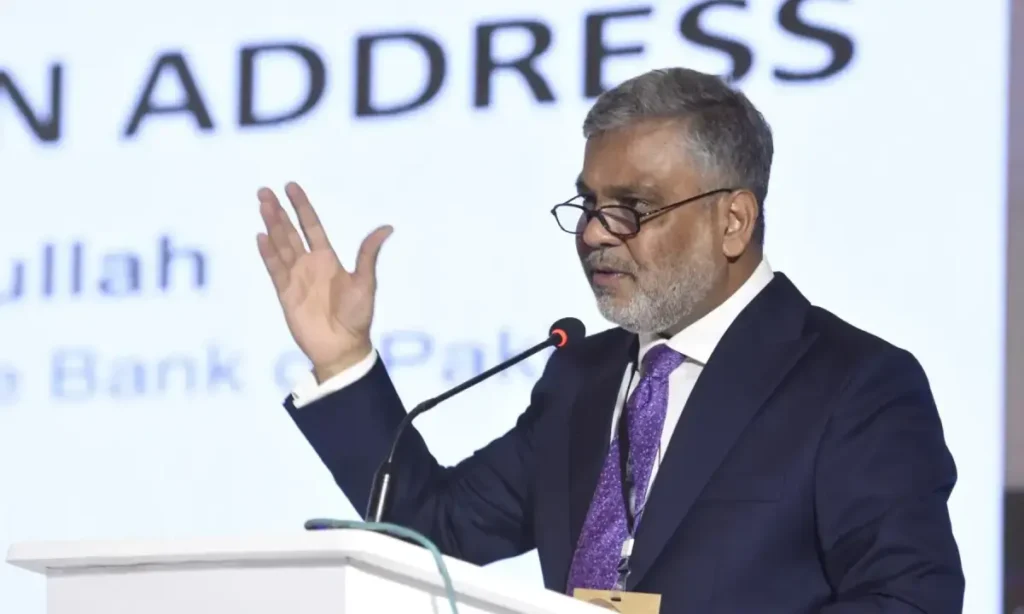
11:30am — Over $550m needed for ‘very ambitious plan’ to reduce emissions by 50pc: SBP official
SBP’s Saleemullah highlighted that heatwaves in Pakistan were intensifying, with temperatures above 50°C no longer being a rare event.
He noted that while the losses from the 2025 floods remained “relatively contained”, they displaced millions and caused great disturbance and losses.
He noted that Pakistan’s aim to reduce its greenhouse gas emissions by 50pc was a “very ambitious plan” that requires financing to the tune of more than $550m.
11:22am — Third session begins
The next session, titled “Mobilising Climate Finance for Pakistan” has begun.
Saleemullah, State Bank of Pakistan’s deputy governor, is addressing as the session chair.
11:15am — NDMA official stresses need for district-level action
NDMA official Idrees Mahsud, asked about synergy within the authority and other institutions, pointed out that the PDMAs were now working actively.
“Personally, I would like to see a dedicated department assisting the deputy commissioner or the district disaster management authority championing DRR and adaptation measures at the district level,” he added.
11:11am — ‘NDMA working on initiatives to make better mitigation decisions’
Idrees Mahsud highlighted that the NDMA has been working since 2007 on different initiatives, including multi-hazard vulnerability risk assessments, to better make decisions to mitigate the impact of those hazards.
He stressed that NDMA’s “prime importance” was building resilient infrastructure and community, along with other interventions.
11:05am — Pakistan doesn’t see adaptation, DRR as ‘very different’
Idrees Mahsud, member of the National Disaster Management Authority’s Disaster Risk Reduction unit, said Pakistan did not see “climate change adaptation and disaster-risk reduction as very much different”.
He said climate change adaptation “is actually disaster-risk reduction, mostly against hydrometeorological” hazards, adding that DRR, on the other hand, could be broader.
11:00am — Govt ‘very actively engaged’ with all provinces: official
Speaking during the session, Aisha Humera Chaudhry, secretary of the climate change ministry, said climate challenges have “forced us to choose between” disaster-risk reduction and adaptation.
She stated that adaptation has more than 170 actions, adding that the government was “very actively engaged” with all the provinces.
Chaudhry said district adaptation plans were the “main building blocks”, noting they included hazard mapping, which was important for disaster-risk reduction.
The official affirmed that Prime Minister Shehbaz Sharif was “regularly taking stock” of the steps, commending the level of seriousness of the leadership.
“Adaptation is an area where Pakistan is very seriously working,” she asserted.
10:52am — Climate change leading to ‘long-term developmental challenges’
Coco Ushiyama, country representative for the World Food Programme in Pakistan, noted that climate change was transforming disasters from emergencies to long-term developmental challenges.
“Adaptation and disaster-risk reduction need to come together, not just in theory but in practice,” she stressed, adding that much of the climate-related finance was “reactive”, mobilised after disaster struck.
Ushiyama also underscored the importance of governance and strengthened inter-ministerial coordination.
10:47am — Second session begins
Today’s second session, titled “Synergies Between Adaptation and Disaster Risk Reduction”, has begun.
10:38am — Youth can find the solution, says climate change minister
Speaking further, Musadik Malik noted that about two-thirds of Pakistan’s population comprised the youth.
He lauded the good education provided by several universities across Pakistan.
“It is their air. They are breathing; they will find the solution,” he said, contending that the youth could find innovative solutions to climate change.
“And what if they fail?” he added. The minister also floated the idea of a “green university” for conducting research in collaboration with Italian experts.
10:25am — Musadik Malik highlights impact of global emissions
Speaking on the impact of air pollution on life expectancy, Climate Change Minister Musadik Malik highlighted that Pakistan did not even contribute 1pc to global carbon dioxide emissions.
He further pointed out that 10 countries produced about 78pc of the global emissions, quipping that those facing the impact of climate change in Gilgit-Baltistan were not the ones responsible for it.
“Is this about rights or justice or political will, and even our political will, not just international?” he wondered.
10:17am — UN official says cost to build resilience is growing
Mohamed Yahya, the UN resident and humanitarian coordinator in Pakistan, has said that the cost to build resilience is growing and financing is “nowhere to be seen”.
He said that in the global debate, there was a tendency to frame countries like Pakistan as “victims of climate change”. He said that while it was true, Pakistan was also a “test case for solutions”.
“If progress is to be accelerated, especially in a country like Pakistan, it will send a powerful signal to the world,” he said.
10:14am — UN official says execution is major challenge to tackling climate challenge
Mohamed Yahya, the UN resident and humanitarian coordinator in Pakistan, in his keynote address, said that Pakistan has witnessed constant floods that cost billions of dollars. He said that the losses every year were probably equal to the IMF programme. He also pointed to the high temperature in Karachi on Monday.
“The constraints and the challenges overall is one of execution … we are seeing very little implementation,” he said.
10:05am — World Bank official recognises Pakistan’s efforts to tackle climate change
S. Adeel Abbas, the regional climate lead at the World Bank Group, has acknowledged the government’s commitment and policy toward tackling climate change.
“I work on 24 countries in the region on climate change. I think Pakistan is among one of those countries that have set the agenda right,” he said, calling for moving toward action.
He said that the World Bank was supporting various climate projects in Pakistan.
9:56am — Sherry Rehman asks why the cost of conflict is not being counted
“Why is the cost of conflict not being counted? That carbon footprint is missing,” PPP Senator Sherry Rehman said. She said that geopolitics was “devouring the future”.
9:53am — PPP Senator Sherry Rehman says conflicts are costing the environment
PPP Senator Sherry Rehman said that “conflicts are costing the environment much more than we know, compute or understand”. She said that there were more than 60 active conflicts in the world.
She also said that data on this was missing. She also said that there was very little discussion on the impact of these wars on the environment.
9:50am — PPP Senator Sherry Rehman highlights gap between action and ambition
PPP Senator Sherry Rehman, in her keynote address, said, “All state climate action … there is a splintered, fragmented movement”.
“While the global crisis is staggering, what is equally devastating is the state of the global movement itself. It is defunded and derided,” she said.
9:47am — Dawn CEO calls for shift in priorities at home
Dawn CEO Nazafreen Saigol Lakhani has called for shifting priorities at home.
“Pakistan must place far greater emphasis on adaptation,” she said, adding that this was not enough.
“At the global level, climate finance must be rebalanced to reflect the reality on the ground, not just global ambition. Adaptation needs to sit alongside mitigation, not behind it,” she said.
“At the same time, we must be disciplined in how we manage the energy transition. We need to scale renewables without constraining growth, invest in modernising our grid, and ensure that transition financing supports development rather than creating unsustainable debt burdens,” she said.
9:44am — Dawn CEO says urgency for Pakistan is immediate
Dawn CEO Nazafreen Saigol Lakhani has said that no single actor can address the challenge of climate change alone.
“Governments provide policy direction and frameworks. The private sector drives investment, innovation, and execution. Communities bring lived experience and accountability. Media plays a critical role in informing the public, shaping discourse, and holding all stakeholders accountable. Real progress depends on aligning these roles into a coherent whole,” she said.
“For Pakistan, this urgency is immediate, and it sits alongside deep economic and development pressures that are already shaping national priorities. Decisions made today on energy, infrastructure, agriculture, and urbanisation will define not just our climate resilience, but the direction of our economic future,” she said.
9:42am — Dawn CEO says climate change threat to Pakistan’s economic stability
“Pakistan is among the most climate-vulnerable countries in the world, facing increasingly severe floods, heatwaves, water stress, and dangerously poor air quality. These are no longer abstract risks or rare phenomena; they are recurring shocks,” Dawn CEO Nazafreen Saigol Lakhani said.
“Behind every statistic showing up on our screens are real lives. Farmers are losing entire harvests, families are forced to leave their homes, children are growing up in hazardous air, and communities are rebuilding after each disaster only to face the next one,” she said.
She said that climate change was not just an environmental crisis.
“It is a threat to Pakistan’s economic stability, public health, and the country’s development trajectory. And the burden is not shared equally,” she said.
9:40am — Dawn CEO delivers opening remarks
Dawn CEO Nazafreen Saigol Lakhani addressed the second edition of the Breathe Pakistan International Climate Change Conference. In her remarks, she said that the platform had grown into “an important space for dialogue, collaboration and action on one of the defining challenges of our time”.
“When we first convened this platform in 2025, we did so with a clear belief that climate change is no longer a distant threat. It is not a conversation for tomorrow. It is a lived reality for Pakistan, for South Asia, and for millions across the globe. Today, as we gather again, that reality has only intensified,” she said.
9:34am — 2-day conference begins
The two-day conference has officially begun. It is being held at the Sheesh Mahal Hall of Serena Hotel, Islamabad. The conference began with the national anthem and the recitation of the Holy Quran.