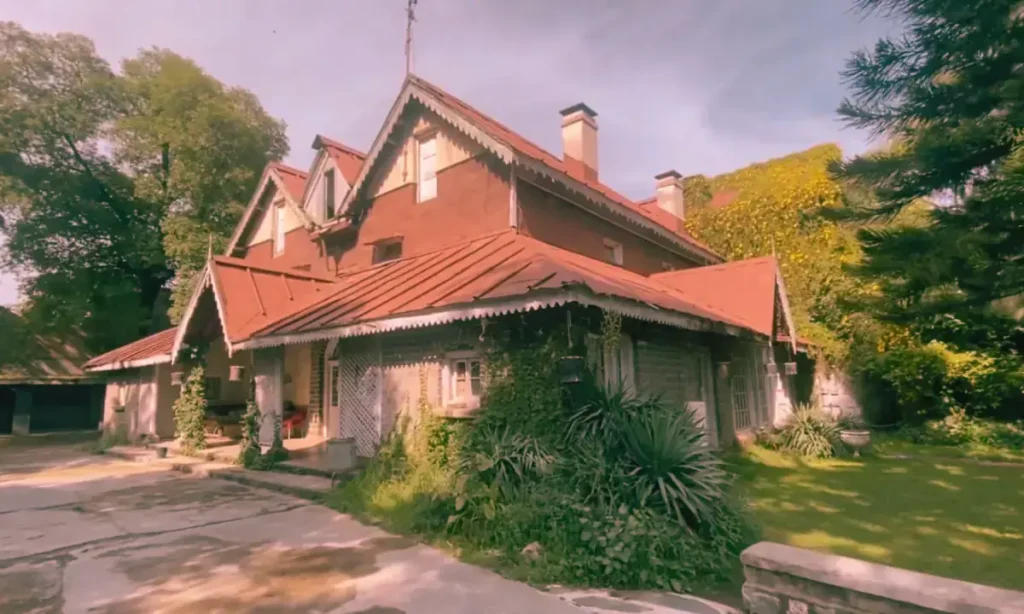
Shahzada House is the destination for a Bukhara legacy.
Abbottabad’s streets mostly dissolve into a mundane blur but Circular Road has a way of catching you by the sleeve. This stretch of town is as silent as silence allows, lined with government offices leaning into one another, until a weathered gate interrupts the monotony.
Behind its rusting iron, sits a house that doesn’t belong to the modern world. It is only when you begin to press the locals for answers that its name is spoken: Shahzada House.
It is a name that carries an old-world grandeur the hushed street can barely support, with its roots stretched across borders and centuries back to Bukhara.
A prince’s journey
The story of Shahzada House is one of a man in open rebellion. Mir Syed Abdul Malik Tura may now be a footnote in history, but he was once the North Star of Bukhara, an heir to a lineage entrenched in power and learning, one that traces its foundations to the Timurid Era, a golden age of culture and science in Central Asia and Persia.
His story is Bukhara’s. Records prove that the city was shaped over the course of many centuries and was heavily inspired by Persianate culture and Islamic scholarship before it emerged as a political centre. After Qutayba ibn Muslim conquered it in the 8th century, it flourished as a capital under the Samanids and was famed for its intellectual and architectural brilliance.
In a later phase, Bukhara became the seat of the Emirate of Bukhara, a political entity that materialised by the late 18th century and continued through the 19th under successive rulers. While the emirate retained internal authority, it faced the pressure of Russian expansion intensifying across Central Asia.
Bukhara attempted to resist Russian encroachment under Emir Nasrullah Khan. But when his successor, Emir Muzaffar bin Nasrullah, came to power, the geopolitical reality had pivoted. Russian advances had tightened their grip on Central Asia, leaving almost no room for defiance. In 1867, Muzaffar entered into a peace agreement with Russians.
The sovereign viewed this treaty as a necessary shield against imperial expansion, but little did he know that by inviting peace with his enemies, he was brewing a bitter rebellion at home. His eldest son, Abdul Malik Tura, interpreted the move as nothing short of a betrayal of their heritage and a complete, humiliating surrender. Tura mobilised resistance against his father’s rule with the backing of the emirate’s elite, including ministers who were uneasy with the growing Russian influence.
Emir Muzaffar had to ask the Russians for help because he could not quell the uprising alone. The response was swift and decisive. Military engineer Governor-General Konstantin Petrovich von Kaufmann mobilised forces. These troops were given clear instructions to crush the rebellion and restore a Russian-backed order to the emirate.
Russian and emirate forces advanced methodically, retaking Karki and securing routes along the Amu Darya, a major river. The military campaign centered around Qarshi in present-day Uzbekistan. By clamping down on these strategic conduits, they dismantled Abdul Malik Tura’s resistance piece by piece, until Qarshi, long associated with the ruling dynasty, succumbed.
The rebel prince was forced to retreat and fled first to Kashgar, then to Afghanistan, and eventually to the Indian subcontinent where he lived out his days under British protection. Tura arrived in Peshawar to find the terrain offered no mercy. The low-lying plains of the frontier were unforgiving and the heat, alien to a man raised in the crisp, high-altitude climate of Uzbekistan, almost broke his remaining spirit.
The British took pity and Tura was moved to the hill station of Abbottabad, whose weather somewhat resembled his lost world. There, amid pine-scented air and rolling hills, they built for him what came to be known as Shahzada House.
And he lives on in stone and memory…
At first glance, the residence appears to be nothing more than a standard colonial bungalow. But its foundations are etched into the unfinished story of a prince who, despite his displacement, refused to accept the terms of his defeat.
Across from his residence, Abdul Malik commissioned the construction of Shahzada Mosque in 1895. His aesthetic sensibilities remained deeply rooted in Bukhara, reflected in architectural elements reminiscent of Central Asian landmarks such as the Kalyan and Bolo Hauz mosques.
He meticulously designed the mosque to make it as much about spiritual etiquette as about layout. He ensured separate entry and exit pathways so that worshippers do not turn their backs toward the qibla, a subtle reflection of reverence embedded in the space. Inside, floral motifs intertwine with Quranic calligraphy and a central courtyard, anchored by a traditional water tank for ablutions, completes the setting, echoing the spirit of sacred architecture of Central Asia.
If you venture past the main prayer area, you might stumble upon a small, enclosed graveyard. It sits unobtrusively within the compound, holding in its stillness the prince’s final years in its grip.
Abdul Malik is buried here alongside his kin with their headstones arranged together, giving the space the feel of a family reunion in the afterlife. Close to his own grave, toward the qibla side, rests his elder son, Shahzada Sikandar, who passed away in 1969. On one side lie his younger son, Shahzada Taimur, and grandson, Shahzada Mehmood. On the other rests his daughter, Bibi Sahiba, who married into local prominence with Syed Abdul Jabbar Shah. Nearby are three marked graves, believed to belong to Abdul Malik’s wives. There is also an unmarked grave, often whispered to be Shah Shuja’s (second son of the Mughal Emperor Shah Jahan), though no inscription confirms this.
There is little here in terms of grandeur; in fact, it could very well be described as just a cluster of graves weathered by the seasons. But together they form a ledger of a dynasty that once moved across empires and eventually found permanent peace in the hills of Abbottabad.
According to Sher Bahadur Khan Punni’s Tarikh-i-Hazara, Shahzada of Bukhara adapted to life in Abbottabad with dignity.
Local lore suggests that during his years here, he would often spend his evenings riding out toward Shimla Hill, accompanied by the British deputy commissioner of Hazara. One can imagine the pair, the Exiled Royalty and the Colonial Administrator, trotting through the town’s secluded outskirts. It is said that upon reaching the hills, Abdul Malik would recite verses in memory of his birthplace.
There is something about the place that still seems to hold onto those moments. At dusk, it is easy to imagine the sound of hooves tapping against the pavement as the prince returns from the hills. But the gates remain closed and whatever history of the Bukhara royals survives here, does so in silence.
The slow erasure of a history
A lone caretaker explains that the property was later leased to a private family after the direct lineage of the prince ran thin. Public access is restricted, and visitors are turned away before they can even cross the threshold. “There is nothing left here for people to see,” he says, though his tone suggests the house is overflowing with things one should see.
For many within Abbottabad’s social circles, the neglect of such a site reflects a broader cultural apathy toward heritage upkeep. They argue that this house is representative of migration, resilience, and cultural synthesis. In a more preservation-minded world, these rooms would be teeming with artists and students instead of being reduced to a sanctuary for cobwebs.
Historians are sounding the same alarm, reiterating the role such sites play in connecting younger generations to histories that transcend modern borders.
However, as things stand, Shahzada House remains suspended between relevance and oblivion. Its locked gates symbolise a gradual erasure. If a deliberate hand doesn’t intervene, what survives today as a physical testament to a prince’s exile may soon exist only in the dry ink of old records and the fading recollections of the elderly.
Header image: Shahzada House in Abbottabad, built in the late 19th century for Bukhara’s exiled crown prince, Syed Abdul Malik Tura — Image provided by the author.
Note: All the pictures in the piece are provided by the author.