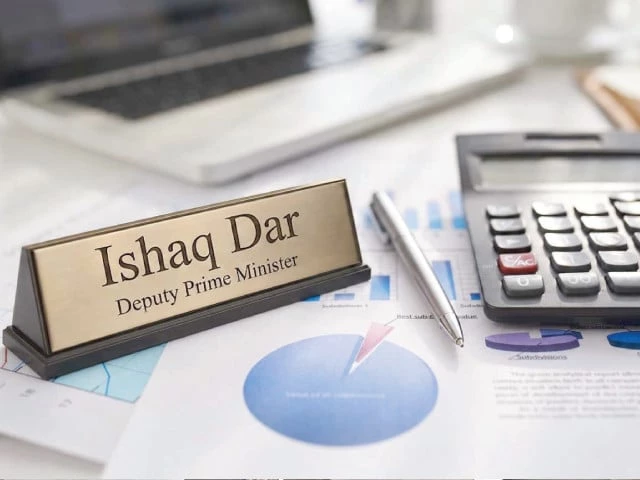
The government on Wednesday handed over the responsibility of making the new budget to Deputy Prime Minister Ishaq Dar after it found the initial work below par, as the International Monetary Fund (IMF) also began its own scrutiny of the new tax proposals.
Prime Minister Shehbaz Sharif has constituted a Dar?led committee to "review, analyse and present tax policy proposals" formulated by the Tax Policy Office working under the Finance Division, showed an official notification. With the formation of the committee, the final responsibility to finalise roughly Rs215 billion to Rs230 billion in new taxes and to grant any tax relief has been handed over to Dar. Finance Minister Muhammad Aurangzeb has been made a member of the Dar?led committee.
Under the deal with the IMF, the government will have to introduce Rs430 billion worth of measures in the new budget, including at least Rs215 billion in additional taxes and another Rs215 billion through enforcement measures. Interestingly, the responsibility for finalising the enforcement measures has also been handed over to a committee led by Minister for Economic Affairs Ahad Khan Cheema, which also held its first meeting on Wednesday.
The prime minister's decision to place Dar at the head of the budget committee and Cheema at the head of the enforcement committee suggests that budget?making responsibility, for all practical purposes, no longer rests in the Q Block – the seat of the finance minister. The government plans to present the budget in the National Assembly soon after Eid holidays, once it is finalised by both the IMF and Dar.
"The prime minister has been pleased to constitute the committee to review, analyse and formulate workable recommendations on the tax policy proposals, prepared by the Tax Policy Office, for presentation before the prime minister," reads the notification.
Committee members include Cheema, Aurangzeb, Planning Minister Ahsan Iqbal and Minister of State for Finance Bilal Azhar Kayani. Others are Secretary Finance Imdad Ullah Bosal, Chairman FBR Rashid Langrial, FBR member Hamid Atiq (also being considered for appointment as deputy chairman FBR), Director General Tax Policy Office Dr Najeeb and Asim Zulfiqar, a senior partner at the chartered accountancy firm PwC.
When contacted, Asim Zulfiqar said he was not consulted before being made a member, and if any potential conflict of interest arises, he will not take part in the proceedings.
The sources said the prime minister decided to constitute the committee because the Tax Policy Office could not satisfy him about the rationale for the new budget proposals, which were presented to him twice.
According to the committee's terms of reference, it will "review and analyse the tax policy proposals formulated by the Tax Policy Office in the context of fiscal sustainability, economic growth, investment climate and revenue enhancement". The committee will also evaluate the legal, administrative and operational feasibility of the proposed tax measures, and assess their potential impact on revenue generation, industry, exports, investment, inflation and the overall economy. The broader scope of the committee suggests that nearly everything related to the budget will be decided by Ishaq Dar, who has served as finance minister four times and often remains in the news about a fifth stint in the Q Block.
Enforcement committee
The sources said there was also dissatisfaction with the enforcement measures proposed by the FBR for the budget 2026?27. After that, the prime minister handed the responsibility to his trusted minister Ahad Cheema. Cheema held his first meeting on Wednesday and asked the FBR to improve its proposals.
"Ahad Cheema directed the FBR to further refine the proposed measures and ensure that all reforms are practical, technology?oriented and capable of delivering effective results," according to a press statement issued by the Ministry of Economic Affairs. Cheema further emphasised the government's commitment to broadening the tax base, revenue optimisation, enhancing transparency and modernising the tax administration system to promote sustainable economic growth and fiscal stability.
Other members of the enforcement committee include Minister for Climate Change Musadik Malik, Advisor to the Prime Minister on Industries Haroon Akhtar Khan, Minister of State for Finance Bilal Azhar Kayani, Chairman FBR Rashid Langrial and Attorney General for Pakistan Mansoor Usman Awan.
Key proposals discussed included the introduction of digital monitoring mechanisms and AI?based systems to detect false data in tax returns, strengthen monitoring of under?reporting and curb tax evasion. The goal is to generate at least Rs215 billion from these measures to help reach the next fiscal year's tax collection target of about Rs15.3 trillion.
The participants also discussed a proposed e?auction system for confiscated goods by customs authorities to ensure transparency and efficiency in the disposal process, according to the press statement. Cheema emphasised that the government will introduce tax enforcement reforms while keeping economic growth in mind, noting that they do not want to create hurdles for the business environment.
IMF meeting
Meanwhile, the government's key interlocutor with international financial institutions, Muhammad Aurangzeb, briefed the visiting IMF mission on Wednesday about Pakistan's macroeconomic outlook, fiscal strategy, reform priorities and the government's ongoing efforts to ensure sustainable economic stability and long?term growth.
The discussions focused on macroeconomic stabilisation efforts, preparations for the upcoming federal budget and the broader reform agenda aimed at strengthening fiscal and external sustainability while fostering sustainable economic growth, according to the Finance Ministry.
Both sides exchanged views on maintaining reform momentum, preserving macroeconomic stability and advancing structural reforms to promote investment, productivity and export?led growth within a balanced and forward?looking policy framework.
Aurangzeb noted that recent data indicated an improvement in exports on both a month?on?month and year?on?year basis, reflecting growing resilience in the economy and a gradual strengthening of macroeconomic fundamentals.
The finance minister emphasised that while stabilisation efforts have produced encouraging results, the government remains fully mindful of structural challenges, particularly external liabilities and the need to accelerate sustainable, export?led growth. He reiterated the government's commitment to deepening reforms aimed at strengthening macroeconomic stability without compromising long?term growth prospects.
Aurangzeb stressed that ongoing policy measures are not driven by short?term considerations but form part of a broader, technically grounded economic transformation strategy endorsed at the highest level.
The visiting IMF mission, led by Mission Chief Iva Petrova, emphasised the importance of sustaining reform momentum, maintaining fiscal discipline and advancing structural reforms to support durable and inclusive economic growth. Discussions also focused on the broader macroeconomic framework, the government's reform agenda and priorities for the upcoming budget.
Source Link