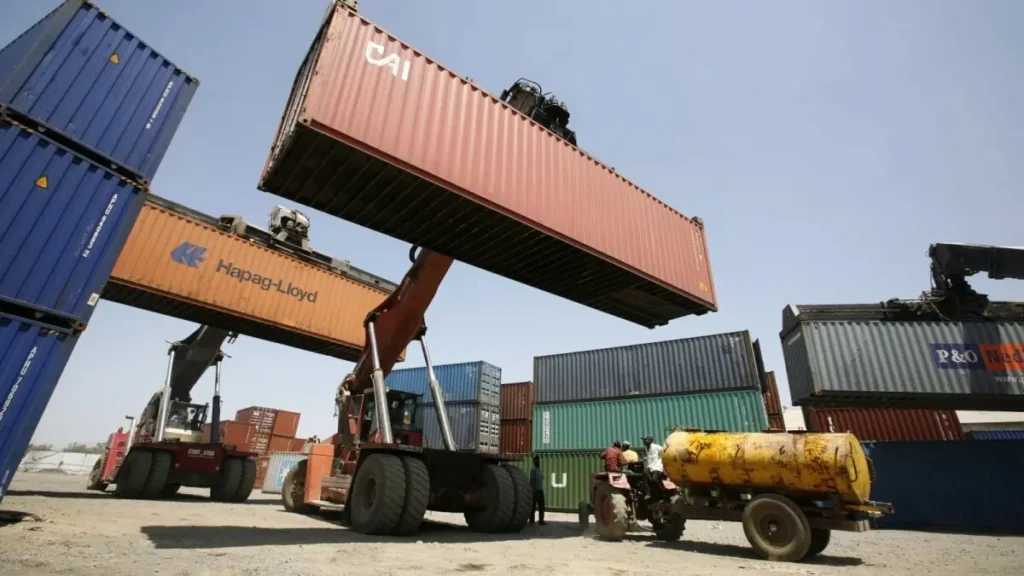
ISLAMABAD: Pakistan’s exports to major Western and Northern European markets have recorded negative growth in the first nine months of the current fiscal year compared with a year ago, despite the continuation of the Generalised Scheme of Preferences (GSP+) status, raising concerns about weakening demand for Pakistani goods.
The development comes against a shifting global trade environment, as the US-Iran conflict sends shockwaves through the Middle East, accelerating the fall in exports to European markets.
Additionally, earlier this year, European Union preferential market access was offered to India, one of Pakistan’s key competitors in textiles.
The EU Ambassador to Pakistan Raimundas Karoblis recently warned that Pakistan’s access to the GSP+ — which allows duty-free entry into most European markets — was neither guaranteed nor automatic, signalling a more conditional approach from Brussels.
For Pakistani exporters, the evolving situation presents a dual challenge: maintaining compliance with EU conditions while facing increasing competition from countries gaining preferential or expanded market access.
Exporters will face mounting pressure to retain their markets amid logistical challenges posed by the ongoing conflict coupled with rising input costs in the country.
Trade analysts warn that the conflict could further dampen export demand, as rising energy costs are likely to squeeze consumer spending in Europe, which is already under strain from the economic fallout of the Ukraine war.
They caution that these pressures could erode purchasing power and weigh further on demand for imported goods, including those from Pakistan.
Official data compiled by the State Bank of Pakistan showed that Pakistan’s exports to European countries recorded a paltry year-on-year growth of 0.94 per cent to $6.86 billion in the nine months (July to March) of fiscal year 2025-26 (9MFY26) against $6.79bn over the last year.
The slowdown is mainly driven by a decline in shipments to northern and western European states.
In FY25, the exports to the EU rose 7.44pc to $8.86bn, up from $8.24bn in the previous fiscal year. In comparison, in FY24, Pakistan’s exports to the EU had dipped 3.12pc to $8.24bn despite its GSP+ status.
Northern and Western Europe
Exports to northern Europe slightly dipped by 0.85pc to $557.31m in 9MFY26, from $562.13m in the corresponding months last year.
Western Europe, which includes countries such as Germany, the Netherlands, France, and Belgium, accounts for the largest share of Pakistan’s exports to the EU.
Exports to this region slightly fell by 3.14pc to $3.30bn in 9MFY26, from $3.41bn in FY25:
- Germany: Exports down 2.97pc to $1.24bn
- Netherlands: Exports down 1.78pc to $1.1bn
- France: Exports down 2.62pc to $411.89m
- Belgium: Exports down 4.73pc to $402.86m
Southern and Eastern Europe
However, there is a slight increase in exports to eastern and southern Europe.
Exports to southern Europe grew by 6.47pc to $2.43bn in the 9MFY26, from $2.28bn in the corresponding period last year.
Spain: Exports up 7.44pc to $1.18bn
Italy: Exports up 4.26pc to $880.13m
Greece: Exports down 8.44pc to $98.16m
Exports to eastern Europe grew 5.06pc to $566.92m in 9MFY26 from $539.63m in the corresponding period last year.
United Kingdom
Before Brexit, Pakistan’s major export destination was the United Kingdom. In the post-Brexit period, Pakistan’s exports to the UK decreased slightly to $1.62bn in 9MFY26 from $1.62bn in the corresponding period last year, a decline of 0.23pc.
In FY25, Pakistan’s exports to the UK increased by 7.19pc to $2.16bn from $2.02bn in the preceding year.