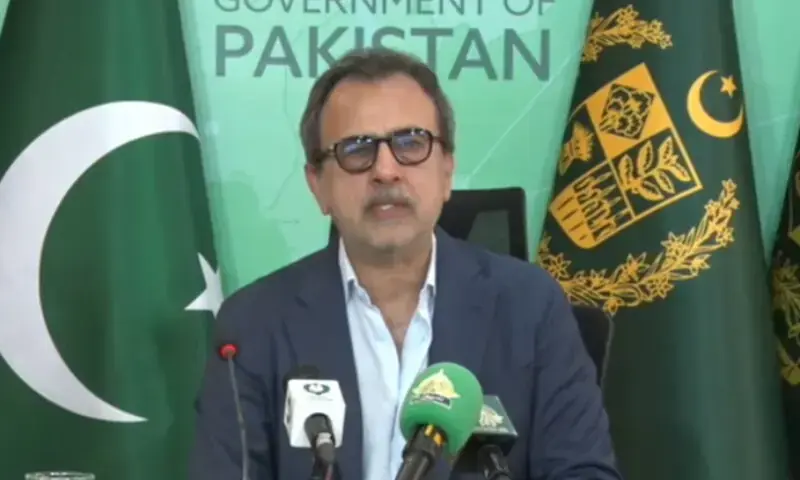
ISLAMABAD: Power Minister Awais Leghari said on Sunday that there had been “no sufficient outcome” of talks to secure discounts from Chinese power producers thus far, unlike over Rs3.5 trillion in savings secured through revised agreements with other independent power producers (IPPs) and public sector plants.
In March, the government had informed a parliamentary panel that about Rs3.5tr in savings had been secured through revisions to power purchase agreements with 29 private and some state-owned power plants, spanning their three to 20-year terms.
The move was aimed at reducing electricity rates.
When Leghari was asked about negotiations with IPPs set up under the China-Pakistan Economic Corridor (CPEC) for tariff rationalisation during a press conference on Sunday, he said, “Sufficient outcome has not come out yet.”
The minister explained that CPEC-related IPPs were set up under a framework. Under that framework, “we have been trying for concessions in the form of debt-reprofiling, but sufficient results have not materialised yet”.
He said a revision of the agreement could only take place while staying within a government-to-government arrangement, as both governments had provided enough guarantees.
“We also have to respect investments that flowed in when no investor was ready to look towards Pakistan”, he said, hoping that “an agreement would be reached towards an improvement”.
Leghari recalled that renegotiations with IPPs, the restructuring of agreements and the closure of old plants had helped secure Rs3.5tr in savings, and that the last agreements with IPPs would expire in 2053.
He also said that a reduction in system losses, transfer of old Genco staff to distribution companies and the use of fiscal space for reduction in circular debt had helped cut the power sector’s budgeted subsidy to Rs890bn this year from Rs1.287tr last year, and it would be further reduced to Rs830bn in the coming fiscal year.
In response to a question, the power minister said the Neelum-Jhelum Hydropower Project had been out of system for about a year and a half because the project had design flaws. He said the Water and Power Development Authority would take another year and a half or so to repair the over Rs500bn project.
“Its closure is causing remarkable losses, amounting to billions of rupees, and due to the non-availability of cheap electricity from this project, expensive electricity has to be arranged for,” he said.
He further stated that a burden of Rs250bn on industrial consumers was removed by ending cross-subsidy.
As a result, electricity tariffs fell across consumer categories over the past two years, he claimed.
Presenting a chart, the minister maintained that the average domestic power tariff had dropped by 16 per cent between May 2024 and 2026 while commercial rates fell by 8pc. The industrial sector got the biggest relief whose average tariff dropped by 33pc while tariffs for general services, bulk consumers and the agriculture sector came down by 10pc, 13pc and 14pc, respectively, he said.
The national average tariff reduced by 20pc to Rs42.26 per unit in May 2026, while this tariff was Rs53.04 per unit exactly two years back, he said.
Responding to a question, the minister said his attempts to remove the electricity duty on power bills did not bear fruit owing to resistance from provinces. However, he added, lowered tariffs had automatically reduced the impact of tax burden on consumers.
The minister also claimed that a “fake campaign was going on for weeks”, with allegations being made that the government was removing subsidies for low-end consumers.
“It is completely false,” he said, adding that the government had introduced a mechanism for the registration of consumers eligible for subsidy, given the increased use of alternative energy sources, such as solar power, that reduced consumers’ dependence on electricity from the national grid.
“The government wants to ensure subsidies go only to the eligible consumers, not the ineligible ones. A QR code registration system has been launched,” he said, adding that the initiative had shown positive results with around two million single-phase consumers registered in about a month.
Leghari said the eligibility criteria for subsidy would be determined through public consultations and “verified eligible consumers will continue receiving their subsidy without interruption”. But, he also said that the subsidy could not be provided to those keeping their consumption below 200 units by the simultaneous use of solar power through multiple meters.
The minister also said solar power self-generation capacity was estimated to expand to 50,000 megawatts in ten years from less than 20,000MW at present despite a shift from the net-metering mechanism to net-billing.