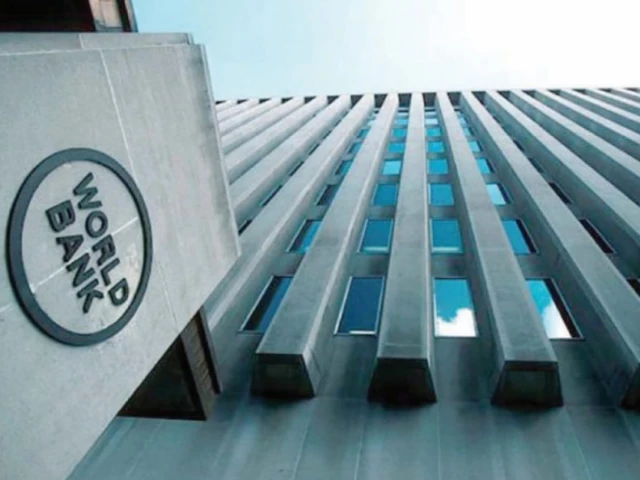
The loan will support improved access to credit and a reduction in credit cost through enactment of a modernised consolidated corporate insolvency law, and increase the volume of receivables-based financing. PHOTO: FILE
ISLAMABAD:
Pakistan plans to draw the full $1.7 billion multi-tranche World Bank loan to widen the tax base and align expenditure with the Constitution, even though the lender has twice rated implementation on the approved $600 million tranche as moderately satisfactory and the government has itself breached one of the package’s conditions twice.
One condition of the package is implementation of the National Tariff Policy. Ironically, the government breached it in June when it raised taxes on imports, and again last month when the Economic Coordination Committee (ECC) of the Cabinet approved additional customs duty to extend protection to a tyre manufacturing company.
The $1.7 billion is being taken in the name of Public Resource for Inclusive Development under the Multiphase Programmatic Approach, with $700 million approved last year.
Beneficiaries of the tranches will be the federal and all four provincial governments, according to World Bank documents. The loans have been taken once again to ensure equity in taxes, cut expenditure and bring it in line with the constitutional scheme, and withdraw electricity and agriculture subsidies.
Government officials said there were no plans to abandon the package despite slow implementation on the first phase of the $700 million loan. Of that amount, $600 million was taken by the federal government in December last year.
The World Bank’s last two implementation status reports on the $600 million loan declared the programme moderately satisfactory. In April this year, it described the federal component as moderately satisfactory on the grounds that “the operation was approved by the World Bank Board on December 19, 2025, but was not yet effective”.
In the second report, released last month, the bank retained the rating while noting some improvements. It said the $600 million operation became effective on May 14, 2026, and an advance disbursement of $164.5 million was made on June 29, 2026.
The next $200 million tranche is being approved for the Khyber-Pakhtunkhwa government.
The bank said the roughly $1.7 billion package will have four overlapping phases. The first, of $700 million, included two operations under the federal government and the Sindh government “to provide enhanced support for complex activities and procurements and enhanced project oversight”.
Under the $600 million loan, the federal government is committed to implementing the National Fiscal Pact to end federal funding for projects and subjects of a provincial nature. However, the government is constantly violating the pact, and in June this year approved Rs87 billion for a Sindh project.
The Sindh government has taken a $100 million loan in the first phase to “demonstrate proof-of-concept for supporting provincial reforms under the national fiscal pact including reforms to mobilize agricultural and property taxation”.
Under the third and fourth phases, the Balochistan and Punjab governments would receive loans.
World Bank documents state that accelerated progress on reforms, including trade liberalisation, a new National Finance Commission Award, power sector restructuring, private participation in state-owned enterprises and strengthened social service delivery, remains essential to support higher growth, create sufficient jobs for a fast-growing working-age population and reverse the recent trend of increasing poverty.
The bank said the fiscal pact aims to rebalance federal-provincial fiscal arrangements by reducing federal spending in areas devolved under the 18th Amendment and strengthening provincial revenue handles such as agricultural and property taxation.
The World Bank has set three main objectives for the $1.7 billion debt package: raising tax revenues; improving the efficiency and prioritisation of public expenditure; and strengthening the fiscal and service delivery data ecosystem.
The bank will support improvements in tax policy, including assessing the equity, efficiency and revenue impacts of proposed reforms. Activities include mobilising key underused provincial revenue sources, implementing and operationalising effective taxation of agricultural income through the establishment of data systems, strengthening property taxation through digitalisation of land records and standardisation of valuation approaches and records, and supporting continued strengthening of General Sales Tax on Services collections through digital data integration.
Under the second objective of strengthened allocation, efficiency and accountability in expenditure, the bank will fund a programme of expenditure reviews to streamline government processes and administrative structure and reduce federal spending on constitutionally devolved functions. It will also support reforms to the electricity subsidy policy, including the design and implementation of a welfare-based subsidy system for residential consumers, and improvements to the federal budget process with continued rollout of the Integrated Financial Management Information System and the e-procurement system to improve tracking and integrity of resource use across federal entities.
Proposed provincial operations under the programme will focus on improving allocative and technical efficiency to adequately and effectively resource human development needs.
Under the third component of an improved statistical and data landscape for policymaking, the bank will fund improvements to the performance of the Pakistan Bureau of Statistics, including governance through the establishment of a Governing Council and Users’ Council, and facilitate data flow between federal and provincial bureaus and other national entities through a National Data and Statistics Hub.