FBR received Rs719 billion worth of sales tax, exceeding the target by Rs85 billion. PHOTO:FILE
ISLAMABAD:
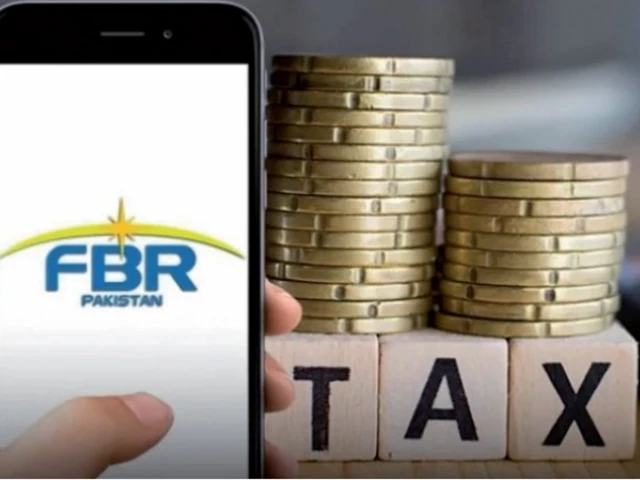
Amid slowing growth in tax collection, the Federal Board of Revenue (FBR) met its first two months’ target of Rs1.71 trillion on the back of higher sales tax receipts that exceeded the threshold, underscoring the challenges being faced in achieving the annual goal.
According to provisional figures, the tax collection increased to Rs1.722 trillion during July-August of the current fiscal year. It was higher by a mere Rs55 billion, or 3.3%, compared to tax receipts during the same period of last year. The pace was far slower than the 17.4% growth required for the annual target. The collection was Rs12 billion higher than the target.
The FBR hit the two-month goalpost due to better collection in July, but it missed August’s target by Rs29 billion till Monday evening, said senior tax officials. As against the Rs930 billion target, the FBR received Rs900 billion.
For the current fiscal year, the government and the International Monetary Fund (IMF) have agreed on the annual tax target of Rs15.263 trillion. This requires a 17.4% increase over last year’s receipts. Unlike in the past, the IMF has made it binding to meet tax targets and the approval of its sixth loan tranche hinges on achieving the H1 target.
Provinces have promised to give a little over Rs1 trillion in grants to the federal government for defence and water projects, subject to the condition that the FBR collects Rs15.263 trillion in revenues. The government has also taken revenue and enforcement measures of over Rs1 trillion in the budget to enable the FBR reach the target.
According to provisional statistics, the tax authority got over Rs685 billion in income tax, falling short of the two-month target by a wide margin of Rs74 billion. The income tax collection was also Rs29 billion less than the last fiscal year, marking negative growth of 4%.
For the second consecutive month, the sales tax collection remained higher than the target. The FBR received Rs719 billion worth of sales tax, exceeding the target by Rs85 billion. The sales tax collection was also 14%, or Rs86 billion, higher than the last year.
Of the total, Rs496 billion, or 69%, of sales tax was generated at the import stage. In the budget, the government has changed the law in order to collect sales tax at market prices of goods, instead of factory-gate prices, for numerous items. This has reduced chances of tax evasion but has broken the value-added chain.
The collection of federal excise duty stood at Rs118 billion, which was almost equal to the target and Rs3 billion higher than the last year. Customs duty collection hit Rs198 billion, which was slightly lower than the target and equal to the previous year’s receipts.
Out of the total taxes, over Rs810 billion, or 47%, was collected at the import stage, where chances of evasion were very slim. The FBR paid Rs155 billion in tax refunds, about Rs31 billion higher than the last year.
The FBR’s enforcement drive faces various implementation challenges. There is delay in banning economic transactions by ineligible persons because of political reasons and inability of the Pakistan Revenue Automation Limited to design a system that could enable effective application of the restrictive measure, said tax authorities on condition of anonymity.
Where the FBR managed to integrate large retailers with the tax system and the number in the last fiscal year jumped to over 17,300 businesses, it could not notify the final income tax rules needed to integrate 14 service providers with the tax authority’s digital system.
About 17,337 large retailers integrated with the Point-of-Sale (POS) network in fiscal year 2025-26, an increase of 31% in the base within one year.
However, the draft Statutory Regulatory Order 288, which the FBR issued in February 2026, remained non-operational. Owing to this, at least 14 service providers could not be integrated with the digital reporting system while over 17,300 retailers were largely traditional businesses like textile.
Without final rules, businesses such as restaurants, hotels, motels, guest houses, marriage halls, marquees, clubs, inter-city travel by road, courier services, cargo services, beauty parlours, clinics and slimming clinics, massage centres, pedicure centres, all medical service providers including dentists, hair implant surgeons, and pathological laboratories, and medical diagnostic laboratories cannot be integrated.
Taxpayers have to register, install and integrate electronic invoicing hardware and software with the revenue board’s computerised system but this is not possible without the notification of a new SRO, said the tax authorities.