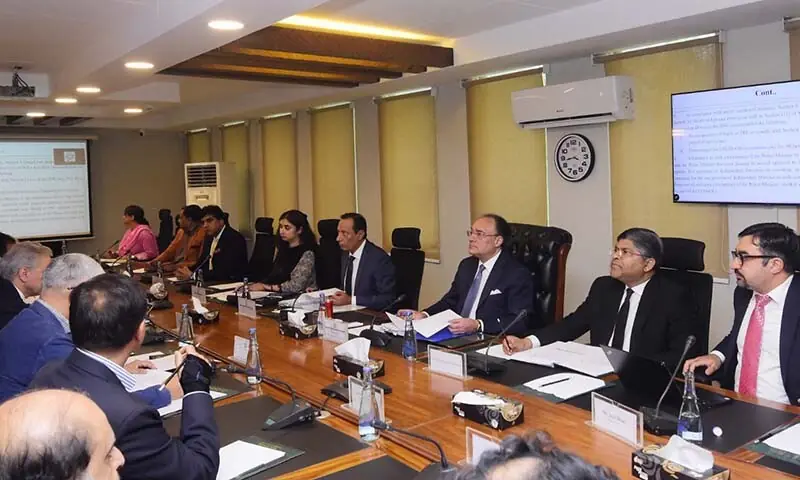
ISLAMABAD: The Cabinet Committee on state-owned enterprises on Thursday rejected a request from two circular debt-hit state-owned gas utilities — Sui Southern and Sui Northern — for exemption from international accounting and financial reporting standards to avoid being declared insolvent.
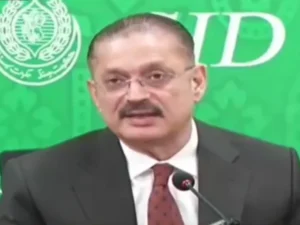
However, the cabinet committee, headed by Finance Minister Muhammad Aurangzeb, “instructed the Petroleum Division to undertake further deliberations with the Finance Division and the Law and Justice Division and submit a revised proposal for consideration”, according to an official statement.
The Petroleum Division had sought exemption for specified energy-sector state-owned enterprises (SOEs) from the applicability of International Financial Reporting Standards (IFRS-14 and IFRS-9), the statement added.
Informed sources said a similar three-year exemption had already been availed of by these entities.
The finance minister reportedly observed that such an exemption could not be allowed while the SOEs Act 2023 remained in place. He therefore directed that the matter, being of a serious nature, be deliberated upon at length, given the strong opposition from the Finance Ministry’s Central Monitoring Unit (CMU), which monitors all SOEs under the requirements of the International Monetary Fund (IMF).
Sitting on a mammoth Rs3.44 trillion gas-sector circular debt, the applicability of IFRS-9 and IFRS-14 could have required the utilities to make provisions for liabilities, many of which would have been unrecoverable, while some could have been recovered from other SOEs, thus eroding their equity despite reasonable billing cash flows to meet operational needs.
The official said the two entities, supported by the Petroleum Division, wanted the continuation of their accounting and reporting standards in line with the old Generally Accepted Accounting Principles (GAAP) for operations under a regulated business model.
IFRS-9 requires the classification of assets based on a business model and cash flow characteristics, including the expected credit loss and impairment model.
According to the International Accounting Standards Board, “IFRS 9 requires an entity to recognise a financial asset or a financial liability in its statement of financial position when it becomes party to the contractual provisions of the instrument.”
“At initial recognition, an entity measures a financial asset or a financial liability at its fair value plus or minus, in the case of a financial asset or a financial liability not at fair value through profit or loss, transaction costs that are directly attributable to the acquisition or issue of the financial asset or the financial liability”.
The IFRS-14 requires reporting deferrals for regulated entities.
The CMU believed both rules should be applied to ensure transparency, as required under the SOE Act, in the accounts and financial results, along with proper footnotes explaining how receivables would be settled as part of the circular debt management plan currently under discussion with the IMF.
The cabinet body also rejected the appointments of two board members, one each from the Petroleum Division, to the boards of directors of two other SOEs — Pakistan Petroleum Limited (PPL) and Sandak Metals Limited (SML) — finding them contrary to good governance standards.
It nevertheless approved the other board members and directed that one member from the Petroleum Division be nominated to the PPL and SML boards. The nominations would subsequently be approved formally by the federal cabinet.
An official statement said the committee “emphasised that the composition of the Boards of State-Owned Enterprises should remain fully aligned with the principles of good governance and the provisions of the State-Owned Enterprises (Ownership and Management) Act and Policy, including the principle of limiting representation from the sponsoring ministry/division to one ex officio director on each board”.
The meeting also considered a summary submitted by the Ministry of Industries and Production regarding the categorisation of the Small and Medium Enterprises Development Authority (SMEDA).
The committee approved the proposal to exclude SMEDA from the list of SOEs in view of its statutory and non-commercial nature.