The roots of Pakistan’s solar revolution lie in a catastrophic confluence of policy failure, global market forces and consumer desperation.
PAKISTAN is undergoing an energy revolution unlike any the country’s planners designed, any donor funded, or any government blueprint envisioned.
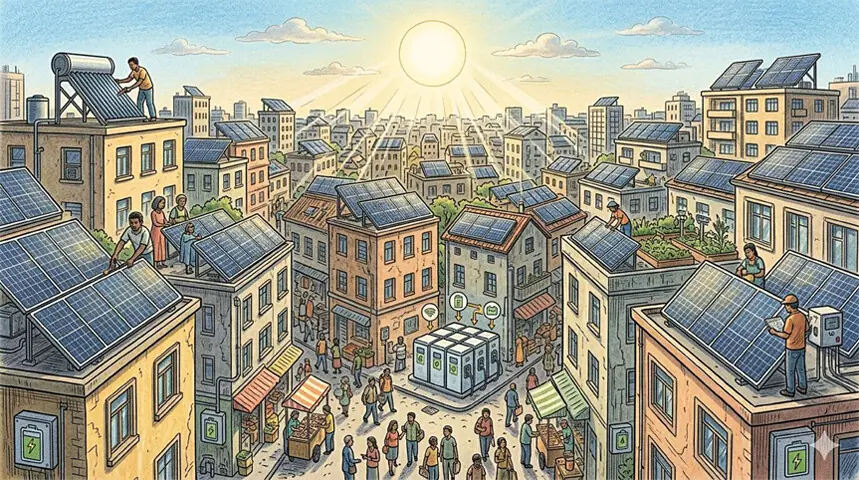
Rooftop by rooftop, tubewell by tubewell, factory floor by factory floor, ordinary Pakistanis are building one of the fastest clean energy transitions ever recorded.
In a country simultaneously battered by catastrophic floods, record-breaking heatwaves and an electricity tariff crisis of its own making, the sun has become both an escape route and, quietly, a contributor to Pakistan’s climate commitments.
This is the story of that revolution, and the storm gathering in its wake.
The roots of Pakistan’s solar revolution lie in a catastrophic confluence of policy failure, global market forces and consumer desperation.
Between 2021 and 2024, electricity tariffs surged by 155 per cent, driven by IMF-mandated removal of subsidies, soaring fuel costs from the Russia-Ukraine war, and capacity payments owed to idle CPEC-era thermal plants.
At the peak, electricity bills in some households exceeded monthly house rent in major cities.
Simultaneously, Chinese solar manufacturers faced massive overproduction.
Panel prices fell from 32 cents per watt in early 2024 to 17 cents by yearend, and further to USD 0.08 per watt by 2025.
This ‘perfect storm’, soaring grid costs meeting collapsing panel prices, ignited an unprecedented consumer response.
In FY 2024-25, Pakistan imported 18GW of solar panels, according to Ember and Renewables First, building on 16.6GW in 2024.
Cumulative imports reached 51.5GW by November 2025, making Pakistan the third-largest destination for Chinese solar exports.
Solar’s share of utility electricity tripled from four per cent in 2021 to 14pc in 2024, reaching 25.3pc by early 2025, placing Pakistan among fewer than 20 countries to achieve that milestone.
The consumer-led revolution has been remarkable, but it has also brought in its wake a storm that the government needs to address rather urgently and effectively, believes Ali Ahsan
Urban high-consumption households were the earliest adopters. Pakistan’s volumetric pricing structure penalises heavy usage, as tariffs rose, those with capital went solar first.
Payback periods compressed to one to two years, and a 2015 net metering policy enabled sale of surplus power to the grid.
By December 2024, there were 283,000 net-metered consumers.
However, official figures capture only a fraction, with Renewables First and TransitionZero estimating that between 27GW and 33GW have actually been deployed, mostly off-grid.
In rural Pakistan, approximately 80pc of the country’s 1.5-2 million tubewells historically ran on imported diesel.
As subsidies were removed, solar pumps became dramatically more economical.
Agricultural electricity demand on the national grid fell 34.3pc in 2024.
The World Resources Institute estimates that half of all tubewells would ultimately convert to solar, adding 5.6-7.5GW of distributed photovoltaic (PV) capacity.
The textile sector, consuming nearly one-third of Pakistan’s industrial electricity, has embraced solar to cut costs and meet global sustainability standards.
The European Union’s Carbon Border Adjustment Mechanism (CBAM) has added urgency for export-facing manufacturers.
Industrial firms have each installed multi-megawatt systems. Industrial grid demand fell from 31,008GWh in FY2023 to 27,830GWh in FY2024, a clear signal of structural defection.
Regulatory turbulence
The Pakistani state has begun to respond, not always constructively.
Under the original net-metering policy, solar consumers enjoyed a real benefit of approximately Rs40-50 per kWh; proposed changes slash this to Rs8-10, an almost 80 per cent reduction.
The government’s Economic Coordination Committee has signalled a move to a net billing framework, significantly undermining residential solar investment.
Hasnat Khan, Senior Vice-Chairman of the Pakistan Solar Association (PSA), is unambiguous in his assessment.
“People have invested their hard-earned money to install solar systems and many have even taken loans,” he said in a media interaction”, adding that the new rules “will make it difficult for people to recover their investment” and stressing: This is green energy and it should be encouraged.”
Waqas Moosa, the PSA Chairman, warns of deeper systemic risk: “We anticipate that a lot of consumers will start choosing to go for batteries, which could have profound implications for the relevance and sustainability of the central grid.”
The off-grid exodus
The most consequential and least-discussed dimension of Pakistan’s regulatory crisis is the battery storage inflection point.
As the National Electric Power Regulatory Authority (Nepra) reduces the economic value of grid-connected solar, the rational consumer response is not to abandon solar; it is to pair solar with a lithium-ion (Li-ion) battery and go off-grid entirely.
Alongside 17GW of solar PV panel imports in 2024, Pakistan imported an estimated 1.25GWh of Li-ion batteries.
According to Moosa, 40-50pc of residential customers were already integrating batteries, and that following the net-metering rollback, he expected this to reach 80-90pc.
The World Bank projects that solar-plus-battery systems could supply over a quarter of Pakistan’s peak energy demand by 2030, and battery imports would reach 8.75GWh.
Once a household pairs solar with adequate battery storage, it no longer needs to sell power to the grid, nor, critically, does it need to buy from it in the evening.
Such households exit the grid ecosystem entirely, eliminating their contribution to fixed infrastructure costs.
The utility death spiral
As higher-income consumers defect, fixed costs, including capacity payments owed to idle CPEC-era thermal plants, fall on a shrinking pool of grid-connected consumers, driving tariffs higher, which incentivises more solar-plus-battery adoption.
Electricity sales on the national grid already fell 3pc in 2024 despite a 6pc rise in registered consumers.
By December 2024, net-metered consumers had already shifted USD563 million (PKR159 billion) in fixed costs onto other consumers.
Without structural reforms, regulators project this regressive transfer could reach USD48.34 billion by 2034.
The cruel irony is that the regulatory response, cutting buyback rates, accelerates precisely the outcome it seeks to prevent, pushing consumers towards full off-grid independence.
Accidental green dividend
Pakistan contributes less than one per cent of global greenhouse gas (GHG) emissions, approximately 400-500 million tonnes of carbon dioxide-equivalent annually.
Yet, it consistently ranks among the world’s most climate-vulnerable nations.
The 2022 monsoon floods, amplified by climate change, submerged one-third of the country, killed over 1,700 people, and caused USD30 billion in damages.
Glacial retreat across the Hindu Kush-Himalayan range threatens water security for 255 million Pakistanis.
Heatwaves exceeding 50°C in Sindh and Balochistan are intensifying.
Pakistan’s energy sector accounts for 46pc of domestic GHG emissions, making the solar transition directly relevant to its mitigation obligations.
Pakistan’s Third Nationally Determined Contribution (NDC3.0) in 2025 committed to a 50pc reduction in projected emissions by 2030, with 60pc renewable electricity as a headline target.
The consumer-led solar surge is now contributing measurably, climbing from 4pc of electricity generation in 2021 to 14pc in 2024, one of the highest proportions in Asia.
The Climate Change Performance Index 2026 ranked Pakistan 15th globally, a rise of 16 places.
However, climate experts caution against over-confidence.
If battery storage allows consumers to exit the grid entirely, the residual grid will increasingly run on idle coal and gas plants that Pakistan is contractually obligated to pay for, producing a grid that is simultaneously dirtier and financially unsustainable for those who remain dependent on it.
The way forward
Pakistan’s consumer-led solar revolution has achieved in three years what six decades of government-led electrification programmes could not.
But sustaining this transition, and aligning it with both economic equity and climate goals, demands that the state must act decisively on several urgent fronts.
The single most critical intervention is for the federal government to formally declare a Battery Energy Storage System (BESS) emergency, treating grid-scale storage as a matter of national energy security.
As solar penetration deepens, the evening demand surge following the sunset of distributed generation is becoming structurally destabilising.
The state must urgently commission utility-led storage projects at the transmission and distribution levels to absorb daytime solar surplus and release it during peak evening demand, smoothing the duck curve, reducing reliance on idle thermal plants, and keeping grid-defecting consumers connected.
Without utility-scale BESS, the spiral from grid-tied solar to full battery-backed off-grid independence becomes economically inevitable for growing numbers of consumers.
The government should also remove taxes on solar panels and classify solar energy as a basic necessity.
The imposition of a 10pc General Sales Tax (GST) on imported solar panels, combined with punitive net billing rates, sends a contradictory signal at the worst possible moment.
The government must remove all import taxes on solar panels and formally classify solar energy as a basic necessity of life, equivalent to water or food.
Solar power is no longer a luxury appliance for the affluent; it is the primary means by which millions of Pakistani households are securing affordable electricity, reducing dependence on costly fuel imports, and contributing to the country’s NDC commitments.
Taxing it undermines climate targets, deepens energy inequality, and drives consumers off-grid entirely, removing them from the grid’s revenue base.
Treating solar as essential will ultimately mitigate the effects of climate change by accelerating the displacement of fossil fuel generation across all consumer categories.
There is a need for government-level initiatives for the agricultural sector. Agriculture accounts for 43pc of Pakistan’s domestic GHG emissions and employs 37pc of the national workforce.
The government must launch a dedicated, nationally-coordinated solar for agriculture programme, going beyond the fragmented provincial schemes, to solarise Pakistan’s 1.5-2 million tubewells, provide subsidised solar water pumping systems to smallholding farmers, and integrate solar irrigation with precision water management to address Pakistan’s deepening water insecurity.
Balochistan’s PKR55 billion tubewell solarisation project and Punjab’s solar kit distributions are meaningful beginnings, but they must be scaled, coordinated and extended to cover all provinces under a unified federal agricultural energy policy.
Such an initiative would simultaneously reduce diesel import costs, cut methane and carbon dioxide emissions from the agricultural energy mix, and build climate resilience for the rural communities that are the ones most exposed to Pakistan’s worsening droughts and heatwaves.
On climate finance, Pakistan’s case for international support is unimpeachable.
The NDC 3.0 quantifies the energy transition need at USD101 billion, 35pc of which is contingent on external grant financing.
The global community’s failure to honour its climate finance commitments to one of the world’s most vulnerable nations represents both a moral failure and a strategic miscalculation.
The writer is Research and Publication Manager, Pakistan Solar Association (PSA).