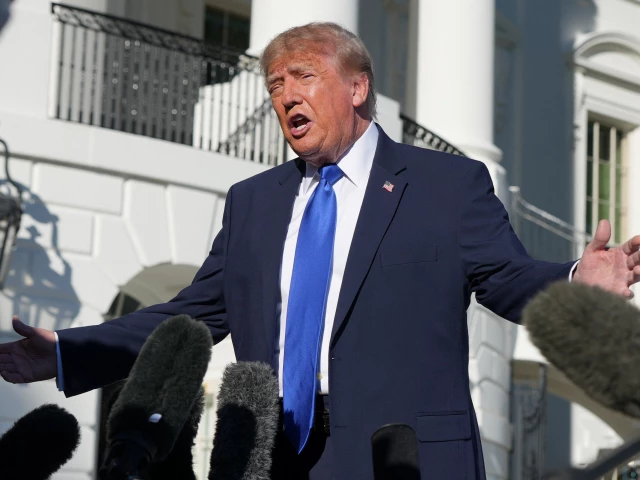
US President Donald Trump speaks to members of the media as he departs the White House en route to Iowa, in Washington, DC, US, October 22, 2026. Photo: Reuters
President Donald Trump said on Friday the US may carry out another military operation against Iran just as the Iran war nears its eight-month mark and rising fuel prices weigh on the US midterm elections.
“We may do another little Epic Fury,” Trump told a rally in Florida, using the US military’s term for its war on Iran. He did not elaborate.
Trump said the US could end the war quickly but questioned whether Washington should seek a swift conclusion or allow the conflict to gradually wind down.
Trump, who has offered shifting goals and timelines for the war, has said in recent campaign remarks that the war will end soon, “one way or the other.”
He said this month the US would not launch an attack on Iran before the November 3 elections that will determine control of Congress, where Trump’s Republican Party holds a narrow majority in both chambers.
Iran intensifies plots against US officials in Mideast: report
US intelligence found that Iran has sharply stepped up efforts to target American officials in the Middle East and other countries, with lethal plots reaching advanced stages, Axios reported on Friday.
The report cited a memo dated October 23 from Director of National Intelligence Jay Clayton to Secretary of State Marco Rubio, which said the information is relevant to more personnel than are currently cleared to see it.
The one-page unclassified memo does not name targets, countries outside the Middle East, or the nature of the plots.
The report said the underlying intelligence has been shared with senior State Department staff, and Clayton offered to downgrade it as much as possible so Rubio can share it more widely.
A US official told the outlet that the intelligence is one reason the agency is reducing embassy personnel in the United Arab Emirates, Lebanon, Qatar, and Jordan, as first reported by CNN.
Iran Revolutionary Guards say two tankers hit mines south of Strait of Hormuz
Iran’s Revolutionary Guards said on Friday that two tankers struck naval mines while attempting to use what they described as “an unauthorised route” south of the Strait of Hormuz, Iranian state media reported.
Iran has detailed plans to hit Gulf undersea cables if war resumes, officials say
Tehran has drawn up detailed plans to target undersea communications cables in the Gulf if the United States and Israel attack Iran again, two senior Iranian security officials told Reuters.
Their comments followed warnings by Iranian officials that undersea cables in the region could become targets in any renewed conflict if diplomacy with Washington collapses.
The two Iranian security officials, speaking on condition of anonymity, gave few details and did not say how or where exactly Tehran would carry out such attacks. But one of them said Iran would aim to prevent repairs after any attacks to prolong disruptions to communications, including internet connections.
“If Iran is attacked, there will be no more red lines … from undersea cables to military bases, including covert ones,” one of the officials said.
The official warned Washington not to “play with fire”, and said Iran had full access to the undersea cables and could easily destroy them.
Yadollah Javani, the deputy head of political affairs for IRGC, said on Wednesday that Iran could target seven major internet cables beneath the Strait of Hormuz if Iranian infrastructure came under attack.
Undersea cables carry around 99% of global internet traffic, according to the International Telecommunication Union, a UN agency. But the global impact of such attacks by Iran could be limited as less than 1% of international bandwidth passes through the Strait of Hormuz, said Alan Mauldin, research director at telecommunications research firm TeleGeography.
The strait separates Iran and Oman, linking the Gulf to the Gulf of Oman and Arabian Sea.
The US Department of State and Iran’s Foreign Ministry did not respond to Reuters‘ requests for comment on the Iranian security officials’ remarks. There was no immediate comment from Gulf states.
Trump vows to deal with Cuba after Iran settled
US President Donald Trump on Friday used a campaign rally in Florida, where Cuban Americans are a potent voting bloc, to vow to address his concerns about Cuba once the Iran war is settled.
In a 90-minute speech in Fort Myers, Florida, Trump repeated that more military action against Iran may lie ahead as he tries to address the causes of a spike in oil prices that has put Republicans on the defensive ahead of the November 3 midterm elections.
With an eye toward the senior Americans who live in Florida, Trump said he planned to spend $250 million to hire at least 5,000 new nurses in elder care facilities all across America.
While the Iran war has no end in sight, Trump talked tough about Cuba, part of a pattern of putting pressure on the communist government there after ousting the leader of Venezuela early this year.
Trump, who won 68% of the Cuban American vote in Florida in the 2024 election, said American naval forces from Iran will stop at Cuba on the way home.
“We’ll have one of them stop about 50 yards off the coast. They’ll raise up their hands, and then we’re going to send Marco Rubio in to finish up the deal,” he said.
Secretary of State Rubio, a former US senator from Florida, has been handling much of the Cuba portfolio for Trump.
Trump’s rally was intended to boost the electoral prospects of Florida Republican Representative Byron Donalds, who is running for governor against Democrat David Jolly.
His speech, the latest in a near-daily blitz of campaign rallies in largely friendly areas, rambled from topic to topic such as the size of his crowds, his White House renovations and his renaming of the Gulf of Mexico to the Gulf of America.
Trump has increased pressure on Cuba in his second term. In September, he labeled Cuba a “failed state” at the UN General Assembly and said “freedom will be coming to Cuba,” prompting a walkout by the Cuban delegation.
Trump has openly stated that his goal is to fundamentally change Cuba’s government. A US-imposed oil blockade has put the country under severe strain as it contends with fuel shortages and blackouts exacerbated by failing infrastructure. UN human rights experts have condemned the oil blockade as a violation of international law.
Trump also escalated his feud with Minnesota Republican Representative Ilhan Omar, a frequent Trump critic, and bashed her home country of Somalia as a “shithouse country.”
“Stronger response”
The plans for possible attacks on undersea cables reflect a conviction in Iran’s leadership that a renewed US military campaign would have to be met with a stronger response than before.
Top security official Mohsen Rezaei warned this month that US-linked digital infrastructure across the Gulf, including data centres and AI facilities, could be targeted in a renewed conflict.
Washington’s Gulf allies have invested heavily in such infrastructure and they “should hold Washington, not Tehran, responsible for any damage to undersea cables,” the second Iranian security official said.
Alex Vatanka, director of the Iran program at the Middle East Institute in Washington, said such threats were intended to deter renewed conflict and put pressure on Washington by making Gulf governments and US companies fear for their investments in the region.
“Tehran wants Gulf states and corporate executives to press (US President Donald) Trump over the risks his policies pose to their investment plans,” said Vatanka.
Multiple cable cuts could slow internet services and disrupt financial transactions, e-commerce and cloud computing, analysts said. The impact would depend on how operators rerouted traffic and the capacity available on alternative connections, Mauldin said.
Restoring connections during wartime could be difficult, experts said, and higher insurance costs and delays in obtaining permits to enter territorial waters could further complicate repairs.
The Red Sea could offer a more significant target than the Strait of Hormuz, particularly if Iran had support from its Houthi allies in Yemen, though Tehran has made no public statement indicating it plans to target cables there.
The Red Sea carries data between Europe, East Africa and Asia, with capacity routed through it accounting for about 3% of global international demand and around 10% of traffic travelling between regions, Mauldin said.
Gulf governments have been investing heavily in technology to diversify beyond oil and become global artificial intelligence hubs, deepening ties with US technology firms.
Iranian strikes directly hit two Amazon Web Services facilities in the UAE in March and damaged infrastructure near one of its facilities in Bahrain. The IRGC named US tech companies including Microsoft, Google, Apple and Nvidia as legitimate targets at the height of the war in March.
Land-based connections can provide alternative routes for internet traffic, and Gulf states and US technology companies are investing in additional infrastructure to improve resilience.
Microsoft plans to invest more than $400 million in subsea and terrestrial connectivity across the Middle East by 2030.