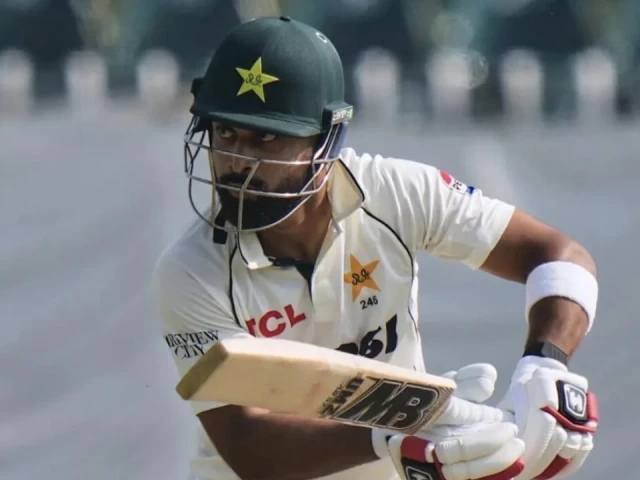
His unbeaten 160 capped a successful return to Test cricket after 11 weeks of red-ball preparation
Abdullah Shafique made his return to Test cricket a memorable one, batting for 117.3 of the 138.3 overs Pakistan faced during their eight-wicket victory over the West Indies in the second Test at Port of Spain.
The 26-year-old scored an unbeaten 160 off 323 balls, hitting 15 fours and three sixes, before making 24 not out from 51 balls in Pakistan’s successful 75-run chase.
It was Shafique’s sixth Test century and his first since October 2024. His 150-plus score was the first by a Pakistan batter in the Caribbean in 49 years, while he also faced more than 200 balls for the seventh time in 48 Test innings.
His innings at Queen’s Park Oval was also his first time batting at No. 3 in Test cricket. He had previously occupied the position only three times in international cricket.
Shafique’s return to the Test side came at short notice. He was brought into the squad as a replacement for Abdullah Fazal, who was ruled out of Pakistan’s West Indies and England tours with a lower-back injury. After joining the squad in Trinidad from Guyana on July 26, Shafique replaced the injured Shan Masood in the playing XI.
But the work that prepared him for the unfamiliar position had begun almost three months earlier.
Towards the end of Lahore Qalandars’ campaign in HBL PSL 11, Shafique received an offer from MIT Solutions to play in the President’s Trophy Grade-II Gold tournament. The team eventually won the competition, while Shafique used the tournament to return to regular red-ball cricket.
“President’s Trophy Grade-II really helped me get to where I am today as I played in seaming and spin-friendly conditions across four venues, toiling under the peak summer sun and scoring valuable runs under pressure for my team,” Shafique told PCB Media.
The opportunity came at a time when Shafique wanted to improve his game in the longer format.
“Our HBL PSL campaign was about to end in the last week of April when I received a call from MIT Solutions who invited me to play the Grade-II tournament and help qualify for Grade-I,” he said.
“I felt slightly perplexed in the beginning but sought help from one of my close friends Saif and asked him to accompany me throughout the tournament.”
Saif, who had learned the throwdown technique using a specialised stick when the two trained together, took leave from his work as a marketing consultant and travelled with Shafique to four cities.
He helped with Shafique’s net sessions and bowled hundreds of balls during the weeks leading into his Test comeback.
MIT Solutions gave Shafique the No. 3 role and asked him to bat through the innings, with the first innings of each team limited to 70 overs.
The plan suited Shafique’s goal of spending more time at the crease.
He started the tournament with an unbeaten 161 off 210 balls at Abbottabad Cricket Stadium. In the following match, he made 66 from 126 balls as MIT Solutions secured their first win
He then produced scores of 75, 33, 39, 25 and 36 before making a decisive contribution against Kingsmen Academy in Peshawar.
On a turning pitch, Kingsmen were dismissed for 86 before MIT Solutions slipped to 61-5. Shafique responded with 127 from 146 balls to help his team secure a 10-wicket victory.
His biggest innings of the tournament came in the semi-final from June 18 to 20, when he scored 193 off 201 balls, including 27 fours and three sixes.
Shafique was the last batter dismissed as MIT Solutions made 377 in 72.4 overs.
The final followed his call-up to the NCA red-ball camp, but he was released to play for MIT Solutions. He again delivered, scoring 87 off 115 balls and 60 off 103 in the two innings against Kingsmen Academy as MIT Solutions drew the match and secured the title.
Hasan Nawaz, MIT Solutions captain and a Pakistan international, said the team’s plan was always for Shafique to bat for long periods.
“The plan in Grade-II was for Abdullah to bat through the innings and it was pleasing to see him remain not out in both innings of his comeback game. I’m glad that mindset has stuck with him at the top level,” Nawaz told PCB Media.
“Abdullah spoke to me about the areas he wanted to improve in his game by playing red-ball cricket. Our team’s ambitions and his personal goal gelled well and paid dividends for both parties. He spent long hours in the nets throughout the tournament and looked after his fitness routines well.”
Shafique said the tournament was demanding, with matches separated by limited recovery time and regular travel between cities.
“I used to go to the ground two hours before the team on match days and faced maximum balls before start of play. We had just one day between the group-stage games and most of it was spent travelling to the next city,” he said.
The conditions also changed from venue to venue, giving him valuable preparation against both pace and spin.
“If you are serious about your game and put in the hard yards then the game rewards you and new opportunities begin to open up,” Shafique said.
“Grade-II was tougher than I expected, the conditions varied from seam to spin across Islamabad, Abbottabad and Peshawar. The challenges on and off the field toughened me and my goal was to upskill myself, take my game to the next level and come back as a changed player.”
That preparation was evident in Port of Spain. Shafique said he had prepared carefully for the West Indies attack and was particularly focused on left-arm spinner Jomel Warrican.
He wanted to prevent Warrican from settling into a rhythm, saying he was determined to keep the spinner from “settling down”.
After Pakistan completed their victory, Shafique called Saif in Sialkot to thank him for the work they had done together.
“I thanked Saif for his selfless efforts and discussed how the plan we hatched in late April has come to fruition perfectly,” he said.
Shafique’s next challenge will be England, where Pakistan are scheduled to play a three-Test series.
The batter has already played one County Championship match for Yorkshire and believes that experience will help him adapt to conditions in Leeds.
“I’ve played one game for Yorkshire in the County Championship last summer and feel confident about adjusting to the conditions at Leeds,” he said.
“I’ve faced England a few times at home (2022 and 2024) and this away series against them will be an exciting challenge.”
His technical style has also attracted praise from former West Indies fast bowler and broadcaster Ian Bishop, who described him as a “Kitaabi player”, referring to his textbook approach.
Shafique said the praise was linked to the foundation laid by his father and uncle, both former first-class cricketers.
“It is always a matter of pride when respected experts praise you,” he said.
“The ‘textbook shots’ I’ve developed is due the work my uncle and father put into my batting technique growing up.”
For Shafique, the Port of Spain century was therefore more than a successful comeback. It was the result of a deliberate return to the longer format, months of demanding domestic cricket and a clear aim to return to the international stage as a more complete batter.