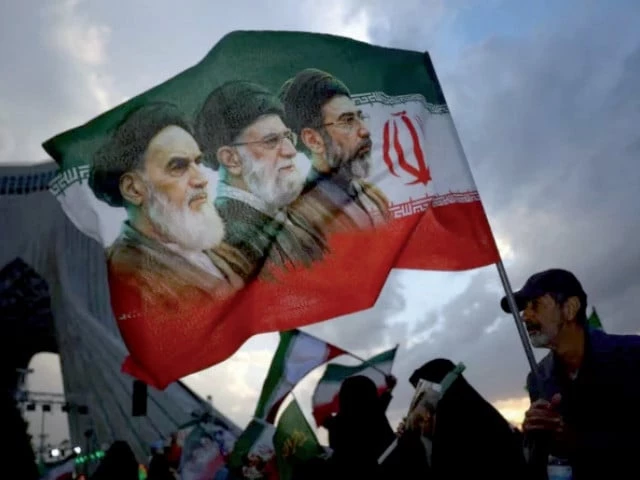
POLITICAL EXPRESSION: A man holds a flag with a picture of late leader of the Islamic Revolution Ayatollah Ruhollah Khomeini during a rally in Tehran on April 29, 2026. PHOTO: REUTERS/FILE
Brig Gen Hassan Zadeh, commander of the Islamic Revolutionary Guard Corps’ Mohammad Rasulullah Corps in Tehran, said the US and Israel had “completely failed” to achieve their objectives against the Islamic Republic, according to the Tasnim News Agency on Saturday.
The news outlet reported that Zadeh said Iran’s “popular strength and comprehensive readiness of the Basij” had made the country one of the major powers in the region and the world, during a visit to upgraded air defense battalions of the 27th Mohammad Rasulullah Division to assess their readiness.
He also claimed that US and Israeli leaders now had no answers before public opinion, their elites or their own people for their repeated failures.
“Today, only part of the immense capabilities and readiness of the 27th Mohammad Rasulullah Division has been demonstrated in this field,” he added.
Iraqi armed group vows revenge for US-Saudi strikes
The leader of Iraq’s Harakat Hezbollah al-Nujaba has promised retaliation for joint Saudi-US strikes last month that hit sites of the country’s Popular Mobilisation Forces (PMF), of which it is a member, Al Jazeera reported.
In a statement, Akram al-Kaabi said diplomacy with Saudi Arabia is “futile”, and that it must be disciplined “through a suitable military response” to avenge the strikes on the PMF.
“Missiles can only be countered with missiles, and fire can only be met with fire,” he said.
Saudi Arabia and the US Central Command said last month that the joint air strikes targeted militias in Iraq responsible for attacks on American troops and Saudi energy infrastructure.
The PMF, a paramilitary force, said at least 20 of its members were killed and 32 wounded in the strikes.
Pentagon urges defence industry to accelerate weapons production amid Iran war
The Trump administration has asked the US defence industry to rapidly escalate the production and delivery of weapons, including munitions that are in extremely short supply due to the war with Iran, The Washington Post has reported, quoting a Defence Department memo, Al Jazeera reported.
Deputy Defence Secretary Steve Feinberg wrote to industry leaders last Wednesday, noting that they have to submit plans to “drive significantly faster, more aggressive delivery schedules and/or increased production for critical capabilities” within 21 days.
“Years-long development cycles are not acceptable,” Feinberg wrote. “We must dramatically accelerate our program schedules and expand our production capacity now.”
There have been multiple reports of the US running short on munitions stockpiles and, more critically, of anti-missile Patriot interceptors.
Trump earlier said that the army has “massive amounts” of munitions, posting on Truth Social that “large amounts are being manufactured and shipped to the US as needed”.
Iran says deal on Strait of Hormuz is close but not enough to open the waterway
Iran said on Saturday that a deal with Oman on control of the Strait of Hormuz was close but would not be enough to free up the waterway, and the United Arab Emirates said Iran had hit another ship there.
An agreement between Iran and Oman over the strait, which separates the two countries, is seen as vital to a wider deal to end the war, which began with US and Israeli attacks on Iran on February 28 and led to Tehran establishing a chokehold over the major energy export route.
A US official, who declined to be identified, said on Friday that Washington anticipated an agreement soon between Iran and Oman, so normal oil traffic could resume.
Read: US-Iran war is ending, Pakistan won
Iranian Foreign Minister Abbas Araqchi said Iran and Oman were “very close” to an agreement on a new shipping route through the strait, but reopening it would depend on other conditions, including US compensation to Iran.
The secretary of Iran’s top national security body, Mohammad Baqer Zolqadr, listed other demands including ending US threats against Iran, stopping aggression against Iran and its Lebanese, Palestinian, Yemeni and Iraqi allies, lifting a blockade and sanctions on Iran and freeing Iranian assets.
Oman reports positive negotiations, condemns ship attacks
Oman condemned what it described as repeated attacks on vessels while transiting the strait, without assigning blame, and said that negotiations with Iran on arrangements for shipping through Hormuz were “positive and constructive”.
“Oman stresses the importance of avoiding any actions that could affect these negotiations and the progress achieved in a manner that takes into account the interests of all parties,” the foreign ministry said.
Araqchi said the previous shipping traffic separation scheme through the strait was no longer acceptable to Tehran and Iran was discussing a temporary route with Oman while technical and legal issues surrounding a permanent route were resolved.
Iran’s President Masoud Pezeshkian, a relative moderate, said he believed now was the best time for an agreement.
“There is cohesion, strength, and unity in the country, and as far as I know, Iran is considered victorious and powerful in this war,” Iranian news agencies quoted him as saying.
Iran has reacted to the US attacks by targeting US bases in Gulf states and Jordan as well as striking shipping in the narrow strait, which carried a fifth of the world’s oil and gas shipments before the war.
The UAE said on Saturday that Iran had attacked a carrier affiliated with the UAE’s state oil company with a missile as it transited the Strait of Hormuz. No injuries were reported in the latest attacks on shipping there.
Read more: Trump’s Iran dilemma: He’s stuck in war with no exit in sight
The UK maritime trade monitor UKMTO said a vessel had caught fire after being hit by an unknown projectile but the fire was put out and there was no reported environmental impact.
There was no immediate comment from Iranian authorities.
In recent weeks, the Trump administration has repeatedly signaled that a deal to open the strait could be close, only to have Iran deny that talks are under way. It was unclear whether the latest flurry of negotiations would yield a more lasting arrangement.
“Once the deal is announced to restore commercial shipping without impediments, the United States will lift the blockade of Iranian ports,” the US official told Reuters on Friday. U.S. actions would be tied to Iran’s implementation of its commitments, he said.
US Central Command said on Saturday it had allowed more than 30 ships through for humanitarian aid since the current blockade started. US forces have turned away 53 ships, disabled two vessels and boarded two others, Central Command said in a statement on social media.
Prices of food and other necessities have increased rapidly in Iran since the conflict began in February. At a news conference on Saturday, Pezeshkian blamed the US for causing difficulties in importing basic goods.
He did not mention any blockade exceptions for humanitarian aid.
Iran’s Revolutionary Guards, who have targeted the ships, also said on Saturday that reopening the strait depended on Washington accepting Iran’s conditions and was not related to the Iran-Oman negotiations.
“Whenever the United States accepts Iran’s conditions, the Strait of Hormuz will certainly be reopened,” said Guards spokesperson Hossein Mohebbi, according to Iran’s Tasnim news agency.
Sources said this week a deal would give Iran some control
A proposed deal between Iran and Oman to help end five months of war between Iran and the US would give Tehran control over ships entering the Gulf through the strait, a senior Iranian source and two regional officials told Reuters on Wednesday, one of the biggest concessions yet to Iran.
US officials have repeatedly said they would never agree to Iran controlling access to the world’s most important trade route for energy supplies. It was not clear whether they had sought to change the parameters of the deal.
Also read: Iran’s top negotiator slams US’s ‘theatre diplomacy on loop’
Iran has used the hostilities to justify charging a toll on oil tankers. That, and the firing on ships that attempt to cross the strait without its permission, has badly disrupted global shipments, causing energy prices to surge and fueling inflation.