
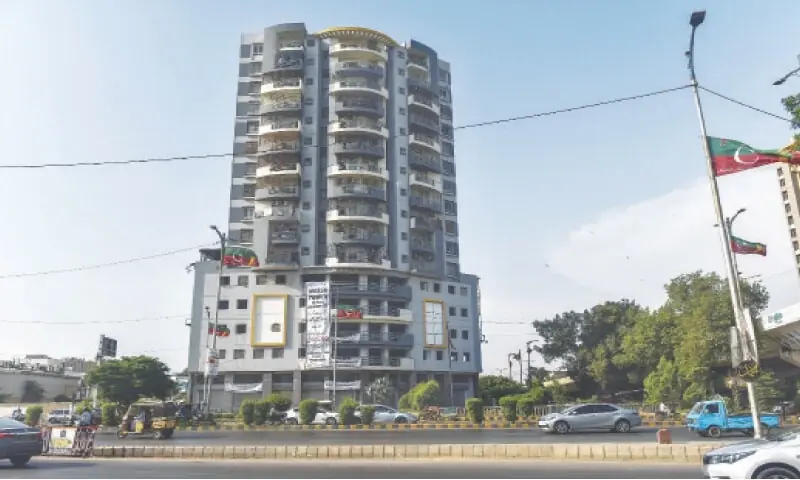
ISLAMABAD / KARACHI: The Federal Constitutional Court (FCC) on Thursday recalled expansive Supreme Court orders from 2018 and 2019, which had authorised the Sindh government to demolish a number of illegally constructed buildings in Karachi, including the infamous 15-storey Nasla Tower on Sharae Faisal.
In a judgement billed as redefining the boundaries of exercising judicial authority, the FCC ruled that though the objective behind the SC directions to demolish illegal buildings were well-intentioned and aimed at improvement of the city, the enforcement of building laws remained primarily within the domain of the provincial government, not the judiciary.
Justice Aamer Farooq, who authored the judgement, was heading a two-judge FCC bench that had taken up a set of appeals initially moved before the Supreme Court, but later transferred to FCC after the passage of the 27th Constitutional Amendment.
The ruling emphasised that it was for the government and its agencies to take all necessary legal measures to ensure due process in each case. The FCC cannot, on the basis of some reports of the Sindh Building Control Authority (SBCA) alone, direct the demolition of dwellings without adherence to the requirements of due process.
Ruling regrets how SC overstepped its role in launching demolition drive across Karachi, expanded into matters that were not placed before the court
The court noted that proceedings before the SC took an unexpected turn when it went beyond the issues before it, and proceeded to issue directions concerning the demolition of buildings that were allegedly illegally constructed in the city.
The matter stems from a case regarding the legality of construction of a multi-storey building in Lyari’s Mussa Lane. In November 2016, the Sindh High Court ordered the SBCA to demolish the building, which was challenged by the building owner before the SC.
The appeal continued to be heard from 2017 onwards and various orders were passed against illegal constructions across Karachi, and action was ordered against responsible officials of the SBCA.
In July 2018, the proceedings took a marked and unexpected turn, when the SC bench, including then-Justice Gulzar Ahmed, summoned a complete list and details of buildings with their status, which were constructed in Lyari Town without the approval of their building plan.
On Dec 21, 2018 the SC observed that it was not just Lyari Town, rather illegal construction had been carried out all over Karachi.
Consequently, the SBCA DG was directed to take action against all responsible officers found involved in aiding and abetting such illegal constructions.
Justice Farooq noted that on Jan 22, 2019, the SC bench headed by Justice Gulzar – who subsequently went on to become chief justice of the Supreme Court – gave an overarching order stating that various commercial activities were underway in Jam Sadiq Ali Park, and ordered all the marriage halls, markets, shopping centres built there to be demolished.
It had also directed the provincial authorities to ensure that city was restored in line with its original master plan, and that no deviation from it should be allowed.
Pursuant to these orders, extensive enforcement actions were undertaken across Karachi, resulting in proceedings against a wide range of allegedly illegal premises, as a result of which Nasla Tower was also demolished after a few years.
Thereafter, many individuals, who were aggrieved by such orders, including the Association of Builders and Developers (ABAD), had filed applications between 2019 to 2025 before the Supreme Court to become interveners in the appeal in question. After the formation of Federal Constitutional Court, all these matters landed in the FCC.
What initially commenced as adjudication of an SHC order gradually transformed into a broader anti-encroachment drive, accompanied by judicial proceedings concerning various allegedly illegally constructed buildings and houses, the FCC judgement regretted.
While the proceedings were initially confined to examining the legality of the impugned order only, they gradually expanded into what may aptly be described as the realm of “continuous mandamus” wherein the SC began to exercise supervisory role, FCC said.
The FCC emphasised that it was a trite law that when a court was seized of a matter, it must remain confined to the issue at hand and ought not to undertake any inquiry that was unnecessary for the adjudication of the matter before it.
FCC regretted that the tangent on which the SC-bench proceeded was not correct. Therefore, the broader directions issued by the Supreme Court did not satisfy the requirement of being necessary for resolving controversy actually pending adjudication.
At the same time, the judgement noted, that it did not seek to legalise illegality or confer any lawful cover upon unauthorised constructions within Karachi. A comprehensive legal framework already exists, supported by rules and designated regulatory authorities tasked with addressing such violations, the judgement said.
The Sindh government and other relevant departments are under a corresponding constitutional and statutory duty to supervise and regulate these matters, the ruling emphasised.
The court then recalled the earlier Supreme Court orders of Dec 21, 2018 and Jan 22, 2019, and withdrew all directions issued, and all consequential reports, proceedings, and actions taken or awaiting implementation in the matter.
In an additional note, Justice Syed Arshad Hussain Shah emphasised that the protection and preservation of fundamental rights of the citizens of Karachi was paramount.
Citizens are entitled to enjoy public amenities and civic facilities that contribute to a healthy, safe, and dignified life, Justice Shah observed adding such facilities include public parks, playgrounds, green belts, recreational spaces, libraries, community centres, footpaths, pedestrian walkways, public beaches, open spaces, sports facilities, healthcare and educational institutions and other civic amenities intended for public use and welfare.
These public assets constitute an integral part of the citizens’ right to life and human dignity and must be safeguarded from unlawful encroachment, arbitrary conversion, misuse or deprivation, the additional note said adding no person or authority, under the guise of any, policy, executive instruction or administrative order may curtail or diminish the rights already existing and approved in master plans except in accordance with the Constitution and the law. All concerned departments, agencies, and local authorities are, therefore, expected to ensure the preservation, maintenance, and accessibility of such public amenities for the benefit of present and future generations, the additional note said.
Published in Dawn, July 10th, 2026