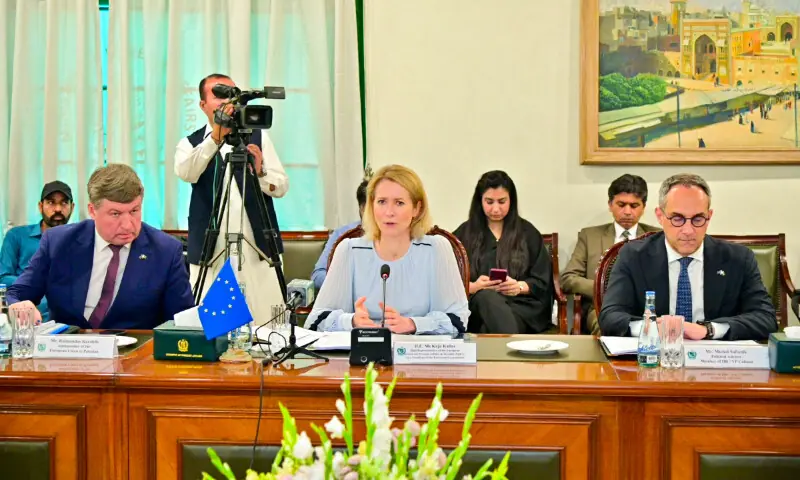
European Union (EU) top diplomat Kaja Kallas on Monday said the bloc sought stability in the region, adding that it was in everyone’s interest for the ongoing war in the Middle East to end and for the Strait of Hormuz to remain open.
Kallas, who serves as vice-president of the European Commission and the EU high representative for foreign affairs and security policy, is visiting Pakistan at the invitation of Deputy Prime Minister and Foreign Minister Ishaq Dar to participate in the 8th round of the EU-Pakistan Strategic Dialogue, which was held earlier today.
In an interview on the Geo News programme ‘Capital Talk’, Kallas said, “This is in everybody’s interest that this war is stopped and the Strait of Hormuz is opened. We are paying a very high price. There are a lot of things dependent on the Strait of Hormuz.”
During the appearance on the show, she commended Pakistan for being a mediator between the United States and Iran, bringing all the parties together, adding that, “Eventually, the [warring] parties have to decide.”
“Everybody is hoping that the first phase of this agreement is signed, so the talks on the difficult topics like nuclear can be started,” she said.
Kallas added that the EU seeks stability in the region. “The problems of our neighbour today could be the problems for us tomorrow. We are all very interlinked.”
She called the Strait of Hormuz a “chokepoint”, mentioning that the EU was also looking forward to diversifying its trade routes and supply chain. “You cannot remain dependent on a single route.”
When asked if she sees any parallels between Russia’s war against Ukraine and Israeli actions in Gaza and Lebanon, she replied: “I see parallels in all these crises undermining international law. We have the UN Charter, which is very clear: you can’t attack another country; you have to respect another country’s sovereignty and territorial integrity. No one should be above the law.”
Talking about the renewal of Pakistan’s GSP+ status, Kallas said, “We discussed it with our counterparts today. The preferential access to our markets is also conditional.”
“It is true that we have a report coming up in July, and then the question of renewing this preference,” she added.
“However, the conventions have to be adopted, particularly on human rights issues, where we need to see improvements.”
She elaborated that the renewal process goes through the EU Parliament.
“The EU Parliament is always scrutinising, and we have been raising these issues on what more can be done to improve the situation,” she said.
When asked whether the EU was satisfied with Pakistan’s legislation to meet the conditions, she said: “Our counterparts are mentioning what they are doing in various files, but this is something where we clearly need to see improvements.”
“We are putting forward some very concrete questions. Hopefully, there is time for improvement in those areas, and then we can renew this scheme easily,” she concluded.