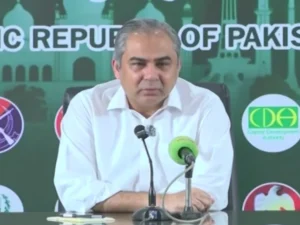
Prime Minister Shehbaz Sharif on Monday called for Islamabad and Beijing to “really be together” in ongoing efforts to restore peace in the Middle East amid the US-Israel war on war.
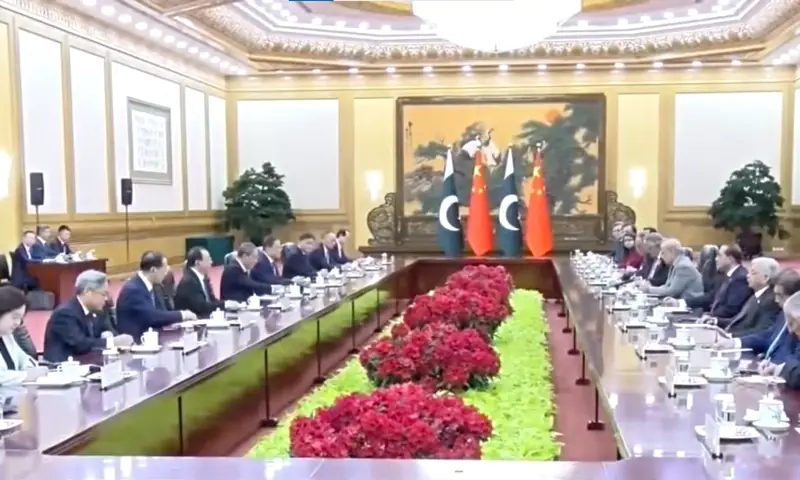
He made the remarks during bilateral talks with his Chinese counterpart Li Qiang at the Great Hall of the People. PM Shehbaz landed in China on Saturday on a four-day official visit, reaching Beijing yesterday after making a stop in Hangzhou.
Addressing the delegation-level talks with Li, PM Shehbaz mentioned the Middle East conflict, saying that the “world is passing through a very critical moment”.
“I think we have to really be together, so that the world at large is at peace and business as usual starts again, because this crisis has hit not only the economy in the region […] but the global community,” he said.
Chief of Defence Forces and Chief of the Army Staff Field Marshal Asim Munir, who concluded his visit to Iran on Saturday, was also present on the occasion.
“There is a crisis in the Gulf and Pakistan has played a very sincere role to mediate between the United States and Iran,” PM Shehbaz said, noting that CDF Munir had just returned from Tehran.
“And he didn’t want to miss this great visit, and he assured me that he will be joining me in this meeting, and he has been travelling throughout the night,” Shehbaz added.
The premier highlighted that the army chief “played a very important role back and forth with the Iranian leadership and the American leadership”, also mentioning Deputy Prime Minister Ishaq Dar’s communications with his regional counterparts.
“We hope and pray to Allah Almighty that peace will be restored forever, and lots of ground has already been covered. Things are moving in the right direction,” PM Shehbaz said.
He thanked President Xi Jinping and the Chinese leadership for their “great support to Pakistan to promote peace and achieve a ceasefire”, adding that Islamabad fully endorsed Xi’s four-point peace agenda.
At the outset of his remarks, the prime minister thanked the Chinese side for its “very warm invitation” to visit China.
“It is always a great pleasure to visit your great country, and each time we come, we find new changes and major developments taking place all over this wonderful country,” he said.
The premier extended his condolences over the tragic gas explosion at a coal mine in Shanxi, where at least 82 people were killed.
PM Shehbaz stressed that the visit came at a “critical moment of history”, noting that both countries were celebrating 75 years of “our glorious friendship and diplomatic relations established by our founding fathers”.
“They did a great job, they laid a strong foundation, a strong edifice between our two countries and here we are, trying to take that legacy and moving in that direction,” he added.
Li also gave his remarks on the occasion.
PM Shehbaz was earlier presented with a guard of honour upon his arrival at the Great Hall of the People.
Both the leaders shook hands and introduced their respective delegations to each other. The national anthems of Pakistan and China were played as both leaders stood at the salute dias.
While in Beijing, the prime minister will hold meetings with the Chinese leadership, including President Xi and Premier Li.
He will also attend a reception hosted by the Chinese People’s Association for Friendship with Foreign Countries to commemorate the 75th anniversary of diplomatic relations between the two countries.
Deputy PM and Foreign Minister Ishaq Dar, Planning Minister Ahsan Iqbal, Information Attaullah Tarar, IT Minister Shaza Fatima Khawaja, and other senior government officials are accompanying PM Shehbaz on the visit.
In his visit so far, PM Shehbaz has focused on bolstering multisectoral cooperation between Islamabad and Beijing, particularly in business and technology.
His visit began with pacts on bilateral cooperation, followed by meetings with the heads of major Chinese companies, including Alibaba Group. Memorandums of understanding (MoUs) and agreements “worth billions of dollars” were signed in Hangzhou.
On Sunday, he highlighted four key areas of future cooperation as he addressed a business forum.
Additional input from APP