• Naqvi lands in Tehran to ‘promote regional peace’, facilitate talks; Dar speaks to Uzbek counterpart
• Araghchi says Iran does not trust the US at all due to contradictory messages
• Iran’s UN envoy blames Hormuz disruptions on aggressors amid claims of Europe’s request for transit
• Putin, UAE president discuss Iran conflict in phone call
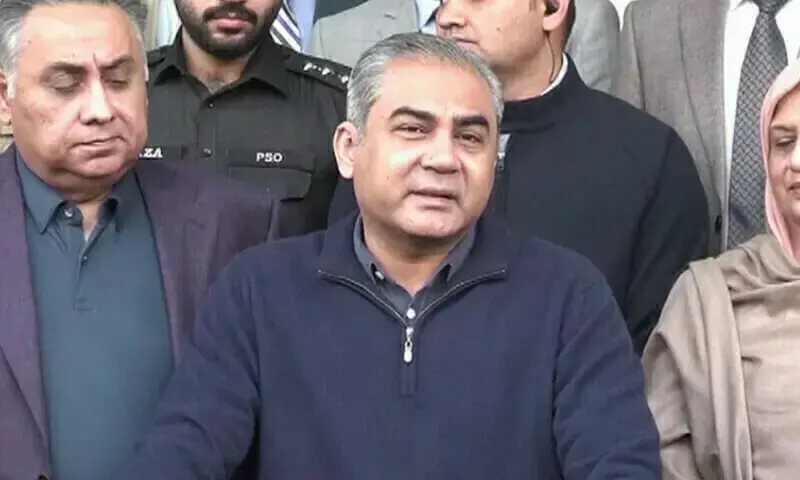
ISLAMABAD: Interior Minister Mohsin Naqvi landed in Tehran on a previously unannounced two-day visit, which diplomatic sources said was linked to Pakistan’s continuing efforts to revive the stalled Iran-US peace process after President Donald Trump rejected Tehran’s latest response to American proposals.
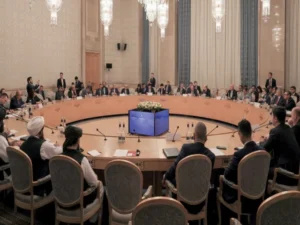
Diplomatic sources in Islamabad said the unscheduled trip was part of Pakistan’s continuing shuttle diplomacy aimed at preventing the negotiations from collapsing entirely after momentum generated by earlier rounds of talks in Islamabad slowed sharply.
The visit, officially framed around bilateral and border security cooperation, came as the fragile ceasefire brokered earlier through Pakistani mediation continued to hold unevenly amid intermittent tensions around the Strait of Hormuz and prolonged disruption to global energy shipping.
Mr Naqvi is expected to hold meetings with senior Iranian officials during the visit, including Interior Minister Eskandar Momeni, with discussions likely to cover both bilateral security matters and the wider regional situation.
The visit came hot on the heels of President Trump’s trip to China and his meeting with Chinese President Xi Jinping, which produced no visible breakthrough on Iran despite speculation beforehand that Beijing could quietly encourage Tehran toward compromise.
Analysts noted that Trump returned from Beijing still publicly emphasising coercive leverage, while simultaneously indicating limited flexibility on enrichment timelines. Speaking to reporters aboard Air Force One, he said he could accept a 20-year suspension of uranium enrichment if Iran provided what he described as a “real” guarantee, appearing to soften his earlier insistence on a permanent dismantlement of Iran’s nuclear programme.
At the same time, he dismissed Tehran’s latest proposal in blunt terms and complained that Iranian officials were backtracking on earlier understandings regarding the handling of highly enriched uranium stockpiles. The deadlock has reinforced concerns that the negotiations are increasingly moving into a prolonged phase of simultaneous diplomacy and pressure rather than toward any imminent comprehensive settlement.
According to the Iranian media, at least 1,260 people were killed in Tehran and more than 2,800 were injured due to the US and Israeli attacks. Some 51,000 residential housing units were damaged, Tehran’s municipal government said, adding that the attacks left 10,733 cars and 754 motorcycles damaged.
Separately, Foreign Minister Ishaq Dar and Uzbekistan Foreign Minister Bakhtiyor Saidov exchanged views on bilateral and multilateral matters of mutual interest, including Pak-Uzbek relations and regional developments. FM Saidov appreciated Pakistan’s constructive role in mediation for regional peace and security, the Foreign Office said in a press release.
‘Can’t trust Americans’
Meanwhile, in an interview with Al Jazeera, Iran’s Foreign Minister Abbas Araghchi said the contradictory statements by the US had made Tehran reluctant about the real intentions of the Americans in these negotiations.
He said, “The most important question right now is the question of trust.
We cannot trust Americans at all.”
The top diplomat said that due to the prevalent mistrust, everything should be defined “very clearly before we can conclude a deal”.
He said things that could not be achieved by force could not be accomplished via talks unless there was a win-win solution.
‘Iran has interest in deal’
Meanwhile, US President Donald Trump said Iran has “an interest in reaching an agreement” as negotiations over the country’s nuclear programme and the ongoing conflict continue without resolution, Anadolu reports.
In a telephone interview with French broadcaster BFMTV, Trump says he is uncertain whether a deal will soon be reached. “I have no idea. If they don’t, they’re going to have a very bad time. They have an interest in reaching an agreement,” he added.
Putin, UAE discuss Iran
Russian President Vladimir Putin discussed the Iran conflict with his United Arab Emirates counterpart, Mohammed bin Zayed Al Nahyan, the Kremlin said in the statement on Saturday. “Both sides emphasised the importance of continuing the political and diplomatic process aimed at reaching compromise-based peace agreements,” it said.
Putin also thanked the UAE for support in humanitarian issues related to the conflict in Ukraine, Reuters reported.
Pezeshkian praises Pope
On the other hand, Iranian President Masoud Pezeshkian thanked Pope Leo for his stance on recent US military strikes against Iran, according to a message published by the Iranian state news agency Fars.
Mr Pezeshkian said the pope had taken a “moral, logical and fair” position against the strikes, which he said were carried out under false pretences, in violation of international law, and with Israeli support.
Hormuz repercussions
Meanwhile, Iran warned of mounting instability in energy markets, supply chains, and global trade flows if the war continued.
The current situation in the Strait of Hormuz and its global economic repercussions are “solely” the responsibility of those who launched war against Iran and their regional partners, Iran’s Permanent Representative to the UN Amir Saeid Iravani told the UN Economic and Social Council.
According to Iranian state-run IRNA, he was addressing the session on ‘Safeguarding Energy & Supply Flows: Supporting Global Development through International Cooperation’.
“In this context, Iran has suffered in two profound and interconnected ways,” Mr Iravani said, adding that in less than a year Iran had been subjected to “two unlawful acts of aggression” that were clear violations of the UN Charter and international law.
As it continues to disrupt shipping in the vital energy route, Iran prepared a mechanism to manage traffic through the Strait of Hormuz along a designated route that will be unveiled soon, the head of the Iranian parliament’s national security committee Ebrahim Azizi said. He added that only commercial vessels and parties cooperating with Iran would benefit from the arrangement. He said fees would be collected for specialised services provided under the mechanism.
Iranian state television said European countries had been in talks with Tehran over transit for ships through the Strait of Hormuz, AFP reported. “Following the passage of ships from East Asian countries, notably China, Japan and Pakistan, we received information today indicating that Europeans have also begun negotiations with the Revolutionary Guards navy” to get permission to pass, state television reported, without specifying which countries.
With input from Agencies
Published in Dawn, May 17th, 2026