
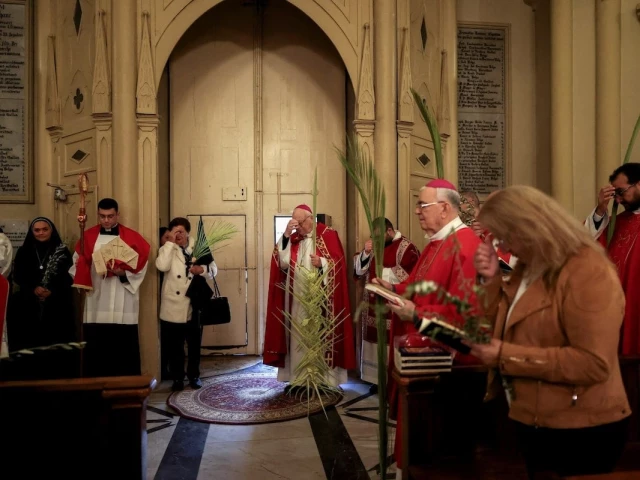
Christian worshippers mark Palm Sunday, following the cancellation of the traditional Palm Sunday procession from the Mount of Olives, amid restrictions on gathering in large groups and the US Israel conflict with Iran, at the Latin Patriarchate of Jerusalem in Jerusalem’s Old City March 29, 2026. PHOTO: REUTERS
In Taybeh, one of the few Palestinian communities with a Christian majority in the occupied West Bank, fears are growing that Israeli occupier attacks on farmland and property could push more families to emigrate, threatening the town’s demographic character and historic Christian presence.
Local officials and clergy warned of the impact of rising violence by Israeli occupiers, which has coincided with worsening living and economic conditions in the town.
Taybeh, east of Ramallah, is one of the few Palestinian towns in the West Bank that still has a Christian majority, according to church and local accounts. Residents say the town’s Christian roots go back thousands of years.
Residents say the attacks have deepened fears in the town, even as they stress their determination to remain on their land.
Also Read: Pakistan raises red flag over illegal settlements in West Bank, calls for Israel accountability
In recent years, Israeli occupiers have established several illegal settlement outposts around Taybeh, the latest in April. The town is now surrounded by several illegal settlements and pastoral outposts where occupiers from the right-wing Hilltop Youth group are active.
Occupier attacks on Taybeh and nearby Bedouin communities have included burning vehicles, stealing sheep and blocking access to farmland, residents said.
Palestinian officials have repeatedly warned that Israel seeks to empty Palestinian lands of Christians in an attempt to separate them from the core of the national struggle and promote a false narrative to the world that the conflict in Palestine is religious rather than political.
Mounting pressure
The Rev Jack-Nobel Abed of the Greek Melkite Catholic Church in Taybeh said the town is “going through a difficult stage” of repeated Israeli restrictions and attacks, especially since the war on Gaza.
“We preserve the faith of this town, which has remained 100% Christian in the West Bank, and we believe we have a mission in this Holy Land, despite the increasing restrictions and attacks we face,” Abed told Anadolu.
He said the situation is not limited to “isolated incidents,” but represents “a policy of pressure aimed at weakening the Christian presence in Palestine.”
Read More: Latin patriarch of Jerusalem condemns destruction of Jesus statue by Israeli soldier in Lebanon
Abed said the “extremist settlement project” affects the daily lives of Taybeh residents through restrictions and attacks by Israeli occupiers. “We do not speak from a place of fanaticism, but from a place of preserving our presence, identity and mission in this land,” he added.
Abed said Taybeh has recently faced several forms of attacks, including movement restrictions, closures and assaults on property.
The overall situation has created “a state of anxiety and fear among residents” and affected social stability, he said. “We are facing a difficult reality, but it does not weaken our faith that remaining and standing firm is the basic message,” he added.
Abed said occupier attacks on monks and nuns in occupied East Jerusalem, along with continued harassment of the Christian presence, are “part of a broader picture of what is happening in Palestine.”
Continuous escalation
Acting Taybeh Mayor Khaldoun Hanna said the town, whose roots go back thousands of years and which has about 1,500 residents and thousands of expatriates abroad, faces “a continuous escalation in occupier attacks.”
Hanna told Anadolu that Taybeh sits on a hill east of Ramallah and its residents depend mainly on agriculture, especially olive farming. But he said that sector has faced increasing restrictions in recent years.
“Israeli occupiers have prevented residents from reaching about 5,000 dunams of farmland, and they have also prevented them from harvesting olives across wide areas, causing major economic losses,” he said.
Hanna said the attacks have not been limited to farmland, but have also included repeated raids into the town, attacks on homes and property, the burning of cars, and attempted vandalism.
Also Read: Israeli police block Catholic cardinal from Jerusalem’s Holy Sepulchre on Palm Sunday
“The most dangerous incident was an attempt to burn the Byzantine Church of St George inside the town, but residents managed to control the fire before it spread,” he said.
Last July, Israeli occupiers set fire near the cemetery and the historic St George Church, drawing wide church and international condemnation of occupier attacks on holy sites and places of worship.
Hanna accused occupiers of acting “under the protection and support of Israeli forces,” saying the goal of the attacks is “to push residents toward migration and empty the area.”
“There are daily pressures on residents and constant attempts at provocation to create friction, but residents try to avoid direct confrontation despite the provocations,” he said.
Worrying migration
Hanna said Taybeh has seen limited but worrying migration in recent years. “In the past two years alone, at least 10 families have left because of the economic situation and ongoing pressure,” he said.
Residents’ reliance on agriculture makes them more vulnerable to field restrictions, Hanna said. “When a farmer is prevented from reaching his land, his main source of livelihood is cut off, and this affects social stability,” he said. “The crisis is not only economic, but also psychological and social, because people feel their future is threatened,” he added.
Hanna said the attacks do not distinguish between members of Palestinian society, saying “mosques, churches and property are all targeted.” He said that despite the continued pressure, residents “remain committed to staying and standing firm on the land.”
The testimonies come amid Palestinian warnings over escalating occupier violence in the West Bank, along with restrictions on residents’ movement, blocked access to farmland and growing concerns over the impact on the Palestinian presence in rural areas, including towns with religious and historic significance such as Taybeh.
More than 770,000 Israeli occupiers live in the West Bank, including about 250,000 in the occupied East Jerusalem, according to Palestinian estimates, in settlements the United Nations considers illegal.
Since Israel’s genocidal war on the Gaza Strip began in October 2023, Israeli forces and occupiers have escalated attacks in the West Bank, killing at least 1,155 Palestinians, wounding 11,750 and arresting nearly 22,000, according to Palestinian figures.