For forty years Washington has known what Tehran is doing but it still didn’t find the right moves.
On Friday, April 11, while Pakistani officials were arranging the seating plan for ceasefire talks in Islamabad, the USS Frank E. Peterson and USS Michael Murphy entered the Strait of Hormuz. Murphy switched on her Automatic Identification System, a deliberate broadcast, visible to every vessel and coastal radar in the Gulf, announcing her presence in a waterway no American warship had entered since Operation Epic Fury began on 28 February.
A radio exchange recorded by a civilian vessel captured the Iranian warning to them: “This is the last warning. This is the last warning.” The American reply invoked the rules of the ceasefire. The same ceasefire whose negotiation was being prepared, at that moment, in a conference room in Islamabad.
Three days later, Vice President J.D. Vance walked out of the Islamabad Marriott after twenty-one hours of talks. He told reporters Iran had “chosen not to accept our terms”. By 9am on Sunday — nine hours and thirteen minutes later — President Donald Trump announced that the United States Navy would block all maritime traffic through the Strait of Hormuz, effective 14:00 GMT. In the hours between Vance’s departure and the blockade order, Trump told reporters the ceasefire was “holding well”.
Holding well. Naval blockade. Same man, same morning. Two destroyers probing Hormuz while the talks were still live.
This is coffeehouse chess. Tricks, traps, and psychological pressure instead of sound positional logic. It works against weaker opponents who panic, but collapses against a prepared opponent.
The trick and the board
A ceasefire operates on a shared premise: both sides have agreed to stop fighting while they talk. A naval blockade is, however, an act of war. Not metaphorically. It is classified as a belligerent act requiring formal declaration, notification to all affected states, and proportionality review, according to the San Remo Manual on International Law Applicable to Armed Conflicts at Sea, which incidentally is the same framework the US has cited for 40 years when criticising Iranian conduct in the Gulf. There is no legal or doctrinal framework in which a ceasefire and a blockade coexist. There is a simple binary; you are either negotiating with your enemy or you are besieging them. In this case, Washington chose a siege.
We need to look no further than the Cuban Missile Crisis of 1962 to find an example of the care with which the word ‘blockade’ was used, since it is defined as an act of war. That 13-day standoff between the United States and the Soviet Union was the closest the Cold War ever came to nuclear conflict. President John F. Kennedy’s advisers warned him never to use blockade to describe US actions against Cuba. His team instead chose to use “defensive quarantine” (as framed under the Rio Treaty), with multilateral authorisation secured before the first ship was turned. The President’s brother and Attorney General, Robert F. Kennedy, argued against the air strike option and pushed for the framework that gave Khrushchev space to climb down. Every word was chosen to limit escalation, maintain legal cover, and preserve the coalition.
Another Kennedy now sits on the Trump cabinet. The name that once defined the most careful exercise of American executive restraint in the nuclear age now belongs to a man in an administration that used the word his grandfather’s advisers refused to say and even posted it on social media. This was done without any UN mandate or coalition, and the United Kingdom explicitly refused to participate.
The Sicilian on the other side of the board
Iran is playing the Sicilian. It did not meet Epic Fury with more fury. It responded with asymmetry in the shape of drone costing between $20,000 and $50,000 that force $4 million Patriot intercepts. SM-3 Block IIA interceptors at $36m went up against Iranian ballistic missiles at $500,000 to $2m. This comes to a cost-exchange ratio of 106:1 on drones and 18:1 on missiles. Iran closed the Strait of Hormuz with mines, fast-attack boats, and cheap unmanned systems, achieving what the world’s most powerful navy could not reverse cheaply. Black controls the centre without occupying it.
Iran’s April 8 strike on the Saudi East-West (Petroline) pipeline cut Riyadh’s output by 600,000 barrels per day in a single kinetic event. Oman was spared in the process, while the Gulf states most closely aligned with Washington absorbed the impact.
What Iran has achieved at the Strait is closer to condominium than closure. Five of six vessels transiting on April 20 used an Iran-approved Bandar Abbas route. The US enforces a blockade at Iranian ports. Iran enforces the waterway. Hormuz opens when Iran says so.
Iran is also bearing tangible costs for maintaining this position. Key sites such as Kharg Island, Abadan, and Natanz have taken direct strikes. The Rial has collapsed. IRGC brigadiers are buried. Hezbollah’s southern Lebanon command is degraded. The Houthi network is thinned. These are real losses on Iran’s balance sheet.
The Mosaic Defence Doctrine — Difa-e-Mozaiki — was designed in the Iran-Iraq war for this. It disperses authority across the IRGC, Artesh, Quds Force, and the Supreme Leader’s office. The structure ensures that no single node is load-bearing and that no individual strike can produce systemic collapse. The costs imposed on Washington’s ledger are the very outcomes this architecture was built to generate. Tehran reopened Imam Khomeini and Mehrabad airports last week.
Forty-five days in, the bill is being racked up. Between $22.3 billion and $31 billion have been estimated as total direct US military spending in five weeks by The American Enterprise Institute. At peak intensity that comes to $21,800 per second. Dated Brent spot (the price refiners actually pay) hit $124.68 on the announcement of the blockade. Goldman Sachs has warned that Brent could average above $100 for all of 2026 if Hormuz stays closed another month.
Here is the cost question the blockade introduces that the war itself did not: the United States is now paying to enforce a closure that Iran already achieved for free. Iran imposed the energy disruption with cheap, distributed, deniable systems. The US Navy is formalising it with a carrier strike group, destroyer escorts, minesweepers, and logistics chains that burn billions per week. America is spending billions to blockade a strait that its adversary already closed with millions.
On the same day the blockade took effect, the White House suspended the Jones Act, the 1920 law requiring US-built, US-flagged, US-crewed vessels for shipping between American ports. Control of Hormuz was declared with one hand. Foreign-flagged tankers were waved into American ports with the other. The announcement of maritime dominance and the admission that Washington’s own tanker fleet could not absorb the disruption were issued hours apart.
The administration’s case
The administration’s stated case is not without substance, at least on paper, as it rests on a series of arguments that appear coherent when considered individually. A blockade chokes IRGC oil revenue faster than sanctions can. It interdicts weapons resupply to Hezbollah and the Houthis. It forces a nuclear-concession timetable by threatening the economic base faster than diplomacy alone would. It signals to Gulf partners that the US force is available without UN cover.
Each of those is defensible in isolation. None survives contact with the cost-exchange numbers above, the Jones Act suspension below, or the eight days that remained on the ceasefire clock when the blockade was ordered. All four also assume a functioning adversary capable of central capitulation. Iran’s IRGC command structure does not permit that. You cannot coerce a decentralised opponent with a centralised instrument.
Counterplay
There are, however, four serious counters that deserve engagement.
First, the madman theory works. Nixon popularised this notion in 1969 when he deployed it against Moscow and Hanoi. He deliberately cultivated an image of unpredictability as a form of coercive leverage, while simultaneously anchoring that posture in a clearly defined back-channel managed by Kissinger. To situate this in the current context, Trump’s back-channel is Kushner. But here’s the catch. While Kissinger operated as a national security figure without any commercial entanglements with the very actors he was engaging, Kushner’s firm, Affinity Partners, is tied to a $2 billion commitment from Saudi Arabia’s Public Investment Fund. A back-channel whose ledger overlaps with the counterparties’ is a different instrument. Madman theory needs a sane back-channel. There isn’t one.
Second, what is being perpetuated as Iran’s asymmetric victory is, on closer inspection, a form of suffocation recast as strategy, because any move to close the Strait of Hormuz simultaneously constrains Iran’s own oil revenues. The country is not so much winning as it is being economically strangled while narrating that strangulation as a calculated game of chess. This interpretation is only partially true. Iran is playing for a Trump approval-rating collapse and a Gulf break with Washington over energy prices. A pressure is already visible in downward revisions of GCC growth forecasts for 2026, with Qatar projected at minus 13 per cent, the UAE at minus 8pc, and Saudi Arabia at minus 6.6pc. Both of Iran’s clocks run ahead of its foreign reserves.
Moreover, cost-exchange ratios flatter the cheaper shot. A $13.5 million PAC-3 intercept of a $30,000 Shahed is defensible if it saves a $2 billion destroyer. This logic holds true at the level of the marginal engagement but begins to break down when applied across the duration of an entire campaign. Over time, defensive magazine depth is exhausted far more quickly than offensive drone production capacity, which shifts the balance in consequential ways. The king the campaign was built to topple is holding. The king that ordered it walks into checkmate.
Lastly, the argument that the legal framework governing such conflicts was already effectively dead is not without precedent. Cases in point: Iraq 2003, Libya 2011, Gaza 2023. Trump did not so much dismantle the international order as he abandoned the pretense of its continued vitality. This, too, is only partially accurate, because frameworks like the Cuban-quarantine model had survived through repeated acts of political choice by successive administrations to uphold them. Erosion through neglect is not demolition by announcement.
Who the blockade is for
Strip away the operational details and ask the institutional question: who benefits from a naval blockade of a strait that is already closed? Not Iran, whose ports were already non-functional, and who now has a legal and rhetorical framework for escalation that the international community will find difficult to dismiss.
Not the Gulf states, whose trade disruption has been formalised under American authority. Riyadh’s silence on the announcement is not diplomatic courtesy. It is institutional fury expressed through omission. Not the negotiations, which died the moment two destroyers pushed through Hormuz while the diplomats were still assembling in Islamabad.
The blockade is for the domestic audience. This is the base that reads “naval blockade” as strength and sees carrier groups as proof of resolve. It does not ask what a blockade costs per day or what legal precedent is destroyed for a decade. It receives “holding well” and “blockade” in the same news cycle and processes both of them as winning. This is not strategy calibrated for an adversary. It is a press conference held for the base.
Pakistan’s position
Pakistan brokered the first face-to-face contact between the United States and Iran since 1979. The Pakistan Air Force mobilised JF-17s, F-16s, and IL-78 tankers to escort the Iranian delegation and establish a protective shield over the flight corridor. Germany, Oman, Turkey, Egypt, and the UN Secretary-General publicly thanked Islamabad. Then the talks collapsed. The blockade followed. But the diplomatic capital did not evaporate, it transferred.
Pakistan is the only state with active military relationships on both sides of this war, is also nuclear capable, shares a border with Iran, and holds a Strategic Mutual Defence Agreement with Saudi Arabia that is now being operationalised with fighter jet deployments to King Abdulaziz Air Base. This combination does not exist elsewhere on the board.
The Gulf states need a security guarantor that is not the United States. Pakistan is building that portfolio in the shadow of a war it tried to stop—the $4 billion Libya deal, the $13 billion defence export pipeline, and a mediation track record that no other actor, not Oman, not China, not the UN, has matched in 2026. The talks may have failed, but the peacemaker’s position on the board did not.
The endgame
The two-week ceasefire was declared on 8 April, and it expired on 22 April.
The ceasefire was already a fiction, which is why we saw both sides violate it within hours. The IRGC’s decentralised command structure produced continued drone and missile strikes on Gulf targets. US-Israeli operations never fully paused. Hours after the ceasefire declaration, Israel launched what Prime Minister Benjamin Netanyahu called “the most strong attacks” across Lebanon, an estimated 357 killed in a single day. Netanyahu explicitly stated the ceasefire “does not apply to Lebanon.” This makes it a ceasefire that excludes the front where the most people are being killed. And to this, Washington’s response was silence.
But a fiction that both sides maintain is different from a fiction that one side publicly abandons. The blockade announcement is that abandonment, dressed in the language of enforcement, stripped of the pretence of restraint.
Iran is playing sound positional chess. Controlling the centre. Maintaining material balance through asymmetric systems. Waiting for the coffeehouse player to run out of tricks and face the board as it actually is.
Trump said the ceasefire is “holding well.” He also ordered a blockade. Both statements cannot be true. Only one of them requires a carrier strike group.
That is the one worth believing.
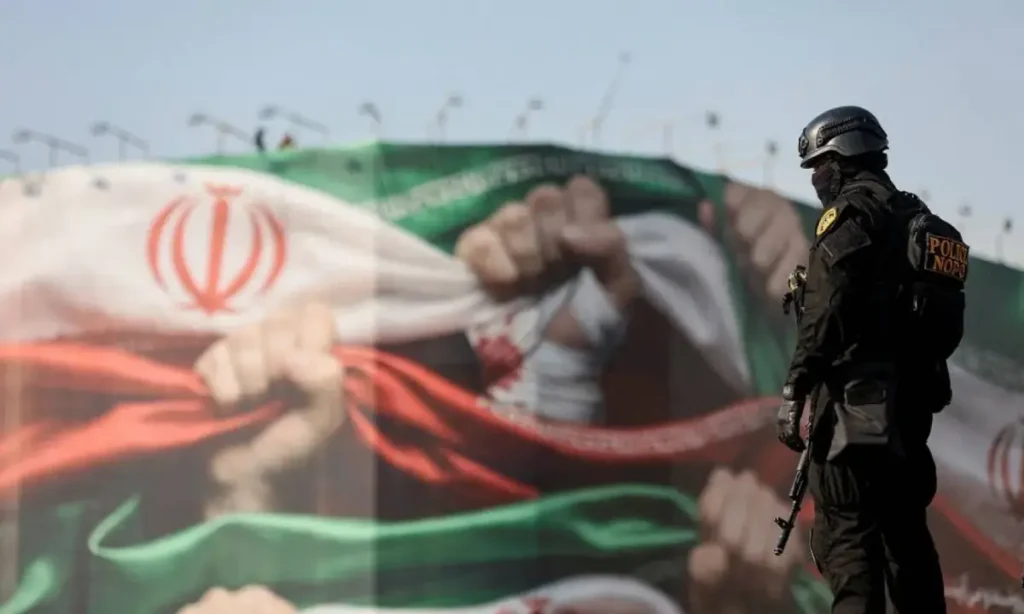
Header image: A member of the Iranian police attends a pro-government rally in Tehran, Iran, January 12, 2026. — Reuters