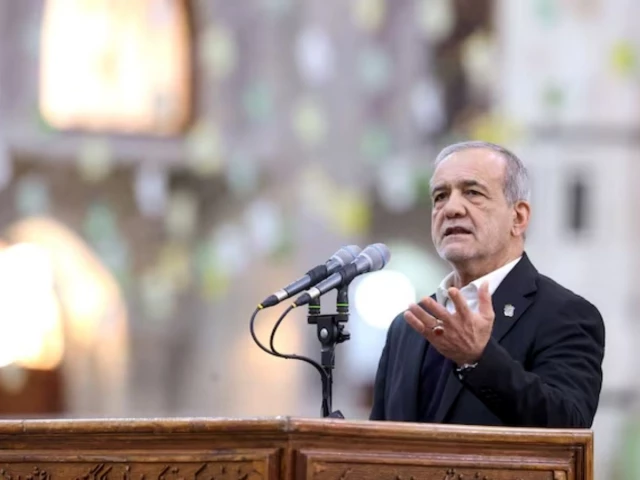
Iranian President Masoud Pezeshkian speaks during a visit to the shrine of the leader of Iran’s 1979 Islamic Revolution, Ayatollah Ruhollah Khomeini, in southern Tehran, Iran, January 31, 2026. Iran’s Presidential website/WANA (West Asia News Agency)/Handout via REUTERS
DUBAI:
Iranian President Massoud Pezeshkian, in remarks broadcast on state TV on Saturday, blamed the United States for the failure of an interim deal with Iran, but said there should be a new attempt at concluding it.
“We were having negotiations, the cowards (Americans) messed everything up…I still think we should go and conclude it,” Pezeshkian said.
Meanwhile, Yemen’s Iran-allied Houthis said they launched attacks on Saudi oil facilities and airports on Saturday, and the Saudi-led coalition fighting the group said it downed two missiles, as clashes between the two sides intensified.
On another front of an escalating conflict reignited by the Iran war, Yemen’s Saudi-backed government said the Houthis also fired three ballistic missiles at coast guard sites in the southern Yemeni port city of Aden.
Saudi authorities did not comment directly on the Houthi statements, though they reported missile debris falling near the site of one of the purported oil targets. It was not immediately clear if any of the reported attacks had hit their targets in the kingdom or had been intercepted.
Houthi military spokesperson Yahya Saree said the group targeted King Khalid International Airport in Riyadh, an Aramco facility in Yanbu, the Rabigh oil refinery, crude oil pumping stations and the East-West Pipeline.
He also said the group targeted King Fahd International Airport in Dammam, an airport in Najran and an airbase in Khamis Mushait.
The Saudi-led coalition earlier said it destroyed two ballistic missiles fired by Houthis towards Yanbu and Taif.
Saudi Civil Defense said debris from intercepted missiles had fallen in the Makkah and Medina regions.
It said parts of the intercepted missiles fell in Wadi al-Mughammas in Mecca, while debris also fell in areas in Jeddah, Taif and Rabigh. It was not clear if that was linked to the Houthis’ reported targeting of the Rabigh oil refinery.
Shortly after that, Houthis denied that they attacked Mecca and Medina, saying that their operations “target Saudi oil facilities and military bases.”
The renewed fighting has shattered a 2022 UN-brokered truce that largely halted cross-border attacks between the Saudi-led coalition, which backs Yemen’s internationally recognised government, and the Houthis, who control the capital Sanaa.
The escalation has opened another front in the US-Israeli war on Iran.
In Yemen, the Interior Ministry of the internationally recognised government said two of the Houthis’ missiles had struck a coast guard headquarters, while a third hit a coast guard building in the Tawahi district.
Houthi spokesman Saree said the group’s forces had targeted Saudi-backed military gatherings at what he called Al-Nasr camp and a naval base in Aden, saying Saudi officers were overseeing the mobilisation there.
There was no immediate comment from the Saudi-led coalition on that assertion.
Earlier on Saturday, Saudi Arabia’s Civil Defense briefly issued alerts warning residents of potential danger in Taif and Yanbu, as well as in the holy city of Mecca and the kingdom’s second-largest city, Jeddah.
About 10 minutes later, the agency said the threat had passed.