Iraq and Syria signed agreements with a consortium including Chevron to study reviving a pipeline bypassing Hormuz
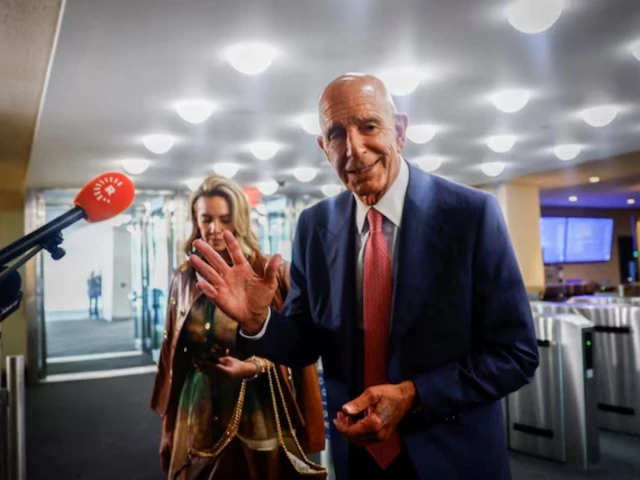
US pecial Envoy for Syria and Ambassador to Turkey Tom Barrack speaks to members of media the United Nations headquarters in New York City, US, September 24, 2026. REUTERS
Thomas Barrack, a top US diplomat in the Middle East, advocated for a firm run by his business partner to take part in the development of an oil pipeline from Iraq to Syria, three people said, activities which appear to violate federal ethics rules.
In July, Iraq and Syria signed memorandums of understanding with a consortium made up of the company, Californian investment group TI Capital, along with Chevron and Qatar’s UCC Holding, to carry out technical and financial studies in preparation for rehabilitating the pipeline, which would skirt the Strait of Hormuz chokepoint.
Barrack, US presidential special envoy to both Iraq and Syria as well as ambassador to Turkiye, has a longstanding business relationship with TI Capital and its founder Ziad Ghandour. During his 2025 confirmation hearings, he said he had a financial interest entitling him to as much as a fifth of the profits from a real-estate venture near San Francisco, California, managed by TI Capital—with Ghandour as chief executive— and that he intended to retain it; public records show.
During engagements with Syrian and Iraqi officials after the start of the war in Iran, Barrack pressed for Ghandour’s firm to be included in the project, according to two of the people who have direct knowledge of the discussions.
On June 16, a month before the consortium agreement was signed, Barrack and Iraqi Prime Minister Ali al-Zaidi issued a joint statement that commended Iraq’s decision “to advance a memorandum of understanding with TI Capital to rehabilitate the Kirkuk-Baniyas Pipeline”. The statement made no mention of Chevron or UCC in connection with the pipeline.
Reuters found no evidence that Barrack stands to profit from the pipeline or other projects. His ties to Ghandour would not constitute a criminal conflict of interest unless he stood to directly profit from the pipeline itself, two ethics lawyers told Reuters.
However, Barrack’s relationship with Ghandour makes such advocacy “a serious problem” under the regulation that prohibits officials from participating in matters that call into question their impartiality because of a personal or business relationship, said Richard Painter, a former chief White House ethics lawyer and a professor at the University of Minnesota Law School.
The impartiality rule, which is not a criminal statute, can be triggered by the involvement of a business associate in a project, regardless of whether the official has a financial interest of his own.
“The ethical concern is the appearance of a conflict of interest,” said Ann Skeet, interim executive director at the Markkula Centre for Applied Ethics at Santa Clara University.
Asked what Barrack would have needed to do to comply, Painter said: “Have nothing to do with this pipeline. Completely recuse. Say this is not a matter I participate in.”
Don Fox, a former general counsel and acting director of the US Office of Government Ethics, said that promotion of TI Capital by Barrack would additionally violate a regulation prohibiting officials from using their office to endorse any enterprise or for the private gain of people they are affiliated with.
Also Read: Pakistan committed to ‘negotiated and peaceful outcome’ between US, Iran: DG ISPR
Barrack has not filed a conflict-of-interest waiver with the US Office of Government Ethics regarding his ties to the company as it participates in the project, according to a Reuters records request. Waivers allow officials with potential conflicts of interest to participate in matters that would otherwise require the employee to be recused.
In a signed ethics agreement before his confirmation hearings last year, he committed to recusing himself from matters directly affecting the financial interests of the real-estate venture unless he first obtained such a waiver.
Barrack’s office and Chevron declined to comment. TI Capital, Ghandour and UCC did not respond to requests for comment.
In a July 17 post on X, Barrack said the involvement of US companies in Iraq and Syria was “a new paradigm” aimed at bringing clarity and opportunity to the region.
A fourth ethics lawyer said it was up to the State Department to decide whether its employee’s financial holdings create a potential conflict of interest.
“Ambassador Barrack has no affiliation with, role in, or financial interest in the Kirkuk-Baniyas pipeline project,” a State Department spokesperson told Reuters, while acknowledging Barrack’s relationship with the TI Capital real-estate venture.
His public comments on the pipeline reflect “long-standing, publicly stated US policy interest in regional energy integration”, the spokesperson said, adding that Barrack was certified to be in compliance with ethics rules.
The disclosed interest
In a financial disclosure filed with the US Office of Government Ethics in March 2025, before assuming his diplomatic roles, Barrack declared an equity stake in ACD-TI Oakley Investment LLC, a venture building a large housing project near San Francisco. The filing did not disclose the size of the stake, but said he was entitled to 20% of the company’s profits when the earnings reach an established minimum.
Read More: Pentagon prepares 3-day intensive Iran strike option as Trump says no attack before midterms: NYT
ACD-TI is managed by TI Capital and headed by Ghandour, California state corporate records show. Reuters was unable to find contact details for a company representative, and did not get a response to questions sent to its postal correspondence address.
The filing said the profit-sharing arrangement was in return for services he provided to the company. Barrack also disclosed to the OGE a paid consulting role with the venture in 2024. The filing does not say whether or how much he was paid.
In a separate signed ethics agreement dated March 7, 2025, three weeks before his Senate confirmation hearing, Barrack listed ACD-TI Oakley among assets he would retain rather than sell.
Bypassing Hormuz
The historic Kirkuk-Baniyas pipeline, which for decades moved Iraqi crude to Syria’s Mediterranean coast, faced sporadic shutdowns from the early 1980s and has been out of action since the US invasion of Iraq in 2003. Mothballed plans to revive it received new impetus this year when, under US attack, Iran restricted traffic through Hormuz, pushing oil prices higher.
Several people told Reuters in August the pipeline would take at least four years and cost $15 billion to build.
The idea of bringing TI Capital into the regional project was raised by Barrack in May at the Milken Institute Global Conference in Los Angeles, a third person with direct knowledge of the conversation told Reuters. The discussion, they added, took place on the sidelines of the event.
With the US war on Iran raging, Barrack and Ghandour also participated in an invite-only panel at the conference, where they discussed in more general terms the need for new energy supply lines in the Middle East, the person said.
A Milken Institute spokesperson declined to provide details of the panel discussion, saying it was closed to the media.
Barrack has engaged in business with Ghandour since at least 2020, when the two men created a $250 million blank-check SPAC that was dissolved after Barrack was arrested in 2021 on charges of acting as an unregistered agent of the United Arab Emirates. He was acquitted in 2022.
The Iraqi cabinet named TI Capital later in July as part of another consortium with UCC Holding and ConocoPhillips to assess the Akkas gas field, one of Iraq’s largest undeveloped reserves. On its website, the firm claims involvement in projects at Syria’s Tartous port, without providing details. Syria’s port authority did not reply to questions about TI Capital, and Reuters could not verify its role in Tartous. ConocoPhillips did not reply to a request for comment.
A person close to Barrack said the ambassador trusted Ghandour to help implement US President Donald Trump’s regional strategy of bringing Iraq and Syria closer to the US. “Ziad is the chosen man. Hand-picked by Barrack,” the person said.
The White House referred Reuters questions to the State Department.