First payloads will fly aboard reusable Lihong-2, testing drug crystallization and space pharma equipment
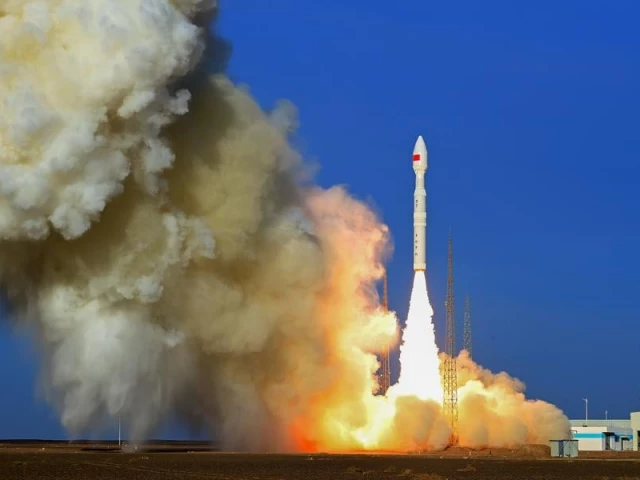
A Lijian-1 Y15 carrier rocket carrying five satellites blasts off from the Dongfeng commercial space innovation pilot zone in northwest China, on July 24, 2026.PHOTO: XINHUA
China’s commercial rocket company CAS Space announced that it joined hands with the Guangzhou Laboratory to carry out collaborative research and development on space pharmaceutical payloads, with a plan of a suborbital flight validation by a reusable spacecraft in 2027.
The first group of payloads is planned to fly aboard the company’s Lihong-2, a reusable launch vehicle. It will conduct protein and small-molecule drug crystallization experiments as well as early technical validation of space pharmaceutical equipment, the company said.
Based in Guangzhou, the laboratory is dedicated to studying respiratory diseases and their prevention and control. Under the collaboration, the lab will raise scientific questions around drug crystallisation and handle experimental design, sample management, ground control and result analysis.
According to Xu Qiang, a lead researcher at the lab, modern medicine has substantial demand for higher-quality structural data, more stable drug crystal forms, disease models that more closely resemble the human body and more efficient screening tools. The space environment may provide new ways to address some of these challenges.
Read More: Chinese hackers impersonated ex-US official to steal emails from AI experts
he microgravity environment of space can help some proteins form higher-quality crystals and offers new experimental conditions for crystal form screening and particle control of small-molecule drugs. Cells under such conditions also more readily form 3D aggregates that can be used to study disease mechanisms and drug responses, Xu noted.
The company said the Lihong series spacecraft are designed for space medicine research, biomedical experiments, manufacturing and space tourism. In January this year, the company’s Lihong-1 rocket completed its suborbital flight test mission in northwest China.
“The near space at altitudes of 100 km to 200 km is an ideal experimental environment for microgravity research like space manufacturing and biomedicine,” said Fan Na, vice president of CAS Space.
The company has established a joint space medicine lab with a hospital based on this concept. “It can bring data back quickly, accelerating new drug development,” Fan added.
Space pharmaceuticals are an emerging sector within the space economy, alongside space breeding, space materials processing, satellite internet and space tourism.
A World Economic Forum report says the space economy is expected to grow from 630 billion U.S. dollars in 2023 to 1.8 trillion U.S. dollars by 2035. Goldman Sachs and other institutions predict the space economy will grow to several trillion dollars over the next 20 years.