Weiman said Israel seeks to “retrospectively” justify strikes by linking victims to Hamas or Islamic Jihad
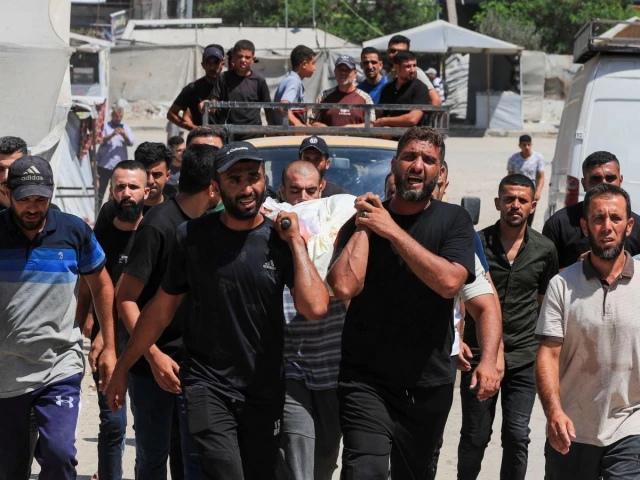
People carry the body of a Palestinian who was killed in Israeli strikes, according to medics, during a funeral in Gaza City, September 1, 2026. REUTERS
The Israeli army “kills first, then thinks and tries to find a reason” afterward to justify strikes on the Gaza Strip, said the executive director of Israeli veterans’ group Breaking the Silence.
In an interview Friday with France 24, Nadav Weiman said the army and Israeli authorities seek to “retrospectively” legitimize attacks by attempting to establish links between victims and Hamas or Palestinian Islamic Jihad after strikes have taken place.
“In cases like this Nasser hospital or the 15 paramedics that were killed by IDF (Israeli army) soldiers in Rafah, or air strikes that are killing three-digit numbers of civilians in Gaza … suddenly the IDF spokesperson in the state of Israel needs to explain to the international community what we did over there and who are the targets for the attack,” Weiman said.
On Aug. 25, 2025, an Israeli attack on the Nasser Medical Complex in the southern Gaza Strip killed at least 20 Palestinians, including patients, health workers, civil defense personnel, and press crews, while several others were injured in the attack, according to the enclave’s Health Ministry.
On March 23, 15 emergency and civil defense workers, who were protected by international law, were killed by the Israeli army in Rafah, southern Gaza.
Weiman said that intelligence personnel compile the names of those killed and then search for evidence that can establish a connection, such as having a relative linked to Hamas or the Palestinian Islamic Jihad movement, being near a building identified as belonging to Hamas or having once been on a payroll.
“Then the IDF (Israeli army) tries to build a case around certain individuals to say we attacked because there were Hamas members over there,” he said.
He questioned how the military could have identified the victims as targets in advance, particularly in the Nasser Hospital attack, where he said a second shell struck the site and killed most of those present.
“This is something that we do after we shoot,” he said, accusing the army of the deadly attacks. “First we shoot, we kill, and then we think and try to find a reason why it happened.”
“I don’t think that the tank that fired the tank shells at the hospital had a booklet with 25,000 Hamas members and looked photo after photo and said, ‘Ah, there are Hamas members over there,’” he added.
Weiman said the practice was not unique to the Nasser Hospital incident and cited the 2018 Gaza border protests, when more than 200 Palestinians were killed by Israeli forces.
Read More: Five killed in Gaza as Israel says it arrests Hamas fighter
On March 30, 2018, the Great March of Return and Breaking the Siege began with Palestinians gathering along the barrier between the Gaza Strip and Israel to demand the right of return for Palestinian refugees and an end to the Israeli blockade of Gaza. The protests also coincided with the anniversary of Land Day. Israeli forces killed 215 Palestinians.
“Back then it was the same on the evening news in Israel: ‘We killed this and that amount of terrorists,’” Weiman added.
He said Breaking the Silence has received testimonies from soldiers in the current Gaza war confirming that “if we shot and killed someone, he would be listed as a terrorist.”
An operations officer from a major battalion that participated in the Gaza genocide told the group that “every night he had to count all of the numbers of the Palestinians they shot at and listed all of them as terrorists. Doesn’t matter if they’re civilian or not,” Weiman said, adding that this happened “because that’s the assumption” in the Israeli army.
He also slammed the Israeli army’s internal investigations into wrongdoing, saying they rarely result in meaningful accountability.
“Almost none,” he said when asked how often such investigations lead to charges or disciplinary action.
According to Weiman, military investigations generally focus on lower-ranking officers rather than examining who “gave the command, authorized rules of engagement or approved the number of civilian deaths considered acceptable as collateral damage.”
He said the focus should instead be on policy “and that’s something that the IDF (Israeli army) cannot investigate because a situation like this where it is out in the world and outside of regulation is wrong, obviously.”
“The problem is what the state of Israel and the IDF (Israeli army) see as legitimate — as okay commands, as crucial commands — and those are the places that we want investigation,” he said.
Israel launched its genocide on Gaza on Oct. 8, 2023. More than 73,000 Palestinians have been killed and over 174,000 wounded, most of them women and children, according to Palestinian figures.
Despite the ceasefire in effect since Oct. 10, 2025, Israel continues to violate the agreement, with attacks that have killed 1,320 Palestinians and wounded 4,385 others, mostly women and children, according to Gaza’s Health Ministry.