Bessent says administration will use full economic, government powers to isolate Tehran
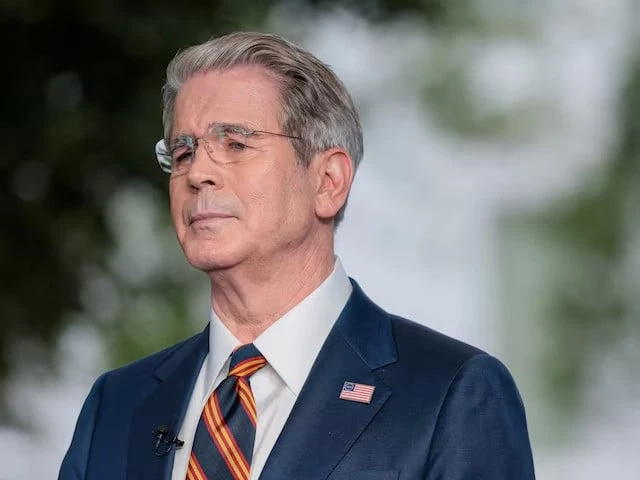
US Treasury Secretary Scott Bessent attends a media interview at the White House in Washington, DC on July 30, 2026. PHOTO: REUTERS
US Treasury Secretary Scott Bessent said Sunday that the United States was entering an “economic D-Day” against Iran following what he described as the Trump administration’s dismantling of the Islamic Republic’s military and nuclear capabilities.
“President (Donald) Trump has dismantled Iran’s military capabilities, destroyed nearly 100 percent of its military factories, and buried its nuclear program,” Bessent said in a post on the US social media platform X.
President Trump has dismantled Iran’s military capabilities, destroyed nearly 100 percent of its military factories, and buried its nuclear program.
We are now entering the endgame. At dawn begins an economic D-Day — the single greatest financial offensive ever marshaled against…
— Treasury Secretary Scott Bessent (@SecScottBessent) August 23, 2026
“We are now entering the endgame. At dawn begins an economic D-Day — the single greatest financial offensive ever marshaled against an adversary.”
Bessent said the administration intended to utilize every available resource to further isolate Iran economically and cut off sources of support for the Iranian government.
“The President has created the conditions to leverage every agency, every authority and action many assumed we would never summon. Our objective is to sever every economic lifeline that sustains the tyrannical regime until Tehran stands alone,” he said.
He also warned governments and other actors against assuming that Washington would be unwilling to impose costs on those challenging its Iran policy.
“The Islamic Republic has subsisted by dressing extortion as security guarantees. It has drawn strength from a calculus that regards Iranian retaliation as certain and American enforcement as negotiable. Under President Trump, that era is over. And those who fear the danger of defying Tehran ought not to discount the cost of testing Washington,” he said.
Bessent did not provide details in the post on the specific economic measures or agencies that would be involved in the planned offensive.
Oil falls as US prepares to unveil new Iran sanctions
Oil prices slipped more than $1 a barrel on Monday as investors took profits ahead of an expected announcement from Washington about imposing more sanctions on Iran that may further disrupt supplies from the Middle East.
Brent crude futures fell $1.23, or 1.3%, to $93.16 by 0829 PKT, while US West Texas Intermediate crude was at $85.7 a barrel, down $1.36, or 1.6%.
Both contracts posted their second weekly gains last week, up more than 5%, as peace talks between the U.S. and Iran hit a stalemate, capping oil shipments through the Strait of Hormuz where a fifth of the world’s supply used to transit.
US Treasury Secretary Scott Bessent, set to hold a press conference at 2 pm EDT (1800 GMT) on Monday, has threatened to impose “the toughest sanctions in history” on Iran. Trump also threatened to impose sanctions on Iran’s trading partners.
“It is unclear whether US policy to economically isolate Iran will prove effective,” Vivek Dhar, a commodities analyst at Commonwealth Bank of Australia, wrote in a note.
“But if the US measures do work as intended, Iran’s ability to respond via increased violence becomes a growing risk for energy markets to consider.”
Iran has condemned US plans to announce new sanctions even as President Masoud Pezeshkian called for a diplomatic solution.
“The more pragmatic members of the Iranian leadership would prefer to de-escalate but the hardliners would probably prefer to fight to the bitter end,” IG markets analyst Tony Sycamore said.
“I think by the end of this week we will have a good idea which side of the Iranian leadership has the upper hand.”
Offers of Iranian crude to Chinese buyers have declined and prices have jumped as the US blockade has cut Tehran’s shipments, according to trade sources.
However, Iran has granted permission for a number of Iraqi oil tankers to pass through the Strait following repeated requests from Baghdad, Iran’s state news agency IRNA reported on Saturday.
Some analysts are expecting the recovery in supplies from the Middle East to take even longer than expected as the US-Iran conflict persists.
“Crude (supply) is tightening. Recent weeks have seen one of the sharpest declines in oil-on-water, whilst onshore inventories are declining as well, including in China,” said Morgan Stanley analysts in a note.
“A reduction in supply is driving this, most notably from the Middle East where several data sources put aggregate exports back at March/April levels,” they said, slowing their assumption for a recovery in Middle East supplies.